
One of the difficulties that many climate models face is predicting the future. Environmental scientists collect tons of data, and in some instances can foretell the level of certain gases in the future. Yet, understanding how the world will respond is tricky. Wind patterns, ocean currents, and weather are incredibly dynamic systems that influence each other and are influenced by many external forces. Fully modeling how the climate behaves in response to exponentially increasing carbon levels has the equivalent complexity of predicting where a toothpick will land after being dropped in a tornado.
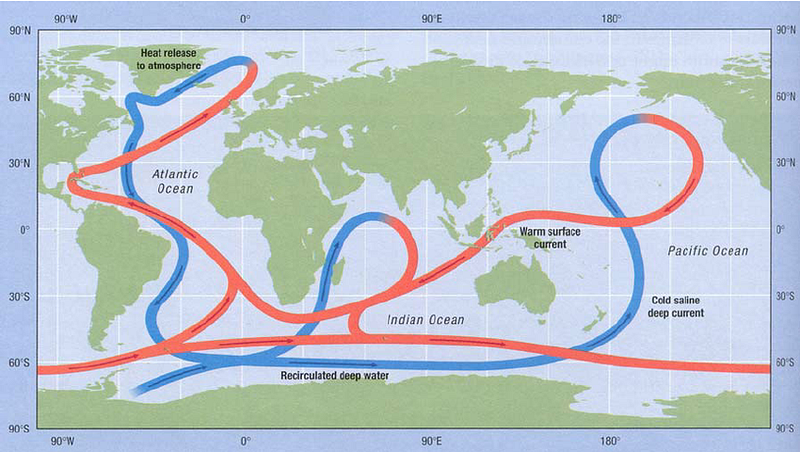 |
| The Thermohaline Circulation by Kathleen Miller |
This uncertainty is why, even climate change scientists, tend to downplay what the possible outcomes of climate change are. There simply doesn’t exist an answer with a low enough uncertainty. It is for these reasons, discussion of the possible Thermohaline shutdown, while being incredibly terrifying, are often eschewed. However, based on observation, history, and safe assumptions scientists in publications have voiced their concerns. So let’s explore this possibility.
Read the Noteworthy Journal Blog story by Aiken Pitchmen - “Climate Change’s Worst Outcome: Thermohaline Shutdown.”

No comments:
Post a Comment