
At least eighteen people have already been killed by this season’s bushfires — and, with most of January and all of February still to come, that number is sure to rise. But these dramatic deaths are far outweighed by the hundreds, perhaps thousands, that will ultimately result from the toxic smoke blanketing Australian cities.
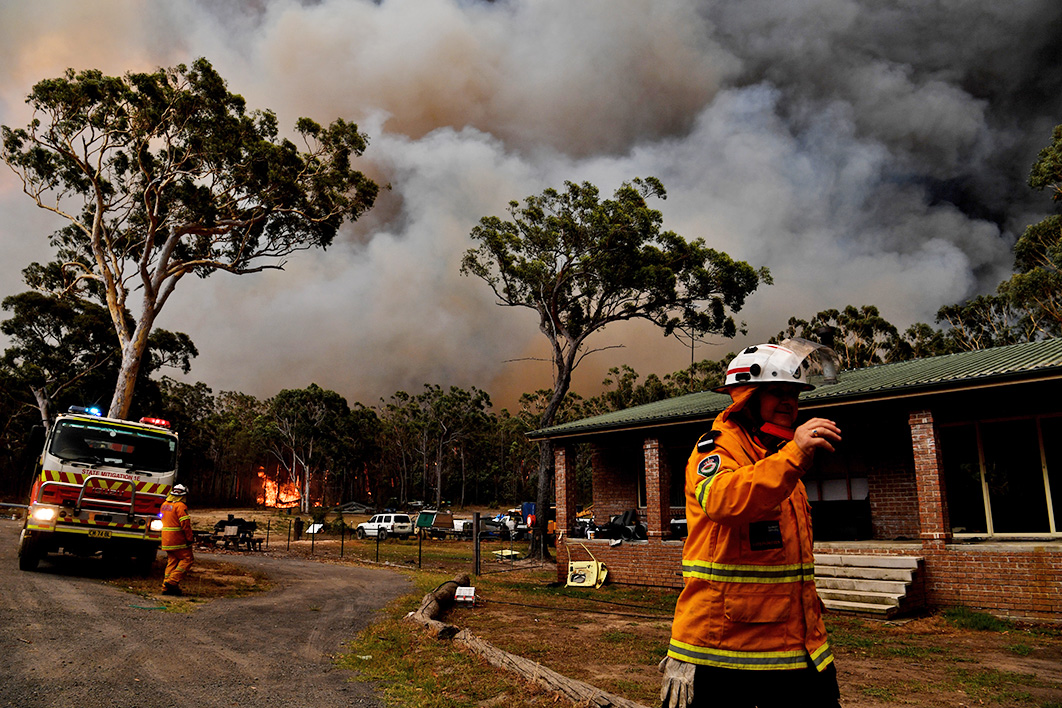 |
| Rural Fire Service firefighters protecting property near Sussex Inlet, on the NSW south coast. |
The most dangerous component of bushfire smoke are tiny particulates, no more than 2.5 micrometres in diameter, known as PM2.5. Over the past twenty years, studies have shown that high levels of PM2.5 have contributed to millions of premature deaths in highly polluted cities like Beijing and Delhi. Sydney, Canberra and other Australian cities have recently joined this list. In 2016 alone, exposure to PM2.5 contributed to an estimated 4.1 million deaths worldwide from heart disease, stroke, lung cancer, chronic lung disease and respiratory infections.
Even before the current cataclysm, air pollution was a major health hazard. While Sydney’s prevailing average of 6 micrograms per cubic metre (6 μg/m3) is within international health standards, it is above the levels observed in most European and American cities. A study led by the Sydney Public Health Observatory’s Richard Broome estimated that particulates and associated forms of pollution already account for between 310 and 540 premature deaths annually.
Read the piece by John Quiggin from Inside Story - “Slow burn.”

No comments:
Post a Comment