
A graveyard of trees fixes into focus on the screen. The television footage zooms in on their burnt skeletons, thin and black. Dark ash is spread beneath their leafless arms. The camera then catches the peloton, a kaleidoscope of colour blurred against the barren landscape. The riders snake through the hillside; their movements are almost alien, otherworldly. It’s the Tour Down Under, at the opening of the 2020 UCI World Tour.
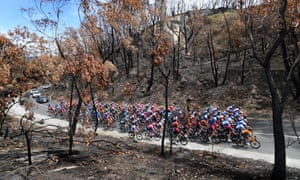 |
| The peloton makes its way through a bushfire-damaged area in the Adelaide hills during stage two of the Tour Down Under. |
Months earlier, across the Australian continent, wildfires raged. These fires spread their fury across the nation, reaching a devastating crescendo along the south-east coast. The red, black and grey ate up national parks, vineyards and farmland. It scorched the beautiful bush and damaged ancient Aboriginal cultural sites. With only a slight altering of circumstance, there might have been no Tour Down Under.
Cycling is a sport with no parallel. What other sport is played out across the world, traversing thousands of kilometres on countless roads, twisting and turning, up mountains, along rivers, next to the coastlines and through narrow towns? What other sport explores the edges of a nation, and races across its heart?
It’s an ever-changing playing field. In pro cycling, only a thin line exists between the athlete and the natural world. It’s beautiful, it’s dramatic and it’s what makes cycling such a great sport. But it could also be its greatest threat. Heatwaves and unpredictable weather could easily stop a race in its tracks, changing outcomes, or even preventing any start.
Read the story from The Guardian by Adam Phelan - “A climate of uncertainty: pro cycling in a warming World.”

No comments:
Post a Comment