Showing posts with label Madrid. Show all posts

31 December, 2019

Fact checking Angus Taylor: does Australia have a climate change record to be proud of?

Australians should be proud of the country’s achievements on climate change, energy minister Angus Taylor has argued in a newspaper column that claims “quiet Australians” don’t accept the “shrill cries” of the government’s climate critics.
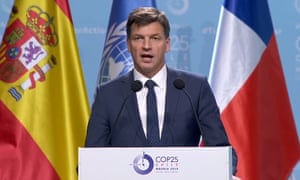
Australia’s energy and emissions reduction minister Angus Taylor speaks at the COP25 UN climate talks in Madrid.
Angus Taylor speaks at the COP25 climate summit in Madrid. The
 energy minister says Australia has an enviable record on climate
change – the Guardian fact checks his claims.
The column, published in The Australian, makes a series of claims about Australia’s emissions and how they compare to other countries, as well as highlighting exports such as LNG that are “dramatically reducing emissions” in other countries.
So is Australia really a paragon of climate virtue – cutting emissions at home while helping the world to cut emissions?

Read the story from The Guardian by Graham Readfearn - “Fact checking Angus Taylor: does Australia have a climate change record to be proud of?

16 December, 2019

Cop25: What was achieved and where to next?

The annual UN climate talks closed in disappointment on Sunday in Madrid, after two weeks spent trying to hash out a deal.
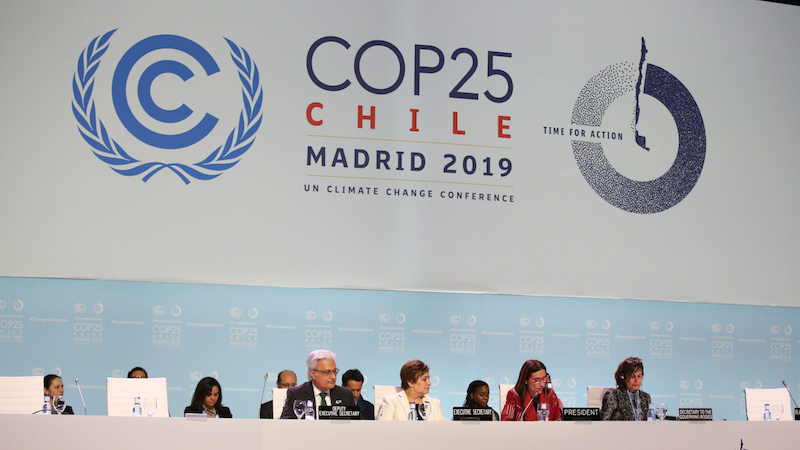
Leaders from UN Climate Change and Chile's
Cop25 presidency lead talks in Madrid 
Countries failed to agree on many of the hoped for outcomes, including rules to set up a global carbon trading system and a system to channel new finance to countries facing the impacts of climate change.
Countries agreed in Paris in 2015 to revisit their climate pledges by 2020. But many countries were pushing this year for a clear call for all countries to submit more ambitious climate pledges next year. This is seen as a key means of ensuring countries put a focus on improving their current pledges, as well as empowering civil society to hold them to account.
But countries such as China and Brazil opposed placing any obligation on countries to submit enhanced pledges next year, arguing it should be each country’s own decision. They instead argued the focus should be on pre-2020 action by developing countries to meet their previous pledges (see below).
As talks reached their final days, tensions grew after a draft decision removed any call for countries to “update” or “enhance” their climate plans by 2020. Instead, it only invited them to “communicate” them in 2020 – far weaker language which put no obligation on enhanced ambition.

Read the Climate Home News story by Jocelyn Timberley - “Cop25: What was achieved and where to next?

15 December, 2019

As U.N. Climate Talks Go to Overtime, a Battle for the ‘Spirit’ of the Paris Pact

MADRID — After two weeks of contentious negotiations, world leaders put in charge of averting a cluster of accelerating climate threats remained at loggerheads late Saturday about whether they could commit, just on paper, to raise voluntary climate targets next year.
Credit...
The annual talks, formally known as the Conference of Parties, which had been scheduled to end on Friday, were meant to hammer out the final details of the landmark 2015 Paris climate accord, and expectations initially ran high that they would yield a collective political call for raising climate targets. 
That is vital for the future of millions. With greenhouse gas emissions on their current trajectory, average global temperatures are on pace to increase to levels where heat waves are very likely to intensify, storms are set to become more severe, and coastal cities are at risk of drowning, according to scientific consensus.

Read the story from The New York Times by Somini Sengupta - “As U.N. Climate Talks Go to Overtime, a Battle for the ‘Spirit’ of the Paris Pact.”

13 December, 2019

How Australia's attempted carbon trickery is stoking India to pollute

In the closing backroom negotiations at the United Nations climate conference in Madrid this week, the full impact of Australia’s proposal to use accounting tricks to nullify its commitments to cut carbon emissions became abundantly clear. In response, India for the first time proposed using credits from old "clean development" projects under the 1997 Kyoto Protocol as a way to water down the targets it committed to under the Paris Agreement in 2015.

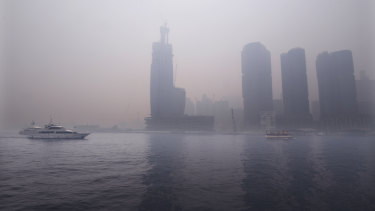
Bushfire smoke in Sydney this week.
Bush fire smoke in Sydney this week.
Prime Minister Scott Morrison told us yet again on Thursday that Australia only accounts for 1.3 per cent of global emissions, so what we do at home makes little or no difference to the environmental outcome. But the tough-talking in Madrid turns that logic on its head. India is the world's fourth-largest emitter. And Australia’s dodgy accounting proposals are stoking India – and other big emitters – to pollute more.


Read the story from The Sydney Morning Herald by Dean Bialek - “How Australia's attempted carbon trickery is stoking India to pollute.”

09 December, 2019

‘Fiddling with accounting': how Australia meets its Paris targets

Image result for radio national logoAustralia's Energy and Emissions Reduction Minister, Angus Taylor, arrives in Madrid later today for the annual United Nations climate talks.
The Government confirmed over the weekend that it would meet its 2030 Paris climate targets – but only by using a controversial accounting loophole and carry-over credits from the old Kyoto Protocol, which expires next year.

Listen to the story from the ABC’s Radio National - “‘Fiddling with accounting': how Australia meets its Paris targets.”

04 November, 2019

Spain Agrees to Host Key Climate Talks After Chile Pulls Out

Madrid has offered to hold the next United Nations climate talks, the leaders of Spain and Chile announced on Thursday. 
The announcement came a day after Chile said it could not host the event because of intensifying protests in the country. 
President Sebastián Piñera of Chile said at a news conference in Santiago on Thursday that he had heard from Prime Minister Pedro Sánchez of Spain and that Mr. Sánchez had agreed to host the summit, which is scheduled to open on Dec. 2 and run through Dec. 13. 
Mr. Sánchez’s office issued a statement saying the two countries would collaborate. Chile would continue to hold the rotating presidency of the climate talks. In a Twitter message, Mr. Sánchez said “multilateral climate action is a priority” for both the United Nations and the European Union.

Read the story from The New York Times by Somini Sengupta - “Spain Agrees to Host Key Climate Talks After Chile Pulls Out."

10 November, 2016

Trump: Ugly for world, ugly for climate, ugly for clean energy

Hurtling towards disaster? What does a Trump
 presidency mean for the global energy market?
About 10 minutes after Donald Trump gave his acceptance speech for his remarkable election as US president, I was invited into the driver’s cockpit of the very fast train travelling from Madrid to Zaragoza, in Spain.

It was a remarkable vision – hurtling at 300kms/hour through a thick fog, barely able to distinguish what lies ahead. The world may be having a similar sensation as it tries to make sense of a Trump presidency and anticipate what happens next.

The reality is that we simply don’t know. As one observer put it yesterday, the media and the others who got everything so wrong will now try to tell us all the things that will happen as a result of all the things they said would not happen.

Nevertheless, it doesn’t look good. And on any conventional assessment, it is a disaster on many levels – particularly for the efforts to address climate change and for the clean energy industry in the US.

Read Giles Parkinson’s story on RenewEconomy - “Trump: Ugly for world, ugly for climate, ugly for clean energy.”