Showing posts with label address. Show all posts

10 October, 2019

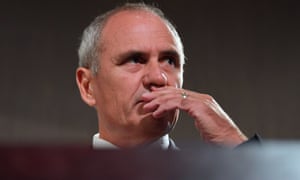
Josh Frydenberg refuses request for RBA deputy to speak on climate change

The treasurer, Josh Frydenberg, knocked back a request for the deputy governor of the Reserve Bank, Guy Debelle, to address a meeting of state treasurers on climate change.

The Reserve Bank of Australia’s deputy governor, Guy Debelle.
The federal treasurer knocked back a request for the Reserve Bank
of Australia’s deputy governor, Guy Debelle, to speak to a state
 treasurers’ meeting about how climate change could affect monetary policy.
The Queensland treasurer, Jackie Trad, wrote to Frydenberg in June asking for Debelle to talk to treasurers at the October meeting of the council of federal financial relations in Canberra on Friday about how climate change could affect monetary policy, inflation and economic growth.

Trad’s request was part of a push for a new “clean economy agreement” that would commit Australian governments to act together to meet targets set under the Paris climate agreement.
“As governments we have a responsibility to provide for the future,” Trad told Guardian Australia ahead of Friday’s meeting.

“That’s why it was so disappointing that Mr Frydenberg was unwilling to allow deputy RBA governor Guy Debelle to address the [council] on the way in which climate change could impact monetary policy, inflation and economic growth.”


Read the story from The Guardian by Sarah Martin - “Josh Frydenberg refuses request for RBA deputy to speak on climate change.”

08 October, 2019

'We declare our support for Extinction Rebellion': an open letter from Australia's academics

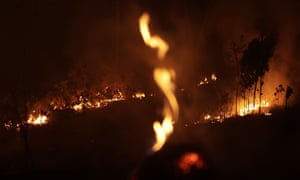
Amazon fires burn at night
The Amazoin fires are just one symptom
of the ecological crisis gripping our planet.

We the undersigned represent diverse academic disciplines, and the views expressed here are those of the signatories and not their universities. While our academic perspectives and expertise may differ, we are united on one point: we can no longer tolerate the failure of the Australian government, or any other government, to take robust and urgent action to address the worsening ecological crisis.

The science is clear, the facts are incontrovertible. We are in the midst of the sixth mass extinction, with about 200 species becoming extinct each day. This includes many species of insects, some of which are essential to our food systems. Many people around the world have already died or been displaced from the effects of a rapidly warming climate. July 2019 was the Earth’s hottest on record. Arctic peat is burning and ice is melting at rates far beyond even the most radical scientific predictions. The Amazon is burning at an alarming rate. All are creating devastating feedback loops, releasing more CO2 and reducing the Earth’s heat reflecting capacities.


19 June, 2019

Call to arms: how can Australia avoid a slow and painful decline?

Australia is at a crossroads. Drift towards a future of slow decline economically and socially or, if action is taken now to address our most important challenges, create a future of greater prosperity for all, globally competitive industries and a sustainable environment.
Ken Henry
Dr Ken Henry says the Australian National Outlook report
 aims to ‘help kickstart a national conversation about
where Australia is heading’. 
That is the conclusion of a major report bringing together the thinking of more than 50 leaders in business, academia, NGOs and the community sector, working with the CSIRO to model alternative futures for Australia. The report is described as a “clarion call” for the nation.

The Australian National Outlook 2019, two years in the making, aims to “help kickstart a national conversation about where Australia is heading”, says its co-chair, Dr Ken Henry, the chairman of the National Australia Bank and former secretary of the Treasury department.


Read the story from The Guardian by Gay Alcorn - “Call to arms: how can Australia avoid a slow and painful decline?

07 May, 2019

The obsessive focus on imaginary costs of climate action is harming our prosperity

The current election campaign discussions on climate change fails to address the real challenges that face the nation. The super-partisan nature of the debate and the focus on mythical costs of action risks significantly harming our prosperity and resulting in another decade of squandered economic opportunity.
 One of the most significant barriers impacting long term
investment and accessing new economic opportunities
is climate policy uncertainty.
I work for an organisation that represents institutional investors like super funds with total funds under management of over $2 trillion. Super funds invest to ensure superannuation holders can retire with dignity. The average superannuation holder will retire around 2050 so what we do to address climate change matters a lot to their retirement funds.

Investors and the companies they invest in and own are exposed to policies that governments put in place. What governments decide also influences if they invest, where they invest and what they invest in.


Read the story from The Guardian by Erwin Jackson - “The obsessive focus on imaginary costs of climate action is harming our prosperity.”

14 September, 2018

Climate change will reshape the world’s agricultural trade

Ending world hunger is a central aspiration of modern society. To address this challenge – along with expanding agricultural land and intensifying crop yields – we rely on global agricultural trade to meet the nutritional demands of a growing world population.
Australia’s grain exports will suffer under climate change.
But standing in the way of this aspiration is human-induced climate change. It will continue to affect the issue of where in the world crops can be grown and, therefore, food supply and global markets.

In a paper published today in Nature Palgrave, we show that climate change will affect global markets by reshaping agricultural trading patterns.

Some regions may not be able to battle climate impacts on agriculture, in which case production of key commodities will decline or shift to new regions.


Read the story form CSIROscope - “Climate change will reshape the world’s agricultural trade.”

04 February, 2018

State of the Union: Trump Glorifies Coal, Shuts Eyes to Climate Risks

It was a distinct irony to hear President Donald Trump open his State of the Union address by reciting the litany of climate calamities that the nation survived in 2017.
President Trump talked about energy, but only fossil
fuels; extreme weather, but not climate change; and
 jobs and trade, without mentioning the thousands
 of U.S. solar jobs his tariff plan puts at risk.
"We endured floods and fires and storms," he said, as he recognized the bravery of public servants who had saved dozens of people trapped in a hurricane and a wildfire.

But he said not a word about the manmade global warming that makes those risks more dangerous year after year. And his only discussion of energy policies made no nod to the clean energy transformation that scientists prescribe to lower greenhouse gas emissions and reduce the risks.


Read the Inside Climate News story by John H. Cushman Jr - “State of the Union: Trump Glorifies Coal, Shuts Eyes to Climate Risks.”

13 January, 2016

Obama speaks up and puts climate deniers down


Barack Obama - he has 'dissed'
those who deny climate science.
President Barack Obama dissed those who deny the science around climate change during his last State of the Union address.
"Look, if anybody still wants to dispute the science around climate change, have at it," Obama said. "You’ll be pretty lonely, because you’ll be debating our military, most of America’s business leaders, the majority of the American people, almost the entire scientific community, and 200 nations around the world who agree it’s a problem and intend to solve it."

Read the Huffington Post story - “Obama Disses Climate Change Deniers.”

21 January, 2015

Brutally direct warning puts climate change on leadership radar


Barack Obama has been brutally direct in warning the world about the threat posed by climate change.

U.S. President, Barack Obama puts
 climate change on leadership radar.
The U.S. President used his State of the Union address to warn of the unfolding seriousness of a disrupted climate saying that no challenge poses a greater to future generations.

An Age story, headed: “Greatest threat to future generations: Obama uses State of the Union to highlight climate change” told how Obama put climate change firmly on the leadership radar.

"The Pentagon says that climate change poses immediate risks to our national security. We should act like it," Mr Obama said.

12 October, 2014

Numbers help us understand climate change


Numbers can be used to describe anything, including the extremes of climate change.

And now the Huffington Post has used numbers, 21 or them exactly, to help us see the reality that is climate change.

The story headed: “21 Numbers That Explain Why The Time To Address Climate Change Is Right Now, Or Maybe Yesterday”, lists 21 numbers to help explain one of the most pressing global issues of our time.