Showing posts with label bearing down. Show all posts

11 January, 2020

Terror, hope, anger, kindness: the complexity of life as we face the new normal

When we come to write the history of climate politics in Australia, it’s possible New Year’s Eve 2019 will be seen as the moment everything changed. That was the day the nation – and indeed the world – watched in horror and despair as the people of Mallacoota fled to the beach to escape the wall of flame bearing down on their town.
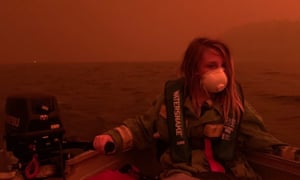
A photo by Mallacoota mother Allison Marion
The photo taken by Mallacoota resident Allison Marion showing
 her 11-year-old son, Finn, seated in the stern of a dinghy.
They weren’t the only ones fleeing the fire that day. In towns from the Blue Mountains to the outskirts of Melbourne, communities were facing catastrophe. But there was something about the images from Mallacoota, the crowds of people and animals huddled on the sand in the eerie red light that somehow brought not just the scale but the uncanniness of the crisis home. “When Brueghel meets the Anthropocene,” a friend of mine tweeted about similar scenes in Malua Bay. More like Bosch, others replied.

Read the story from The Guardian by James Bradley - “Terror, hope, anger, kindness: the complexity of life as we face the new normal.” 

04 May, 2019

How Do You Save a Million People From a Cyclone? Ask a Poor State in India

BHUBANESWAR, India — Flights were cancelled.
Cyclone Fani made landfall in Puri, India, on Friday.
Officials said the gusts reached at least 100 m.p.h. (160kph)
Train service was out.

And one of the biggest storms in years was bearing down on Odisha, one of India’s poorest states, where millions of people live cheek by jowl in a low-lying coastal area in mud-and-stick shacks.

But government authorities in Odisha, along India’s eastern flank, hardly stood still. To warn people of what was coming, they deployed everything they had: 2.6 million text messages, 43,000 volunteers, nearly 1,000 emergency workers, television commercials, coastal sirens, buses, police officers, and public address systems blaring the same message on a loop, in local language, in very clear terms: “A cyclone is coming. Get to the shelters.”

It seems to have largely worked. Cyclone Fani slammed into Odisha on Friday morning with the force of a major hurricane, packing 120 mile per hour winds. Trees were ripped from the ground and many coastal shacks smashed. It could have been catastrophic.

But as of early Saturday, mass casualties seemed to have been averted. While the full extent of the destruction remained unclear, only a few deaths had been reported, in what appeared to be an early-warning success story.


Read the story from The New York Times by Hari Kumar, Jeffery Gettleman and Sameer Yasir  - “How Do You Save a Million People From a Cyclone? Ask a Poor State in India.”

30 November, 2017

Melbourne weather: Victoria on alert for worst floods in over 20 years

Record-breaking rain is bearing down on Victoria, with forecasters expecting "major flooding" of all Melbourne's rivers as the state enters "uncharted territory”.

"Half the inhabitants of Melbourne have probably never seen something like this," Scott Williams, senior forecaster at the Bureau of Meteorology said.

"This is a vast, intense, high impact event for this state.”

Tim Wiebush, deputy chief officer of the State Emergency Service, said Victorians should get ready for the rain.

"This a major heavy rainfall event that we haven't seen for quite some time and people need to be alert to the potential for flash flooding and riverine flooding," he said.


Read the story in the Melbourne Age by Anna Prytz and Tom Cowie - “Melbourne weather: Victoria on alert for worst floods in over 20 years.”