Showing posts with label billions of dollars. Show all posts

08 April, 2020

Nuclear fusion promises a clean, green energy future — but there's a catch

It's a nuclear race like no other, involving billions of dollars and hundreds of scientists from across the globe.
An artist's impression of what the enormous ITER plant will look like. In the centre is the glowing chamber for the plasma.
An artist's impression of the completed ITER.
The pink section in the middle is the tokamak.
Their aim is as ambitious as it is monumental: to replicate the energy source that powers the solar system, effectively building a mini sun — a swirling mass of super-heated atomic plasma so hot that it can only be contained by a magnetic field.
The process is called nuclear fusion.
Scientists believe that if fusion technology can be successfully harnessed as a human energy source, it could help save the world from future environmental catastrophe.
Read the story from the ABC by Anthony Funnell for Future Tense - “Nuclear fusion promises a clean, green energy future — but there's a catch.”

26 February, 2020

Governments urged to invest in roads, water, telecoms to protect against natural disasters

Infrastructure Australia has urged federal and state governments to invest billions of dollars shoring up the country's water supply, roads and telecommunications networks to protect them from national disasters and climate change.
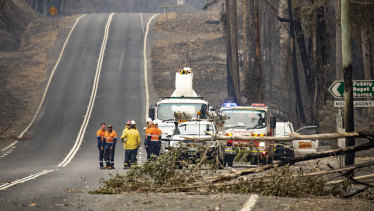
Infrastructure Australia says the summer's fires and the drought have highlighted the need to build resilience into the nation's infrastructure.
Infrastructure Australia says the summer's fires and the drought have
 highlighted the need to build resilience into the nation's infrastructure.
Releasing its latest priority list, IA chief executive Romilly Madew said years of drought and the summer's bushfires had highlighted the need to ensure the nation's infrastructure was more resilient.
"Compounding issues of unprecedented infrastructure demand, severe drought and other environmental changes require a focus on our resilience strategies and a consensus on where to invest now for our nation's future prosperity," she said on Tuesday.
IA identifies the most pressing major infrastructure needs of the country each year and ranks them in terms of importance. Proposals from governments, councils, lobby groups and the private sector are vetted by the agency.

23 January, 2020

Conservative States Seek Billions to Brace for Disaster. (Just Don’t Call It Climate Change.)

WASHINGTON — The Trump administration is about to distribute billions of dollars to coastal states mainly in the South to help steel them against natural disasters worsened by climate change.
But states that qualify must first explain why they need the money. That has triggered linguistic acrobatics as some conservative states submit lengthy, detailed proposals on how they will use the money, while mostly not mentioning climate change.
A 306-page draft proposal from Texas doesn’t use the terms “climate change” or “global warming,” nor does South Carolina’s proposal. Instead, Texas refers to “changing coastal conditions” and South Carolina talks about the “destabilizing effects and unpredictability” of being hit by three major storms in four years, while being barely missed by three other hurricanes.
Louisiana, a state taking some of the most aggressive steps in the nation to prepare for climate change, does include the phrase “climate change” in its proposal in one place, an appendix on the final page.

Read the story from The New York Times by Christopher Flavelle - “Conservative States Seek Billions to Brace for Disaster. (Just Don’t Call It Climate Change.).”

06 October, 2019

The new language of climate change: Trillions.

It didn’t seem that long ago that it was all about billions — billions of dollars of climate investments, billions of tons of carbon reductions and billions in new market opportunities. Billions of assets under management being screened for climate risk. All to stem billions more in environmental damage, GDP loss, natural capital savings and ecosystems decline. And probably a billion other things.
That was so last year.
Bye-bye, billions. It’s time for trillions to seize center stage.
Yes, trillions. With a T.
In the ramp-up to Climate Week, unfolding in hundreds of events across New York City over the next five days or so, there’s been a raft of reports, commitments and declarations touting big, big numbers. It’s a clear sign that the money side of climate change — both costs and opportunities — is rising in lockstep with a recognition of the stakes to people and the planet.

Read the story from GreenBiz by Joel Makower - “The new language of climate change: Trillions.

28 January, 2019

German plan to phase out coal would cost a cool $64 billion.

Berlin: Germany will spend tens of billions of dollars to end its use of coal power within two decades, if a plan agreed to by representatives of the power industry, environmental movement, miners and local interest groups becomes official policy.
Protesters hold a poster before the meeting of a panel
of experts on the exit of the use of coal in Germany on Friday.
The deal, hammered out on Saturday after more than 20 hours of intense, often fractious negotiating among a 28-member commission appointed last year by Chancellor Angela Merkel, would be one of the most significant energy transformations a nation has yet attempted in the face of climate change.


Read the story from The Age by Melissa Eddy - “German plan to phase out coal would cost a cool $64 billion.

04 January, 2019

Drought aid: Where has the money been allocated and what difference is it making on-farm?

Billions of dollars in government aid, across all tiers, has gone to farmers during the drought this year.
Many farmers are struggling to find or buy feed to keep their stock alive.
Tens of millions more has been raised by corporations and individuals.

But has the money been well spent? Or is it a case of spending good money after bad?

ABC Rural has been tallying the figures and, while it is not at all a comprehensive list as the drought continues, it shines a light on who is putting in and where the funds are going.


(Surely it would have made sense to be paying all adults, including farmers, a Universal Basic Income all along  and drought aid would have been unnecessary - Robert McLean)

29 August, 2018

Top government adviser blasts Australia's flawed financial response to drought

A top government adviser has blasted Australia's response to drought, saying billions of dollars have been wasted in taxpayer-funded rescue packages that do not help farmers.
Prime Minister Scott Morrison prepares to board his
 plane following a regional drought tour at Quilpie in Queensland.
In a warning to Prime Minister Scott Morrison, who is drawing up a new response to the worsening disaster, Productivity Commission chairman Peter Harris said the extra help would be "condemned to failure" if policy mistakes of the past were repeated.

Mr Harris pointed to government subsidies that had actually led to higher freight and feed costs, which quickly earned a stinging rebuke from the government’s new drought envoy, the former deputy prime minister Barnaby Joyce.


20 June, 2013

World Bank commits billions to combatting climate change


The World Bank is beginning to commit billions of dollars to flood prevention, water management and other projects to help major Asian cities avoid the expected impact of climate change, a dramatic example of how short the horizon has become to alleviate the effects of global warming.
 

A story in the Washington Post - “Climate change threatens trouble in the near future, World Bank says” – told its readers about the unfolding challenges of climate change.

It discussed the “hot spots” that will bear the brunt of the impact as sea levels rise, tropical storms become more violent, and rainfall becomes both more sporadic and — in the rainy season — more intense.

The story said the bank was now focusing much of its planning in some countries on how to build infrastructure and re-engineer cities to better withstand environmental stress.