Showing posts with label climate change policy. Show all posts

26 February, 2020

Labor’s biggest climate problem is itself

Anthony Albanese doesn’t need to convince the majority of Australian voters to support his plan for net zero emissions by 2050. Let me say that again: Labor doesn’t need to “sell” its climate change policy. Instead, it’s an issue that needs to be managed.

Anthony Albanese.
The assumption that every prescription taken to an election must get majority support is just one of those fallacies of political analysis. As noted before, no one would seriously assert that Labor’s tenth-order campaign promise to “increase the numbers of doctors in remote, rural and regional Australia” got a thumbs down from the voters when they elected the Coalition in May last year. People voted primarily on other stuff. Not everything in a campaign is a vote decider; in fact, most of it isn’t.
It is revisionism of the highest order to describe climate policy as meaningfully responsible for Labor’s 2019 defeat. The fault for the loss of that winnable contest lies with the big juicy targets the party presented to the government, most importantly the thing the Coalition (and some in the media, helpfully) dubbed “the retirement tax,” along with the fictional “death tax” and the very real housing policy — probably in that order. Throw in Bill Shorten’s evasive demeanour and longer-term doubts about Labor and the economy (which both Bob Hawke and Kevin Rudd also had to deal with to win office), and it was a perfect storm.

Read the story from Inside Story by Peter Brent - “Labor’s biggest climate problem is itself.”

12 January, 2020

Australia’s top scientists urge government to do more on global warming

Australia's most prestigious scientific organisation has added to growing pressure on Prime Minister Scott Morrison over climate change policy, calling on the government to "take stronger action" in response to the unprecedented bushfire crisis.
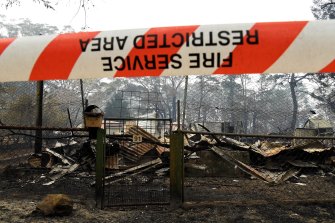
The remains of a house in Wingello. The Australian Academy of Sciences says any bushfire response must extend beyond rebuilding.
The remains of a house in Wingello. The Australian Academy of
Sciences says any bushfire response must extend beyond rebuilding.
The Australian Academy of Science, made up of the country's pre-eminent scientists, has declared the link between human induced climate change and extreme weather to be clear and said Australia needed to put in place long-term plans for a more dangerous future.
"As a nation, we must deal with extreme weather events more effectively than we currently do. As such events become more frequent and severe, we must adapt Australia and Australians accordingly, as well as strengthen mitigation efforts," the academy's president John Shine said in a statement.
Professor Shine said there was "abundant evidence available" to understand what was happening with the environment and Australia needed to look to that science for disaster responses and future policies.

Read the story from The Age by Fergus Hunter - “Australia’s top scientists urge government to do more on global warming.”

17 December, 2019

Australia ranked worst of 57 countries on climate change policy

Australia is the worst-performing country on climate change policy, according to a new international ranking of 57 countries. The report also criticises the Morrison government for being a “regressive force” internationally.
Morrison government
Australia and the Morrison government scored the
 lowest possible rating of 0.0 for climate policy.
The 2020 Climate Change Performance Index, prepared by a group of thinktanks comprising the NewClimate Institute, the Climate Action Network and Germanwatch, looks at national climate action across the categories of emissions, renewable energy, energy use and policy.
Across all four categories, Australia was ranked as the sixth-worst performing of the 57 countries assessed.

Read the story from The Guardian by Sarah Martin - “Australia ranked worst of 57 countries on climate change policy.”

13 December, 2019

Australia ranked worst of 57 countries on climate policy

Australia has been singled out as the worst-performing country on climate change policy, according to a new international ranking.
Image result for Australia ranked worst of 57 countries on climate policy
Australia is failing badly when it comes to climate change policy.
The non-profit thinktank NewClimate Institute, based in Berlin, looks at national climate action across the categories of emissions, renewable energy, energy use and policy.
Australia came 51st out of 57 countries across all four categories, including dead last in the assessment of climate policy - below countries that are not known for their green credentials, such as Russia, Saudi Arabia and Kazakhstan.
Australia scored a zero out of 100 for its climate policies.

20 May, 2019

Steggall optimistic about climate collaboration with Abbott 'handbrake' gone

The new independent MP for Warringah, Zali Steggall, says the Coalition has been given a clear mandate to govern and expressed optimism about a shared "starting point" with Prime Minister Scott Morrison on climate change policy.
Incoming independent MP Zali Steggall has backed
 the Coalition to form government.
Ms Steggall, who trounced former prime minister Tony Abbott in the historically blue-ribbon seat in Sydney's north, said on Sunday the Coalition would have at best a slim majority in Parliament and would need to keep crossbench MPs onside.


Read the story from The Age by Fergus Hunter - “Steggall optimistic about climate collaboration with Abbott 'handbrake' gone.”

02 April, 2019

'Climate of Change' on Four Corners

The struggle to reduce Australia's greenhouse gas emissions.

Climate change policy has been one of the most divisive issues in modern Australian political history. 


It has brought down governments and toppled political leaders.

At times the debate has become so polarised that the average Australian could be forgiven for tuning out.

With a Federal election looming, Four Corners brings the debate back to what is actually happening in the nation right now.

So much focus has been placed on energy policy, electricity prices and the role of coal, but this is only one part of the picture.

Four Corners walks you through key areas of everyday life and industrial production which fuel our carbon emissions - from the cars we drive, the animals we breed to gas we export.

The program investigates whether Australia is on track to deliver on the targets the nation has pledged to fulfil, and what effect the policies of successive governments have had on our emissions.


With activists on both sides of the debate pushing to make the Federal poll a climate election, this is a must watch Four Corners.

Labor's emissions policy does not have to be a carbon tax to have a cost

Bill Shorten’s new climate change policy asks Australian companies to make a huge effort to cut their greenhouse gas emissions in a way that is certain to come at a cost.
Don't get hung up on whether Labor's policy is a "carbon tax".
Industrial polluters will have to pay to bring down their emissions or buy permits to meet Labor’s ambition to reduce emissions by 45 per cent by 2030, and some of them will have to pass these costs on to customers.
This does not make it a carbon tax. The semantic debate over a "tax" has poisoned Australian debate on energy and climate for too long. It is about time the policies were examined without resort to stale political soundbites.

The Labor policy expands the Coalition’s existing "safeguard mechanism" by extending it to more companies and applying a stricter benchmark for emissions.


Read the opinion  piece from The Age by David Crowe - “Labor's emissions policy does not have to be a carbon tax to have a cost.”

01 April, 2019

Labor’s climate change policy explained: here's what we know

Just days before the federal election is called, Labor has released the final component of its climate change policy
Bill Shorten charges an electric car after launching
Labor’s climate change policy in Canberra on Monday. 
Scott Morrison has promptly declared it is carbon tax 2.0 and the regulations will impose massive costs on Australians. Given this partisan debate, which has paralysed Australian politics for a decade, has been characterised by hyperbole and misinformation, let’s work through this latest policy instalment, sector by sector, and then consider the implications.


Read the story from The Guardian by Katharine Murphy - “Labor’s climate change policy explained: here's what we know.”

05 November, 2018

Kerryn Phelps zeroes in on climate change and Peter Dutton's eligibility

The newly minted independent MP for Wentworth, Kerryn Phelps, has pledged to tackle climate change policy as her first priority after she was formally declared the winner of the once blue ribbon Liberal seat in Sydney’s east.
The new member for Wentworth, Kerry
Phelps, intends to tackle climate change.

Phelps said she would move to reinstate the Climate Change Authority to provide a scientific voice in the debate, put forward reforms to vehicle emissions standards and look at ways to use the crossbench clout to stop the Adani coalmine.

“We can stop fiddling around with talking about new coalmines because no one wants to fund them,” she said.

“Government policy needs to establish a foundation for business to invest in renewables for our future and to protect our environment. That is something the Australian people are saying they want.”


Read the story from The Guardian by Paul Carp - “Kerryn Phelps zeroes in on climate change and Peter Dutton's eligibility.”

13 July, 2018

Reset climate policy to fix energy market

In releasing yet another report on electricity prices, ACCC chairman Rod Sims said that the energy market is ‘‘broken’’. What is needed is not a repair job on the whole electricity market but a clear decision on climate change policy.

The 35 per cent real increase in household electricity bills in the past decade is certainly a significant burden but the ACCC’s 398-page report, On restoring electricity affordability, part of a veritable reference library on the topic in the past few years, must not be allowed to muddy the water.

The electricity market basically works except Australia cannot establish how fast to cut its greenhouse gas emissions and make the transition from coal to renewables. Mr Sims’ vague language only encourages the usual suspects to claim that the solution to the problem is building more coal plants.


Read the Editorial from The Age - “Reset climate policy to fix energy market.”

07 May, 2018

Is the revolving door syndrome harming Europe's climate change fight?

Campaigners have sounded the alarm over climate change policy in Europe after uncovering evidence about the closeness of the relationship between governments and major energy firms.
The "revolving door" and the closeness of the relationship
 between governments and major energy firms is hurting
Europe's climate change policy position.
Greens-European Free Alliance, the political grouping in the European Parliament that commissioned the research, says it opens the door to fossil fuel-friendly firms having an influence on Europe’s climate change policy.

It’s part of a wider ‘revolving doors’ issue in Brussels that sees former European Commissioners and other high-ranking staff move into the private sector to work for firms lobbying to shape EU legislation.

The report calls for safeguards to be put in place to help prevent conflicts of interest arising because climate change is "the greatest and most urgent challenges of our time”.


Read the story by Chris Harris from Euronews - “Is the revolving door syndrome harming Europe's climate change fight?

28 April, 2017

Westpac’s new climate change policy is bad news for Adani's Carmichael mine in Queensland

Westpac has effectively ruled out financing Adani Group's controversial, giant coal mine in Queensland's Galilee Basin under a new climate change policy.
Westpac's decision effectively blocks it
from funding the Carmichael mine.
The bank's "new climate change position statement and action plan" restricts lending to projects which use "the highest quality coal in advanced power generation technologies”.

"Our lending to customers in the thermal coal sector is limited to those that have a calorific value which ranks in the top quartile globally," the new position statement said.

That effectively would prohibit lending to ventures using coal from Australia's last untapped resource in Queensland's Galilee Basin.

Westpac is restricting finance for new mines to those using resources in the top 15 per cent of coal quality globally.


07 December, 2016

Backbench forces Josh Frydenberg into humiliating climate policy backdown

Environment Minister Josh Frydenberg
 has a fine line to walk on climate policy.
Environment and Energy Minister Josh Frydenberg has been forced into an humiliating U-turn on climate change policy less than 48 hours after releasing details for a pending review.

After two days of vocal opposition from the Coalition backbench, the minister has shelved plans for a review of the direct action climate policy next year to examine whether to introduce an emissions intensity scheme for the electricity industry - a form of carbon pricing.

It is understood skittishness in the government leadership group led to the idea being dropped on Tuesday.

It follows Fairfax Media reporting on Monday, based on an interview with Mr Frydenberg, that the long-awaited review would consider such a scheme while focusing on limiting electricity price rises, maintaining energy security and cutting greenhouse gas emissions.

Read the story in today’s Melbourne Age - “Backbench forces Josh Frydenberg into humiliating climate policy backdown.”

14 July, 2016

Jotzo wonders about Turnbull's appetite for the climate challenge

Director of the Centre for Climate
Economics and Policy at the
Australian National University,
Frank Jotzo, wonders whether or not the
 re-elected Malcolm Turnbull has the
appetite to tackle climate change. 
The re-elected Coalition government has the opportunity to revamp its policies on climate change. Transition of the energy sector is key if the 2030 emissions target is to be met. But with a razor-thin majority in Parliament, will Prime Minister Malcolm Turnbull have the appetite and internal authority to tackle the challenge?

In contrast to the past three federal elections, climate change policy was not one of the big issues in this campaign. Faced with a fairly comprehensive climate policy blueprint from the Labor Party, the Coalition opted not to say much on the subject. A carbon tax and emissions trading scheme have been ruled out, but the door for climate and energy policy reform has not been slammed shut.

In fact, there has been a clear sense that the government accepts that there needs to be a more comprehensive policy framework than just the subsidy-based Emissions Reductions Fund, with its inherent problems. In 2015, Environment Minister Greg Hunt announced that there will be a climate change policy review during 2017

15 June, 2016

Great Barrier Reef struggling under coalition's watch

Greg Hunt's recent foray into the Twittersphere – in response to Ellen DeGeneres' appeals to Australia to protect the Great Barrier Reef – has all the hallmarks of the Environment Minister's signature style that we've come to know and love.

(After DeGeneres, a star in the Finding Nemo sequel Finding Dory, released a video message calling on humankind to protect the reef; Hunt tweeted her several times, saying "Aust govt is doing more than ever to protect it", "We're working to protect #GBR by tackling the short term problem of water quality & long term threat of climate change" and more.)

Let's face it – it's not hard to see why this is the man tasked with defending the Australian government's seemingly indefensible climate change policy, the Emissions Reduction Fund, even to the point of contradicting the government's own consultants who say the program won't deliver. Anyone who can keep a straight face while insisting that Australia is an exemplar for its efforts to protect the reef can probably pull off anything.

Read Sarah Gill’s story in today’s Melbourne Age - “The truth about the reef isn't so great.

05 June, 2016

Climate change policy was a vote-changer early in election campaign

Strong climate change policy is a vote-changing matter for a majority of Australians, a new poll shows, establishing the issue as an important battleground one week into the election campaign.

According to the ReachTEL survey of 2400 people, conducted for a coalition of environmental groups, 64 per cent of respondents said they would be more likely to vote for a party seeking 100 per cent renewable energy in 20 years and 48 per cent said they would be more likely to support a party reducing Australia's net carbon emissions to zero by 2050.

Read Fergus Hunter’s story in the Melbourne Age - “Election 2016: Climate change policy a vote winner for majority of Australians.”

15 May, 2016

Strong climate change policy is a vote changer

Strong climate change policy is a vote-changing matter for a majority of Australians, a new poll shows, establishing the issue as an important battleground one week into the election campaign.

According to the ReachTEL survey of 2400 people, conducted for a coalition of environmental groups, 64 per cent of respondents said they would be more likely to vote for a party seeking 100 per cent renewable energy in 20 years and 48 per cent said they would be more likely to support a party reducing Australia's net carbon emissions to zero by 2050.

Read Fergus Hunter’s story in the Melbourne Age - “Election 2016: Climate change policy a vote winner for majority of Australians."

13 April, 2016

Oil and gas industry spends millions to obstruct climate change policy

Australia's peak oil and gas industry lobby group spent almost $4 million last year trying to "obstruct" more ambitious climate change policy, according to British research group InfluenceMap.

It was part of an overall $150 million spent globally in 2015 by five major oil companies and lobby groups.

The Australian Petroleum Production & Exploration Association (APPEA) represents the domestic oil and gas industry and counts among its 70 members giant companies such as Woodside, Shell Australia, and Chevron Australia.

According to the analysis, InfluenceMap estimated that APPEA spent about $5.5 million on climate-related advocacy in 2015 though expenditure on staff, public campaigns, advertising and other external public relations.

Read Tom Arup’s story in today’s Melbourne Age - “Australian oil and gas lobby spent millions advocating against climate action: report.”

(The Shepparton-based group Slap Tomorrow has worked enthusiastically for more than three years no to raise among Goulburn Valley the profile of, and interest in, climate change and has had some support from local businesses, private and public donations, and unending hard work from a small band of volunteers.

Slap Tomorrow has organized several forums at which many aspects climate change were addressed and while the many speakers have been generous in the provision of their time and undoubted skills, the total spend has probably not exceeded $30,000 dollars – an amount that is of little consequence compared to the millions of dollars the fossil fuel corporations are prepared, and able to spend to convince the public that all is well and that climate change is little more than a leftist conspiracy – Robert McLean.)

01 December, 2015

The ghost of Tony Abbott stalks the halls in Paris


B
ill Shorten nearly got it right when he proclaimed on ABC radio: “Malcolm Turnbull and I are both in Paris, but the person who is running Australia’s climate change policy is Tony Abbott.”

A more accurate summation would be Tony Abbott and his allies are trying to run that policy as the battle for the heart and soul of the Coalition government remains unresolved.

It is not only the Monkeypod room lunchers – the conservative Liberals who join Immigration Minister Peter Dutton for lunch on parliamentary sitting Tuesdays – but also the Nationals who are on alert for the old orthodoxy.

Read The New Daily story - “Climate change in Paris, storms in Canberra.”