Showing posts with label fossil fuel industry. Show all posts

04 May, 2020

In A Post-Pandemic World, Renewable Energy Is The Only Way Forward

The Economist’s regular cartoonist, KAL, summed it up neatly in his cartoon last week: the battle humanity is waging against the coronavirus is only the preliminary round, and after that, we have a much bigger and stronger opponent waiting for us, called the climate emergency. That some people still may think that something as objectively and scientifically proven is still up for debate could be seen as one of the greatest achievements of the fossil fuel industry. It’s not. It’s the greatest threat to human life.
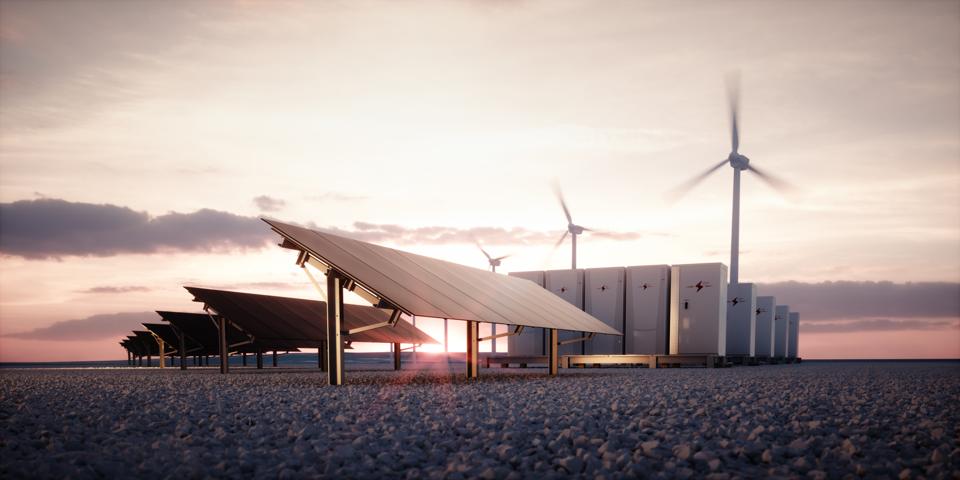
Dawn of new renewable energy technologies. Modern, aesthetic and efficient dark solar panel panels, a modular battery energy storage system and a wind turbine system in warm light. 3D rendering.

Pollution affects us all, very much so. In addition to being responsible for some seven million deaths annually, it makes us more vulnerable to all kinds of respiratory diseases, including, of course, those caused by viruses such as SARS-CoV-2, which could also become seasonal and repetitive. Not only do we know that we need to fix this problem: we also know that not doing so is killing us, and we now have a pressing example of this.
Read the story from Forbes by Enrique Dans - “In A Post-Pandemic World, Renewable Energy Is The Only Way Forward.”

21 April, 2020

Fossil fuel lobby to use Covid-19 to push for weaker climate laws

Australian researchers warn that governments and powerful business lobby groups may use the Covid-19 crisis as an opportunity to water down environmental controls, with the fossil fuel industry most likely to take advantage.
Fossil fuel lobby to use Covid-19 to push for weaker climate laws ...
Add caption
In findings published in the journal Regulation and Governance, economists from the Australian National University found that studies of the behaviour of corporations and governments during previous economic crises show they were able to predict how the government responses to Covid-19 may be influenced by vested interests.
The researchers from the ANU’s Energy Change Institute and the School of Regulation and Global Governance warn that the power of large incumbent industries, like that of the fossil fuel lobby, could use their power to convince governments than an economic crisis could justify the relaxation of climate change and environmental regulations..
Read the story from RenewEconomy by Sophie Vorrath - “Fossil fuel lobby to use Covid-19 to push for weaker climate laws.”

13 April, 2020

Carbon emissions from fossil fuels could fall by 2.5bn tonnes in 2020

Global carbon emissions from the fossil fuel industry could fall by a record 2.5bn tonnes this year, a reduction of 5%, as the coronavirus pandemic triggers the biggest drop in demand for fossil fuels on record.
Coal-fired power plant in winter with emissions blowing
Analysts expect a slump in heavy industry to drive
 demand for gas and coal down by about 2.3% each.
The unprecedented restrictions on travel, work and industry due to the coronavirus is expected to cut billions of barrels of oil, trillions of cubic metres of gas and millions of tonnes of coal from the global energy system in 2020 alone, according to data commissioned by the Guardian.
Read the story from The Guardian by Jillian Ambrose - “Carbon emissions from fossil fuels could fall by 2.5bn tonnes in 2020.”

05 March, 2020

Climate campaigners condemn 'insidious' cocktail party for MPs and coal industry

Environmental campaigners say a cocktail night involving the fossil fuel industry and federal politicians represents an “insidious” lobbying effort to undermine climate action.
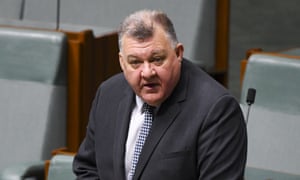
Liberal MP Craig Kelly
Pro-coal Liberal MP Craig Kelly, pictured, and Labor’s Joel
 Fitzgibbon have hosted a cocktail event to discuss carbon capture
and storage with industry leaders.
The pro-coal Liberal MP Craig Kelly and Labor’s Joel Fitzgibbon hosted a cocktail event at Parliament House to discuss carbon capture and storage with industry leaders on Wednesday night.
An invite seen by the Guardian was sent out by Kelly and Fitzgibbon, who chair the parliamentary friends of resources, together with representatives of Santos and the carbon capture body CO2CRC. The event is described as a “cocktail event to mark the inaugural meeting of the CO2CRC Carbon Capture and Storage Policy Forum”.

Read the story from The Guardian by Christopher Knaus - “Climate campaigners condemn 'insidious' cocktail party for MPs and coal industry.”

26 February, 2020

A net-zero emissions future provides a great opportunity for farmers

The recent announcement by federal Labor to target net zero emissions by 2050 provides a great opportunity for the agricultural sector in Australia to diversify and thrive.  I’ve watched with interest as some suggest this policy will wipe out Australian agriculture, just as they hypothesised the same for the fossil fuel industry. Nothing could be further from the truth. I see there is a huge opportunity for both farmers and brand Australia. However, we need to compare apples with apples – not apples to coal, as some are trying to do.
Although agricultural production contributes around 15 per cent of emissions, it also provides the greatest opportunity to reverse the current trajectory and get a two-for-one benefit in the process.
The red meat industry is committed to net zero emissions by 2030.
You see, investing in research and helping farmers change some agricultural practices will not only reduce CO2 and greenhouse gas emissions but sequestering carbon can actually reverse some of the damage. Additionally it makes famers more resilient to climate change.


Read the story from The Sydney Morning Herald by Niall Blair - “A net-zero emissions future provides a great opportunity for farmers.”

03 February, 2020

Scott Morrison is stuck in a time warp – more gas is not the answer.

The prime minister, Scott Morrison, surrounded by advisers out of the fossil fuel industry, is stuck in a time warp.
Coal fired power plant
‘Morrison claims we need a lot more gas to continue the
energy transition already in play. The experts disagree.’
His claim that “there is no credible energy transition plan, for an economy like Australia in particular, that does not involve the greater use of gas as an important transition fuel” is demonstrably wrong. There are many.
A decade ago solar and wind were expensive, gas was cheap, batteries had no conceivable role in a power grid and pumped hydro storage was a forgotten technology. Conventional wisdom held that gas was a “transition fuel” – that since gas generation has half the emissions of coal power (if we foolishly turn a blind eye to emissions caused when extracting gas), we could reduce emissions by switching out coal power stations for gas turbines.

Read the story from The Guardian by Simon Holmes à Court - “Scott Morrison is stuck in a time warp – more gas is not the answer.

30 January, 2020

Invest with the best

In tandem with the urgent need to decarbonise the global economy, the movement to divest from the fossil fuel industry has grown rapidly in recent years. In Australia, divestment commitments have been made by local councils, charitable trusts, universities, super funds, and the ACT government.
Waiting for a miracle: federal resources minister Matt Canavan,
a proponent of “clean coal,” listening to prime minister Scott
Morrison at last year’s Liberal National Party convention in Brisbane.
While this progress is remarkable, only a minority of institutional investors have so far adopted a comprehensive policy of divestment from companies extracting or using carbon-based fuels. At the moment the spotlight is on UniSuper, the industry superannuation fund covering the university sector, which continues to include unsustainable investments in its standard portfolios.
With most national governments falling far short of the commitments needed to reach the goals set out in the Paris Agreement, the case for divestment has only become more urgent. Investing in such corporations is not a defensible option for institutions, like universities, that expect to endure for centuries.

Read the Inside Story by John Quiggin - “Invest with the best.”

25 January, 2020

Angus Taylor’s secret consultation on emissions cuts stacked towards big emitters

Federal energy minister Angus Taylor’s “expert panel” – tasked with identifying new opportunities to achieve emissions reduction – has undertaken consultation with a handpicked group of representatives heavily stacked towards the fossil fuel industry and Australia’s largest emitters.
Image result for Angus Taylor’s secret consultation on emissions cuts stacked towards big emitters
Angus Taylor has "stacked" hand-picked panel with
 people from the fossil fuel industry and large emitters.
Taylor launched a closed consultation process last year to a select group of organisations that was not announced publicly and was made without an opportunity for the wider public to provide input.
Despite many media reports, there is little to no public information about the “Expert Panel Examining Opportunities for Further Abatement”, with no information appearing on the website of the Department of the Environment and Energy’s website, even though the department is involved in the review.
The ‘expert panel’ is led by former Origin Energy CEO and president of the Business Council of Australia, Grant King, along with Susie Smith, the CEO of the Australian Industry Greenhouse Network, which represents many of Australia’s largest emitters. The chair of the Clean Energy Regulator, David Parker, and ANU Law School professor Andrew Macintosh are also on the panel.

Read the story from RenewEconomy by Michael Mazengarb -  “Angus Taylor’s secret consultation on emissions cuts stacked towards big emitters.”

25 November, 2019

We push fossil fuels with the zeal of a drug lord – we do not care about the misery we are creating

The Coalition is too closely linked to the fossil fuel industry to be able to contemplate a future without coal, oil or gas. As climate change-induced crises continue through Australia, they must distance themselves from the industry associations and their lobbyists, and face up to a future which is different from the past, one that can be both exciting and beneficial to all Australians.
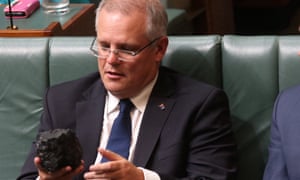
Then treasurer Scott Morrison with a lump of coal during question time in the house of representatives in parliament house, Canberra, 9 February 2017
‘The problem, as we are now seeing, is that
 the industry associations are also heavily
invested in our political processes,
to the detriment of us all.’
While unprecedented bushfires burn across the country – first in New South Wales and Queensland, then in Western Australia and now in South Australia and Victoria – it is worth pausing for a moment on the word “unprecedented” to let it sink in. Unprecedented does not mean unexpected. At BP, over 20 years ago, we acknowledged climate change and what it would bring and that we needed to reduce emissions. Our acknowledgment brought cries of foul from industry associations and many peer companies.

07 July, 2019

Fuelling the climate crisis: why LNG is no miracle cure for Australia’s coal addiction

On Thursday, Australia’s emissions reduction minister, Angus Taylor, told parliament the country’s thriving liquified natural gas (LNG) trade – a fossil fuel industry – was cutting global greenhouse pollution by 150 million tonnes a year.
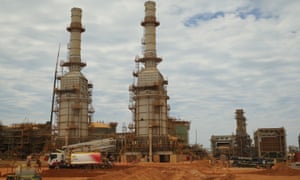
Part of the Chevron LNG project on Barrow Island, Western Australia
The idea the export gas industry is good for the planet –
and Australia deserves credit for it – appears set for a serious
 workout in this parliament.
It was no small claim: equivalent to more than a quarter of what Australia emits every year.

Two days earlier, an analysis by US-based researchers and anti-fossil fuel advocates the Global Energy Monitor found if all US$1.3tn worth of LNG developments planned across the globe went ahead they would do at least as much to drive the world into climate catastrophe as new coal investments, possibly more. Australia is a significant player in this drive, with $38bn in investments on the books – fourth behind only the US, Canada or Russia.


Read the story from The Guardian by Adam Morton - “Fuelling the climate crisis: why LNG is no miracle cure for Australia’s coal addiction.” 

17 December, 2018

Fossil Fuel Industry Ally Targets UCLA Law Professors’ Climate Liability Work

A conservative think tank with deep ties to the fossil fuel industry has sued UCLA to obtain email correspondence between two UCLA climate law professors and pro-environment individuals involved in climate change litigation.
UCLA law professor Ann Carlson is one of two professors
 studying climate liability that has been targeted by a
Freedom of Information lawsuit similar to those used against
climate scientists. 
The lawsuit was filed last month in California Superior Court by the Competitive Enterprise Institute (CEI), a libertarian group that lobbies against limits on greenhouse gas emissions and claims that CO2 is good for the environment. CEI argued the university hasn’t complied with two public record requests made in February and May under the California Public Records Act.

According to the lawsuit, Competitive Enterprise Institute v. Regents of the University of California, the emails show environmental law professors Cara Horowitz and Ann E. Carlson discussed future meetings with others, including staffers from several attorney general offices, to discuss new legal actions against major carbon producers.


Read the Climate Liability News story by Marco Poggio - “Fossil Fuel Industry Ally Targets UCLA Law Professors’ Climate Liability Work.”

17 June, 2018

Our energy challenge in 6 eye-popping charts

Renewable energy is winning and coal is on the skids. Disruption of the fossil fuel industry is well under way, and the global energy system is being decarbonised. We’re right on track, right?

To avoid dramatic climate system tipping points, the world needs to decarbonise very quickly and start drawing down the level of carbon in the atmosphere, because it’s already unsafe. As one dramatic example, in past periods when greenhouse levels were similar to the current level, temperatures were 3–6°C higher and sea levels around 25–40 metres higher than in 1900.

So climate warming is now an existential risk to human civilisation, that is, an adverse outcome that would either annihilate intelligent life or permanently and drastically curtail its potential. It is now too late for incremental, measured steps to protect what we care about. Winning slowly is now the same as losing.

So how are we going with our energy system? It is the predominant source of the dramatic human-caused rise in the level of greenhouse gases, which over the last century has increased 70 percent, from 280 parts per million carbon dioxide equivalent (ppm CO2e) to 480 ppm CO2e.


Read the report from Climate Code Red - “Our energy challenge in 6 eye-popping charts.”

29 March, 2017

How AEMO’s new boss will reform Australia’s energy vision

Audrey Zibelman, the new chief executive of the Australian Energy Market Operator, has been in the job for little over a week, but is already making her mark, signalling the biggest shift in energy management philosophy in a generation.

Audrey Zibelman.
If Australia’s fossil fuel industry had hoped that last September’s state-wide blackout would lead to a u-turn on the shift to cleaner and decentralised energy system, then the release of the Australian Energy Market Operator’s final report in the event would leave them bitterly disappointed.

And if they had any thoughts that the new CEO of AEMO, Audrey Zibelman, was going to afford them the indulgences that they had gotten used to over the last few decades, then they are going to be disappointed on that too.

Several hundred energy market participants converged on Adelaide’s Hilton Hotel on Wednesday to hear the findings from the final report into the now notorious system black and, more crucially, to hear the first public insights from the new AEMO boss.


Donald Trump's anti-climate plans won’t fool nature

Back in 1983, well before the fossil fuel industry realised it had a climate problem, the physics and chemical impacts of burning coal, oil and gas were uncontroversial.

Donald Trump on Tuesday in the White House.
The US President signed an executive order
winding back his predecessor's climate policies.
As US President Donald Trump unveils his plans to roll back his predecessor Barack Obama's climate change policies and end his "war on coal", it's worth a reminder the science has been settled for decades no matter what politicians do.

The Earth had an "effective temperature" that was a simple balance of the solar radiation and what it radiated back to space, I learnt as a Harvard freshman in my entry-level Science A-30 course on The Atmosphere.

Our atmosphere was "an insulating blanket" keeping the planet's surface at about 298 degrees Kelvin (25 degrees) compared with space's 3 degrees K, the matter-of-fact notes I found while sorting out some old boxes show. 


Read Peter Hannam’s story in today’s Melbourne Age - “Donald Trump's anti-climate plans won’t fool nature.”

19 November, 2016

Trump begins filling environmental posts with clowns

 American students protest outside the UN
 climate talks during the COP22 international
 climate conference in Marrakesh in
reaction to Donald Trump’s victory in
the US presidential election. 
Come on, you can admit it. I admit it. I admit that after Trump’s election victory, I secretly hoped and even though that his rhetoric was worse than its bite. He only said those crazy things during the campaign to get elected. He wouldn’t really follow through on his plans to completely gut the US commitment to keeping the Earth habitable. Oh how naive we were. Trump’s plan to fill positions in his administration shows things are worse than we could have ever feared.

According to recent reports, Trump has picked long-time climate denier and spokesperson for the fossil fuel industry Myron Ebell to head the Environmental Protection Agency transition. This basically means the EPA will either cease to function or cease to exist. It also appears that the US will pull out of any agreements to limit greenhouse emissions.

It means we have missed our last off-ramp on the road to catastrophic climate change. That may sound hyperbolic, but I study the rate that climate change is happening – the amount of heat accumulating in the Earth’s system. We didn’t have any time to waste in implementing Obama’s aggressive plans, and Trump will result in a decade of time lost.

18 September, 2016

Fracking worsens methane emissions

Methane emissions from the fossil fuel industry are responsible for the majority of the recent rise in global atmospheric methane, according to a new study published in the Proceedings of the National Academy of Sciences.

This research adds to the growing body of evidence that disputes the fossil fuel industry's assertion that other sources of methane are causing the increase.

Fugitive fossil fuel methane emissions have increased by approximately 24 million tons per year since the 1980s, with much of the growth occurring after the year 2000—around when the shale gas boom began in the U.S.

30 August, 2016

'Just 90 companies are to blame for most climate change' - Heede

Last month, geographer Richard Heede received a subpoena from Representative Lamar Smith (R-TX), chairman of the House of Representatives Committee on Science, Space, and Technology.
The output of this oil refinery in Rodeo, California,
is a small part of Richard Heede's carbon inventory.
 
Smith, a climate change doubter, became concerned when the attorneys general of several states launched investigations into whether ExxonMobil had committed fraud by sowing doubts about climate change even as its own scientists knew it was taking place. The congressman suspected a conspiracy between the attorneys general and environmental advocates, and he wanted to see all the communications among them. Predictably, his targets included advocacy organizations such as Greenpeace, 350.org, and the Union of Concerned Scientists. They also included Heede, who works on his own aboard a rented houseboat on San Francisco Bay in California.

Heede is less well known than his fellow recipients, but his work is no less threatening to the fossil fuel industry. Heede (pronounced "Heedie") has compiled a massive database quantifying who has been responsible for taking carbon out of the ground and putting it into the atmosphere. Working alone, with uncertain funding, he spent years piecing together the annual production of every major fossil fuel company since the Industrial Revolution and converting it to carbon emissions.

11 May, 2016

WATCH 'marries off' money-hungry polluters

WATCH will be "marrying off" a mining
baroness and money-hungry politician.
You're invited to our wedding of the year!

Did you know that big polluters have handed $3.7 million to the major parties since the last election? And that our Government will give them $7.7 billion in subsidies this year? We must stop the flow of money that is propping up the fossil fuel industry.

So in nine days, Wodonga and Albury Towards Climate Health (WATCH) will join forces with 350.org to host a mock marriage between a mining baroness and a politician to highlight how wedded they are.

WATCH says: “We'll have an award winning local actress playing the bride and you may be surprised at who the other actors are.

“It’s shaping up to be a memorable and hilarious ceremony that will unfold out the front of The Hon Sussan Ley’s office.”

The “wedding on 12.30pm Friday, May 20 starts at 12:30pm in Kiewa St, Albury, and as the festivities will all over within 15 minute, those attending are urged not to be late.

WATCH welcomes everyone to join the ceremony, but asks people to not bring presents, confetti or political placards.

Should it be wet the “wedding” will be held under the eaves next door, but people are encouraged to being an umbrella.

18 April, 2016

Considering the culprits behind the climate crisis

This week, 193 world governments will begin putting pen to paper on the world’s first agreement to keep global warming below 2 degrees. This agreement is a huge symbolic blow to the fossil fuel industry, but it will remain symbolic unless politicians cut their ties with the culprits behind this climate crisis – the fossil fuel industry.

Right now, the impacts the Paris accord is designed to stop are unfolding at a terrifying rate. Record-breaking temperatures robbed the Arctic of its winter. The Great Barrier Reef is perishing in front of our eyes. February was the hottest month recorded to date. Last year, bushfires in Western Australia raged so fiercely that they created their very own weather system.

We always knew this would happen if we didn’t wean ourselves off fossil fuels. It was always assumed we had more time – that the impacts of climate change would be felt in a hypothetical future. But recent evidence shows we’re out of time – the planet is now entering uncharted territory. Much of what will happen next is already out of our hands.

Despite the crisis unfolding around it, the current Australian government seems determined to ignore the role it has to play in preventing the planet from cooking.

Six months ago, Australia agreed to the Paris deal. Yet, since then, Australia has reapproved one of the world’s largest coalmines, opened a new research centre for the fossil fuel industry, cut funding for renewable energy, cut funding for climate research. The bewildering list goes on and on.

Read The Saturday Paper story - “The links between big polluters and politicians.”