Showing posts with label intensifying. Show all posts

23 July, 2019

‘Sunday has been cancelled': heatwave lingers in New York City

New York: With a record-breaking heatwave intensifying over much of the US midwest and east coast through the weekend, it was a bad time for Annie McQueen's air conditioner to break down in her New York City apartment.
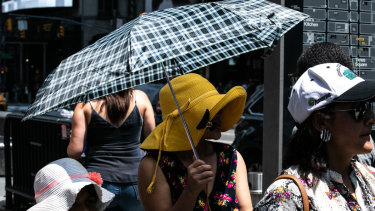
A person holds an umbrella for shade in  Times Square.
A person holds an umbrella for shade in Times Square.
Cities across the affected regions have opened public cooling centres, and after a sticky night in which the combined forces of a ceiling fan and a floor fan in her bedroom offered little relief, McQueen, 76, headed to one of them on Sunday at a senior centre in downtown Brooklyn.
She sat smiling near the door of the Raices Times Plaza Neighbourhood Senior Centre, beyond which the air was predicted to cook up to a high of 36.7 degrees, though it would feel more like 43.3 degrees with the humidity, according to the National Weather Service.
Inside, old Christmas decorations fluttered in the breeze near the cooling system's ceiling vents. "It feels just right," McQueen said. Lunch was three different varieties of salads.

Read the story from The Age by Jonathan Allen - “‘Sunday has been cancelled': heatwave lingers in New York City."

05 October, 2018

Science under siege

While the news from Washington has been dominated by Brett Kavanaugh’s candidacy for the Supreme Court and how it will help cement Donald Trump’s legacy, the administration has been intensifying its attack on science and redoubling its efforts to dismantle regulations designed to protect health and the environment and tackle global warming. The legacy of that campaign could be much more toxic and longer-lasting than the outcome of the Kavanaugh hearings, and not just for the United States.
Presidential polluter: Donald Trump boarding Air Force One
for a trip to a fundraiser in Minnesota earlier this month. 
In the past two weeks alone, reports reveal fresh attacks on independent sources of advice. The Office of the Science Advisor to the Environmental Protection Agency seems set to be dissolved. This senior post offers advice to the EPA and its administrator on science underpinning health and environmental policies, regulations and decisions. The head of the EPA Office of Children’s Health, a respected paediatric epidemiologist, has been placed on unexplained administrative leave following reports that the incumbent has repeatedly clashed with administration officials bent on loosening pollution regulations. The disputes are reported to centre on the planned weakening of mercury emission rules, announced on 30 September, the administration’s failure to act on a recommendation by EPA scientists that the organophosphate insecticide chlorpyrifos be banned, and the proposal to dismantle programs that protect children from lead poisoning.


Read the story by Lesley Russell from Inside Story - “Science under siege.”

16 August, 2018

No break for drought-hit areas as new research points to warmer years

Prospects of an early end to the big dry affecting much of eastern Australia are diminishing, with the latest estimates from the Bureau of Meteorology pointing to drought conditions intensifying and seeping southwards into Victoria.
Dry conditions that have taken hold over much of NSW,
such as this farm near Mudgee, are forecast to extend into Victoria.
Separately, new research out Wednesday points to an acceleration of global warming in the years to 2022, with natural variability predicted to accelerate the background increase in temperatures from climate change.


Read the story by Peter Hannam from The Sydney Morning Herald - “No break for drought-hit areas as new research points to warmer years.

12 March, 2018

Climate change is a disaster foretold, just like the first world war

“The lamps are going out all over Europe, we shall not see them lit again in our life-time.”
‘The extraordinary – almost absurd – contrast between
what we should be doing and what’s actually taking
place fosters low-level climate denialism’ 
The mournful remark supposedly made by foreign secretary Sir Edward Grey at dusk on 3 August 1914 referred to Britain’s imminent entry into the first world war. But the sentiment captures something of our own moment, in the midst of an intensifying campaign against nature.

According to the World Wildlife Fund’s 2016 Living Planet Report, over the last four decades the international animal population was reduced by nearly 60%. More than a billion fewer birds inhabit North America today compared to 40 years ago. In Britain, certain iconic species (grey partridges, tree sparrows, etc) have fallen by 90%. In Germany, flying insects have declined by 76% over the past 27 years. Almost half of Borneo’s orangutans died or were removed between 1999 and 2015. Elephant numbers have dropped by 62% in a decade, with on average one adult killed by poachers every 15 minutes.

We inherited a planet of beauty and wonders – and we’re saying goodbye to all that.
The cultural historian Paul Fussell once identified the catastrophe of the first world war with the distinctive sensibility of modernity, noting how 20th century history had “domesticate[d] the fantastic and normalize[d] the unspeakable.”

Consider, then, the work of climate change.


Read Jeff Sparrow’s story from The Guardian - “Climate change is a disaster foretold, just like the first world war.”

09 February, 2018

Icons at Risk: Climate Change Threatening Australian Tourism

Australia’s most popular tourist destinations are in the firing line, with intensifying climate change posing a significant threat to the nation’s iconic natural wonders.

The Climate Council’s ‘Icons at Risk: Climate Change Threatening Australian Tourism’ report shows Australia’s top five natural tourist attractions could be hit by extreme heatwaves, increasing temperatures, rising sea-levels, coastal flooding and catastrophic coral bleaching.

Australia’s iconic beaches, wilderness areas, national parks and the Great Barrier Reef are the most vulnerable hotspots, while our unique native wildlife is also at risk, as climate change accelerates.


Read the Climate Council report - “Icons at Risk: Climate Change Threatening Australian Tourism.”