Showing posts with label pandemic. Show all posts

21 April, 2020

In times of coronavirus and climate change, we must rethink national security.

The catastrophic summer bushfires incinerated the livelihoods and the lifestyles of so many Australians who live along our coastal fringe. And while the landscape is recovering, albeit slowly, their circumstances are not. Indeed, the arrival of the pandemic has smashed their personal and economic security even further. The hit to the national economy from the combined events will be comparable to that of the second world war, the debt taking decades to run down.
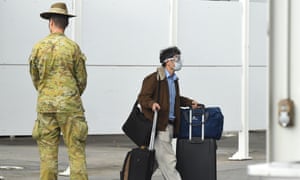
A member of the Defence Force watches over as returning overseas travellers are ushered towards waiting buses for the beginning of their 14-day quarantine after arriving at Sydney International Airport in Sydney, Australia, 29 March 2020.
Millions of Australians are significantly less secure now
than they were six months ago. And if our citizens
 are not secure, how can the nation be secure?’
Australia has not been at war. We have not been attacked by an enemy using armed force to subject the nation to its will. Yes, some troops were called out in an act of political theatre, and the navy put to sea, but not a shot was fired, nor a bombing sortie flown. Yet millions of Australians are significantly less secure now than they were six months ago. And if our citizens are not secure, how can the nation be secure?
Read the story from The Guardian by Allan Behm - “In times of coronavirus and climate change, we must rethink national security.” 

19 April, 2020

Economic lockdown causes strong reduction in air pollution globally

No, dolphins and swans didn't return to the canals of Venice to swim in clear water as an unexpected side effect from the pandemic – these claims were shown to be fake.
But new research reveals it is true the grinding halt on global economic activity has had a remarkable effect on ground and atmospheric pollution.
Using satellite images and data from thousands of air quality stations, European researchers have found a 20 per cent decrease in air pollution – including ground-level nitrogen dioxide (usually caused by car pollution), ozone, and fine particulate matter (PM2.5) - during the first two weeks of lockdown in 27 countries around the world.

Read the story from The Age by Miki Perkins - “Economic lockdown causes strong reduction in air pollution globally.”

26 March, 2020

A Green Reboot After the Pandemic

EW YORK – The COVID-19 coronavirus has forced entire countries into lockdown mode, terrified citizens around the world, and triggered a financial-market meltdown. The pandemic demands a forceful, immediate response. But in managing the crisis, governments also must look to the long term. One prominent policy blueprint with a deep time horizon is the European Commission’s European Green Deal, which offers several ways to support the communities and businesses most at risk from the current crisis.
COVID-19 reflects a broader trend: more planetary crises are coming. If we muddle through each new crisis while maintaining the same economic model that got us here, future shocks will eventually exceed the capacity of governments, financial institutions, and corporate crisis managers to respond. Indeed, the “coronacrisis” has already done so.

The Club of Rome issued a similar warning in its famous 1972 report, The Limits to Growth, and again in Beyond the Limits, a 1992 book by the lead author of that earlier report, Donella Meadows. As Meadows warned back then, humanity’s future will be defined not by a single emergency but by many separate yet related crises stemming from our failure to live sustainably. By using the Earth’s resources faster than they can be restored, and by releasing wastes and pollutants faster than they can be absorbed, we have long been setting ourselves up for disaster.


Read the Project Syndicate story - “A Green Reboot After the Pandemic.”