Showing posts with label plants. Show all posts

23 April, 2018

Will rising carbon dioxide levels really boost plant growth?

Plants have become an unlikely subject of political debate. Many projections suggest that burning fossil fuels and the resulting climate change will make it harder to grow enough food for everyone in the coming decades. But some groups opposed to limiting our emissions claim that higher levels of carbon dioxide (CO) will boost plants’ photosynthesis and so increase food production.
New research published in Science suggests that predicting the effects of increasing CO levels on plant growth may actually be more complicated than anyone had expected.
To understand what the researchers have found out requires a bit of background information about photosynthesis. This is the process that uses light energy to power the conversion of CO into the sugars that fuel plant growth and ultimately provide the food we depend on. Unfortunately, photosynthesis is flawed.


Read the piece on The Conversation by a Senior Lecturer in Plant Biochemistry from the University of Westminster, Stuart Thompson - “Will rising carbon dioxide levels really boost plant growth?

03 April, 2018

Scientific experts 'extremely concerned' by plan to stop extinctions.

Australia’s blueprint to save animals and plants from extinction is inferior to that of developing nations such as Rwanda and Myanmar, according to scientists who warn the strategy “falls far short” of addressing a crisis in species loss.
There are less than 1000 numbats left in the wild. The
species is threatened by loss of habitat and feral predators.
The draft proposal has also prompted questions over why humans, urban areas and industrial landscapes have been included in the official definition of “nature”.

The federal government says the document is still a draft and “not government policy”.
The Department of the Environment and Energy released a draft plan in December titled Australia's Strategy for Nature 2018-2030.

The 17-page document aims to protect biodiversity – which includes plant and animal species, habitats and ecological communities – against threats such as climate change and urban development. Critics derided it as a “global embarrassment”.


Read Nicole Hasham’s story from The Age - “Scientific experts 'extremely concerned' by plan to stop extinctions.

10 March, 2018

Why aren’t Australia’s environment laws preventing widespread land clearing

Australia has national environment laws – the Environment Protection Biodiversity Conservation Act (EPBC Act). Yet given the staggering rates of land clearing taking place, resulting in the extinction and endangerment of plants and animals in Australia, these laws are clearly not working.
Land clearing, as seen here in a property near St
George, Queensland, does not trigger Australia’s
 Environmental Protection and Biodiversity Act. 
About 395,000 hectares of regrowth and old growth vegetation were cleared during 2015-16 in Queensland. Australia is set to clear up to 3 million hectares of native forest by 2030, and more than 1,800 plant and animal species are currently listed as threatened nationally.

When the EPBC Act was first implemented in 1999, the idea was for it to provide reinforced federal environmental protection to areas of national environmental significance. But in reality, many projects that come within the ambit of the Act are not rigorously evaluated for their environmental impact.


Read the piece on The Conversation by  the Director of the Centre for Energy and Natural Resources Law at Deakin Law School from Deakin University, Samatha Hepburn - “Why aren’t Australia’s environment laws preventing widespread land clearing.”

04 March, 2018

Ancient carbon discovered coming from Arctic soil

Scientists have published new evidence that old or even ancient carbon, pulled out of the atmosphere and stored in the bodies of plants hundreds or thousands of years ago, is being set loose again from soils in the Arctic region.
The discovery is a potentially worrying indicator that "permafrost"
soils may already be worsening the problem of climate change.
It's a potentially worrying indicator that these "permafrost" soils may already be worsening the problem of climate change. However, scientists are still debating just how much old carbon Arctic soils should release normally even without climate change, leaving the ultimate significance of the findings unclear.


Read Chris Mooney’s story in The Age - “Ancient carbon discovered coming from Arctic soil.”

03 February, 2018

Are You a Wizard or a Prophet?

The term “GMO” can be a Rorschach test. It makes some people see potential for plants that can grow in any ecosystem, resist drought and disease, and yield massive amounts of food and prosperity for all. Human innovation, this camp says, can get us out of any jam.

But many environmentalists see a racket that will give mega-corporations control over the world’s food supply and encourage thoughtless consumption. We are part of the Earth’s global ecosystem, the second group contends, we can’t “bio-hack” our way out of every problem.

In his latest book, The Wizard and the Prophet: Two Remarkable Scientists and Their Dueling Visions to Shape Tomorrow’s World, journalist Charles C. Mann traces current incarnations of these world views to two 20th-century figures agronomist Norman Borlaug and ecologist/activist William Vogt. Both men were unlikely scientists, and both have left their fingerprints all over environmental thought.


Read the story by Diana Crow form Neo.Life - “Are You a Wizard or a Prophet?

27 December, 2017

$180bn investment in plastic factories feeds global packaging binge

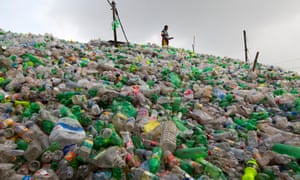
The global plastic binge which is already causing widespread damage to oceans, habitats and food chains, is set to increase dramatically over the next 10 years after multibillion-dollar investments in a new generation of plastics plants in the US.
One million plastic bottles are bought around the world every minute, with most ending up in landfill or in the sea.
One million plastic bottles are bought around the world every
 minute, with most ending up in landfill or in the sea. Photograph:
Fossil fuel companies are among those who have ploughed more than $180bn since 2010 into new “cracking” facilities that will produce the raw material for everyday plastics from packaging to bottles, trays and cartons.
The new facilities – being built by corporations like Exxon Mobile Chemical and Shell Chemical – will help fuel a 40% rise in plastic production in the next decade, according to experts, exacerbating the plastic pollution crisis that scientist warn already risks “near permanent pollution of the earth.”


Read Matthew Taylor’s story on The Guardian - “$180bn investment in plastic factories feeds global packaging binge.”

22 April, 2017

Plants have feelings too

Human beings have five senses – taste, touch, sight, hearing and smell. These senses help us navigate the world and act as warning signs of dangers. We use them to make everyday decisions; for example, when it starts raining we pull out our umbrellas, and when it’s hot we take off our jackets.
Plants react to the environment around them.
Although they may seem passive, plants have their own complex sensory systems too, designed to respond to dangers or other changes in their environment.

Dr Kim Johnson.
Plants may not have eyes, ears or a tongue, but their skin can perform many of the same functions. Plants are not only aware of when it rains or when it’s windy, but they can respond accordingly.

Dr Kim Johnson, a research fellow in the School of BioSciences, University of Melbourne, studies the world of plant senses.


Read the Pursuit article by Dr Kim Johnson from the School of BioSciences at the University of Melbourne’s Faculty of Science  -  “Plants have feelings too.”

29 March, 2017

Australia’s animals and plants are changing to keep up with the climate

Climate change is one of the greatest threats facing Australia’s wildlife, plants and ecosystems, a point driven home by two consecutive years of mass coral bleaching on the Great Barrier Reef.

Flora and fauna can adapt to climate change,
but some are more successful than others.
Yet among this growing destruction there is a degree of resilience to climate change, as Australian animals and plants evolve and adapt.

Some of this resilience is genetic, at the DNA level. Natural selection favours forms of genes that help organisms withstand hotter and drier conditions more effectively.

Over time, the environmental selection for certain forms of genes over others leads to genetic changes. These genetic changes can be complex, involving many genes interacting together, but they are sufficient to make organisms highly tolerant to extreme conditions.


Read the piece by a professor from the School of BioSciences and Bio21 Institute at the University of Melbourne, Ary Hoffmann, on The Conversation - “Australia’s animals and plants are changing to keep up with the climate.”

16 October, 2016

Keeping watch on temperature and rainfall with ClimateWatch

ClimateWatch was developed by Earthwatch with the Bureau of Meteorology and The University of Melbourne to understand how changes in temperature and rainfall are affecting the seasonal behaviour of Australia's plants and animals.

The first continental phenology project in the Southern Hemisphere, ClimateWatch enables every Australian to be involved in collecting and recording data that will help shape the country’s scientific response to climate change.

Check out the ClimateWatch website.

31 March, 2016

Forum looks at 'Species on the Move'

Plants and animals all over the world are responding to warming temperatures, many by shifting where they live.

A team of international experts were in Tasmania’s Hobart in February to talk about the surprising ways climate change is affecting the planets natural ecosystems – from the Arctic to the tropics, on land and in the ocean.

The “Species on the Move” public forum heard how a changing climate is impacting Indigenous communities in the Arctic.

This special event featured a series of short talks and was followed by question and answer sessions.

13 September, 2015

The grass grows greener at first and then takes a turn for the worst


G

lobal warming may initially make the grass greener, but not for long, according to new research conducted at Northern Arizona University (NAU).

The study, published in Nature Climate Change (doi:10.1038/nclimate1486), shows that plants may thrive in the early stages of a warming environment but begin to deteriorate quickly.

“We were really surprised by the pattern, where the initial boost in growth just went away,” said Zhuoting Wu, NAU doctoral graduate in biology.  As the ecosystems adjusted, the responses changed.

Read the Northern Arizona University report - “How climate change affects plants”.

15 June, 2015

Excess cabon dioxide a detriment rather than a boon to plants


I

n contrast to a popular conservative argument, a new study has found that increased atmospheric carbon dioxide isn’t necessarily a boon to plant growth — instead, it causes plants to have a more difficult time absorbing nitrogen, a nutrient critical to plant growth and health.

Published in the journal Global Change Biology, the study found that as carbon dioxide levels in the air increase, the concentration of nitrogen in plants decreases, thus decreasing the plant’s protein levels and growth ability. The team of international researchers studied the impact of increased atmospheric carbon across multiple types of ecosystems — from grasslands for forests — by looking at large-scale field experiments conducted in eight countries across four different continents.

“For all types of ecosystem the results show that high carbon dioxide levels can impede plants’ ability to absorb nitrogen, and that this negative effect is partly why raised carbon dioxide has a marginal or non-existent effect on growth in many ecosystems,” Johan Uddling, senior lecturer at the Department of Biological and Environmental Sciences at the University of Gothenburg and lead researcher on the project, said in a press statement.

Among conservatives — and some scientists — there has been a long-held hope that climate change could actually stimulate plant growth in the short term, as the atmosphere becomes more rich with carbon dioxide.

Read the ClimateProgress story - “High Carbon Levels Can Make It Harder For Plants To Grow”.

08 May, 2014

The myth and mistunderstanding about CO2, plants and food value


Claims that increasing carbon dioxide would benefit the world’s plants is not, in a sense, incorrect.

Plants need CO2 to grow, but complications arise when the carbon dioxide levels pass acceptable concentrations.

A plant’s productivity, growth and value in terms of a food crop deteriorate once C02 levels exceed evolutionary limits.

The world presently have CO2 levels at about 400 part per million (ppm) and by mid-century it will be far higher and so the world’s food crops, and billions of people, will suffer.

Reporting in a story headed: “Rising CO2 level may cut crop nutrients, study finds”, the Huffington Post explains how tests aimed at understanding expected mid-century atmospheric concentrations of 550ppm were carried out by the Harvard School of Medical Health.

18 May, 2012

Climafe change alerting the life of our plants and with that, ours too


Reuters reports that scientists are finding that plants are flowering much earlier because of climate change.

That change, Reuters reports in a story headed: Plant study flags dangers of warming world” will have a “knock-on” effect for food chains and eco systems.

Global warming is having a significant impact on hundreds of plant and animal species around the world, changing some breeding, migration and feeding patterns, scientists say.


Increased carbon dioxide concentration in the atmosphere from burning fossil fuels can affect how plants produce oxygen, while higher temperatures and variable rainfall patterns can change their behaviour.

"Predicting species' response to climate change is a major challenge in ecology," said researchers at the University of California San Diego and several other U.S. institutions, according to Reuters.