Showing posts with label recent years. Show all posts

05 May, 2020

‘Blown away': Safe climate niche closing fast, with billions at risk

As much as one-third of the world's population will be exposed to Sahara Desert-like heat within half a century if greenhouse gas emissions continue to rise at the pace of recent years.
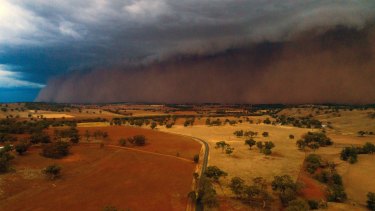
Dust storm near Orange, NSW in January. The relatively stable climate that has supported human civilisation for the past six millennia is likely to shift in the next 50 years because of climate change.
Dust storm near Orange, NSW in January. The relatively stable climate
that has supported human civilisation for the past six millennia
 is likely to shift in the next 50 years because of climate change.
Scientists from China, the US and Europe found that the narrow climate niche that has supported human society would shift more over the next 50 years than it had in the preceding 6000 years.
As many as 3.5 billion people will be exposed to "near-unliveable" temperatures averaging 29 degrees through the year by 2070. Less than 1 per cent of the Earth's surface now endures such heat.
That heat compares with the narrow 11- to 15-degree range that has supported civilisation over the past six millennia, according to research published Tuesday in the journal Proceedings of the National Academy of Sciences.
Read the story from The Age by Peter Hannam - “‘Blown away': Safe climate niche closing fast, with billions at risk.”

23 June, 2019

Study: U.S. Fossil Fuel Subsidies Exceed Pentagon Spending

The United States has spent more subsidizing fossil fuels in recent years than it has on defense spending, according to a new report from the International Monetary Fund. 
The dome of the U.S. Capitol is seen behind the smoke
 stacks of the Capitol Power Plant, the only coal-burning
power plant in Washington, D.C.
The IMF found that direct and indirect subsidies for coal, oil and gas in the U.S. reached $649 billion in 2015. Pentagon spending that same year was $599 billion.
The study defines “subsidy” very broadly, as many economists do. It accounts for the “differences between actual consumer fuel prices and how much consumers would pay if prices fully reflected supply costs plus the taxes needed to reflect environmental costs” and other damage, including premature deaths from air pollution.

Read the story from Rolling Stone by Tom Dickinson - “Study: U.S. Fossil Fuel Subsidies Exceed Pentagon Spending.”

18 June, 2019

Environment reporters facing harassment and murder, study finds

Thirteen journalists who were investigating damage to the environment have been killed in recent years and many more are suffering violence, harassment, intimidation and lawsuits, according to a study.
Goldmining in Tanzania.
Goldmining in Tanzania. 
The Committee to Protect Journalists (CPJ), which produced the tally, is investigating a further 16 deaths over the last decade. It says the number of murders may be as high as 29, making this field of journalism one of the most dangerous after war reporting.
On every continent, reporters have been attacked for investigating concerns about abuses related to the impact of corporate and political interests scrambling to extract wealth from the earth’s remaining natural resources.
These resources end up in all manner of products – from mobile phones to pots and pans – with consumers largely unaware of the stories behind them.

Read the story from The Guardian by Juliette Garside and Jonathon Watts - “Environment reporters facing harassment and murder, study finds.” 

07 December, 2018

’Brutal news': global carbon emissions jump to all-time high in 2018

Global carbon emissions will jump to a record high in 2018, according to a report, dashing hopes a plateau of recent years would be maintained. It means emissions are heading in the opposite direction to the deep cuts urgently needed, say scientists, to fight climate change.
Almost all countries are contributing to the rise in emissions,
with China up 4.7%, the US by 2.5% and India by 6.3% in 2018.
The rise is due to the growing number of cars on the roads and a renaissance of coal use and means the world remains on the track to catastrophic global warming. However, the report’s authors said the emissions trend can still be turned around by 2020, if cuts are made in transport, industry and farming emissions.

The research by the Global Carbon Project was launched at the UN climate summit in Katowice, Poland, where almost 200 nations are working to turn the vision of tackling climate change agreed in Paris in 2015 into action. The report estimates CO2 emissions will rise by 2.7% in 2018, sharply up on the plateau from 2014-16 and 1.6% rise in 2017.


15 November, 2018

Keep it in the ground’: what we can learn from anti-fossil fuel campaigns

From the fossil fuel divestment movement to the Stop Adani campaign, in recent years we’ve seen a wave of climate activism that directly targets fossil fuels — both the infrastructure used to produce, transport and consume them, and the corporations that finance, own and operate that infrastructure.
Former Liberal Party leader John Hewson at an event
 protesting Adani’s Carmichael Mine in October 2018.
What makes targeting fossil fuels so attractive for activists, and can we learn anything from them?

Climate change became a topic of mainstream international concern in the early 1990s. For the first two decades of international climate cooperation, until the failed Copenhagen climate conference in 2009, the international environment movement embraced a more “technocratic” approach.

 Professionally-staffed environment groups made technical arguments aimed at persuading politicians and the public to adopt global climate treaties, national greenhouse gas emission reduction targets, and complex market-based policy mechanisms such as emissions trading schemes.


Read the piece from The Conversation by a PhD Candidate in Political Theory from the Department of Government at the London School of Economics and Political Science, Fergus Green - ’Keep it in the ground’: what we can learn from anti-fossil fuel campaigns."

28 August, 2018

Energy industry calls on Taylor to not give up the energy policy fight

Industry is looking past the anti-windfarm headlines that new energy minister Angus Taylor has generated in recent years and hoping his expertise in the sector will allow him to forge a national policy.
The newly appointed Minister for Energy, Angus Taylor.
The ill-fated National Energy Guarantee played a central role in the downfall of Malcolm Turnbull's prime ministership this month, but the industry is urging Mr Taylor to not give up on energy reform.


Read Cole Latimer’s story from The Age - “Energy industry calls on Taylor to not give up the energy policy fight.”

30 May, 2018

Tony Abbott fires warning shot at party leadership on energy

Energy Minister Josh Frydenberg has assured Coalition MPs that electricity customers were “through the worst” of the price spikes of recent years, as former prime minister Tony Abbott fired another warning shot over the government’s energy policy.
Former Australian Prime Minster, Tony Abbott.
Mr Frydenberg told Liberal and Nationals colleagues that he expected prices to fall in Queensland and stay relatively flat in NSW and South Australia according to forecasts for the next pricing period from July.

The assurance came as several MPs expressed their concern about energy and Mr Abbott sought an assurance that the government’s policy would go back to the Coalition party room for a decision by all members.


Read the story from today’s Age - “Tony Abbott fires warning shot at party leadership on energy.”