
Every period of American history is often associated with a particular national or international crisis, which performs the twofold function of both simplifying the past for the general public and providing an overview of the significant progress our country has made over the years. The American Revolutionary War; the Atlantic slave trade; the Civil War; the suffrage movement; Jim Crow; the world wars; the Great Depression — these are all tumultuous parts of our national history that are reminiscent of certain centuries and decades, and they will always remain as such.
It was in this spirit, then, that the civil-rights activist W. E. B. Du Bois attempted to contemporaneously identify the “problem of the Twentieth Century.” In his 1903 book The Souls of Black Folk, he wrote the following:
“Herein lie buried many things which if read with patience may show the strange meaning of being black here at the dawning of the Twentieth Century. This meaning is not without interest to you, Gentle Reader; for the problem of the Twentieth Century is the problem of the color line.”
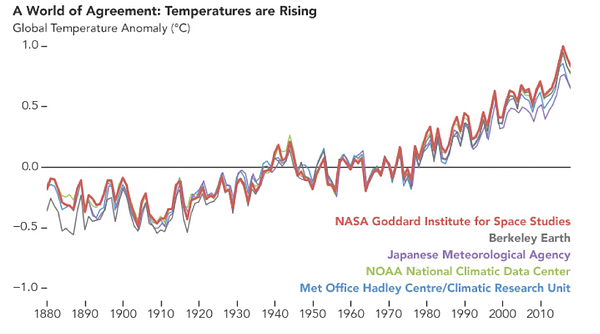
Now, setting aside the merits of Du Bois’s assertion, what might be said to be the problem of our current century? In responding to this question, one might very well move in the direction of anything from institutional racism to class disparities to U.S. foreign policy. But I humbly submit that the singular, universal crisis of the Twenty-first Century is undeniably anthropogenic climate change.
Read the story from Medium by Omid Panahi - “Climate Change: The Problem of the Twenty-first Century.”

No comments:
Post a Comment