Showing posts with label American history. Show all posts

15 July, 2019

People in Coal Country Worry About the Climate, Too

Dwayne Thomas, who is 70 years old and president of his local chapter of the United Mine Workers of America in southwestern Pennsylvania, spent 43 years working in Appalachian coal mines. For generations, in mines and the nearby steel mills that coal made possible, his family, like many others, has relied on jobs in the fossil fuel industry. Mr. Thomas knows the sacrifices that come with the work. His father, Elmer, died of black lung in 1995. His brother Robert was killed in an accident at the Maple Creek Mine in Bentleyville, Pa., in 1996.
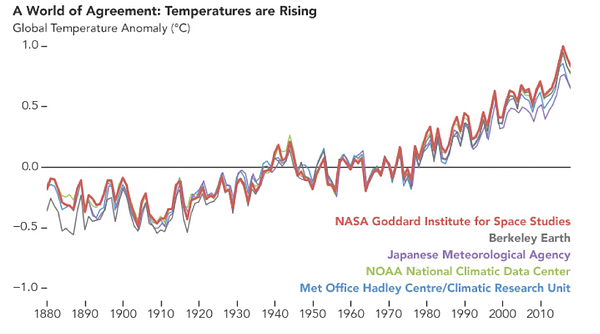
Despite having a sense of patriotism and longstanding pride in the role that miners have played in American history, he’s also aware that his region’s dependence on fossil fuel jobs needs to end. “Climate change is happening,” he told me recently by phone from his home in Fayette County, Pa. “We have to tackle it before it becomes too large an entity to take on.”
The best way to begin tackling climate change, as Mr. Thomas sees it, is taking the Green New Deal seriously, rather than rejecting it out of hand, as President Trump did this week, complaining that “it’ll kill millions of jobs” and “crush the dreams of the poorest Americans.” 

Read the story from The New York Times by Eliza Griswold - “People in Coal Country Worry About the Climate, Too.”

08 June, 2019

Climate Change: The Problem of the Twenty-first Century

Every period of American history is often associated with a particular national or international crisis, which performs the twofold function of both simplifying the past for the general public and providing an overview of the significant progress our country has made over the years. The American Revolutionary War; the Atlantic slave trade; the Civil War; the suffrage movement; Jim Crow; the world wars; the Great Depression these are all tumultuous parts of our national history that are reminiscent of certain centuries and decades, and they will always remain as such.
It was in this spirit, then, that the civil-rights activist W. E. B. Du Bois attempted to contemporaneously identify the “problem of the Twentieth Century.” In his 1903 book The Souls of Black Folk, he wrote the following:
“Herein lie buried many things which if read with patience may show the strange meaning of being black here at the dawning of the Twentieth Century. This meaning is not without interest to you, Gentle Reader; for the problem of the Twentieth Century is the problem of the color line.”

Now, setting aside the merits of Du Bois’s assertion, what might be said to be the problem of our current century? In responding to this question, one might very well move in the direction of anything from institutional racism to class disparities to U.S. foreign policy. But I humbly submit that the singular, universal crisis of the Twenty-first Century is undeniably anthropogenic climate change.

Read the story from Medium by Omid Panahi - “Climate Change: The Problem of the Twenty-first Century.”

07 July, 2018

Trump’s embattled EPA chief Scott Pruitt resigns amid scandals

Washington: US Environmental Protection Agency chief Scott Pruitt, one of the most scandal-plagued Cabinet officials in American history, is leaving the agency, President Donald Trump tweeted Thursday.
EPA director Scott Pruitt pictured in Rome in June 2017.
"I have accepted the resignation of Scott Pruitt as the administrator of the Environmental Protection Agency," Trump said in a tweet. "Within the agency Scott has done an outstanding job, and I will always be thankful to him for this.”


Read the story from The Age by Evan Halper - “Trump’s embattled EPA chief Scott Pruitt resigns amid scandals.”