Showing posts with label bushfires. Show all posts

06 April, 2020

Coronavirus and degrowth

This is proving a remarkable year for all the worst reasons. First, we experienced Black Summer, the most severe season of fires in Australia’s history. (The 173 fatalities of the Black Saturday Australian bushfires on 7 February 2009 retains the record for most deaths).
Degrowth

Then Australia experienced floods: on one hand, a mercy after the drought and snuffing out the fires, but; on the other hand, it brought its own human and social destruction, pollution and despair. This happened at the same time as the record-breaking three months of severe winter flooding in the United Kingdom.
Meanwhile, the Antarctic endured an ‘unprecedented heat wave’. Brewing, simultaneously, was the public health and economic crisis of Covid-19, or coronavirus.
Read the story from Ecologist by Anitra Nelson and Vincent Leigey - “Coronavirus and degrowth."

10 March, 2020

More drought in Australia's future as weather patterns change

The Indian Ocean weather pattern that contributed to eastern Australia's intense drought and bushfires is becoming more common because of climate change - and can reach worse extremes.
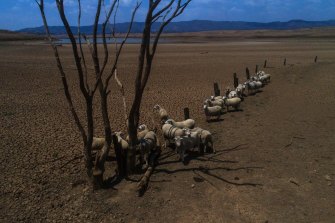
Sheep on the parched lake floor of the Burrendong Dam. The reservoir, one of the largest in the Murray Darling Basin, was down to about 1 per cent full during the worst of the recent drought.
Sheep on the parched lake floor of the Burrendong Dam.
The reservoir, one of the largest in the Murray Darling Basin,
was down to about 1 per cent full during the worst of the recent drought.
Using coral cores drawn from Indonesian islands, an international research team led by Australians reconstructed climatic conditions in the Indian Ocean over more than 500 years. Of particular interest was a phenomenon known as the positive phase of the Indian Ocean Dipole (IOD).

Read the story from The Age by Peter Hannam - “More drought in Australia's future as weather patterns change.”

16 February, 2020

Think Australia's bushfires killed a lot of animals? Weak environmental laws threaten the lives of more

In a previous life, I obtained an environmental science degree and worked as a fauna ecologist for an environmental consultancy.
A koala sits among woodchips on cleared land.
Koalas are predicted to be extinct across New South Wales
and Queensland by 2050 according to conservation groups.
On an environmental impact study (EIS) in the rocky jump-up country out of Winton a few years ago, my colleagues and I recorded a healthy population of rock wallabies living in the caves and cliffs where a proposed coal mine was to be built.
Despite being listed as vulnerable under the federal Environment Protection and Biodiversity Conservation (EPBC) Act, the presence of the animals wasn't a barrier to the project going ahead.
The developers' planned to catch and remove the wallabies they could, and those they couldn't catch were going to be fenced inside the tailings dam where they would most likely die.
This wasn't an unusual scenario.
Every EIS I worked on — for coal, coal-seam gas, gas refinery, bauxite, housing estates, and airport expansion projects — during a three-and-a-bit year period found species listed as vulnerable or endangered.

02 February, 2020

Are Australia’s Bushfires The Result of Climate Change?

For the last few months, my country has been on fire. An estimated 18.6 million hectares have been burnt, nearly 6,000 buildings destroyed, almost one billion animals were killed, and at least 29 people are dead.These bushfires are regarded by the NSW Rural Fire Service as the worst bushfire season in memory for that state.
Was climate change responsible for this?
Australia’s ravaged landscape has drawn the attention and sympathy of people from every corner on earth, with multi-million dollar donations pouring in to help those affected, as well as to support the brave men and women who are on the frontlines fighting the fires. For some, there is no clearer case for the effects of anthropogenic global warming than to simply take a glance at Australia; a country which is literally aflame.
As a result, the fires have sparked worldwide debate surrounding climate change — as well as Australia’s failure to address the issue. Primarily, the conversation has centered around Australia’s Prime Minister Scott Morrison, who has faced a tsunami of backlash after he was found to be on holiday in Hawaii as the fires began to worsen in December. Scott Morison also happens to be religious, and pretty quiet when it comes to his opinions on climate change. Needless to say, ScoMo (as he’s colloquially called) has served as the embodiment and personification of all climate denialism, with many seeing him as the spark which started Australia’s recent burning.

Read the Medium story by Louis O’Neill - “Are Australia’s Bushfires The Result of Climate Change?

(Louis, it seems, is attached to "Scotty from marketing" department - Robert McLean)

28 January, 2020

The Australia fires portend a future of climate apartheid

It will be a long hot summer in Australia. Fires of almost biblical proportions have swept across the country, devastating land, property and wildlife. More than 30 people have been killed, a billion animals have died, and more than 3,000 homes have been burned down. The cost of the bushfires has been estimated at $2bn and could climb even further.
Rural Fire Service (RFS) volunteers and NSW Fire and Rescue officers fight a bushfire encroaching on properties near Termeil, Australia on December, 3, 2019 [AAP image via Reuters/Dean Lewins]
Rural Fire Service (RFS) volunteers and NSW Fire and Rescue
 officers fight a bushfire encroaching on properties near Termeil,
 Australia on December, 3, 2019
Although heavy rain and lower temperatures this month have helped put out some fires, the threat of the blaze coming back is still imminent
Meanwhile, Australian Prime Minister Scott Morrison's response to this environmental catastrophe has been to refuse to expand measures to combat climate change. In December, as the death toll was climbing and Australian fire brigades struggled to control the fires, the prime minister left the country for a holiday in Hawaii.
His attitude and actions illustrate quite well just how the wealthy and their political allies plan to rule our burning planet.

Read the story from Al Jazeera by David A. Love - “The Australia fires portend a future of climate apartheid.”

Heatwave to bring 45C days to NSW and Victoria with torrential rain for Queensland

Bushfires could flare back up across NSW and Victoria with an extreme heatwave expected for parts of both states on Friday, while a slow-moving low-pressure system is pushing torrential rain across Queensland.
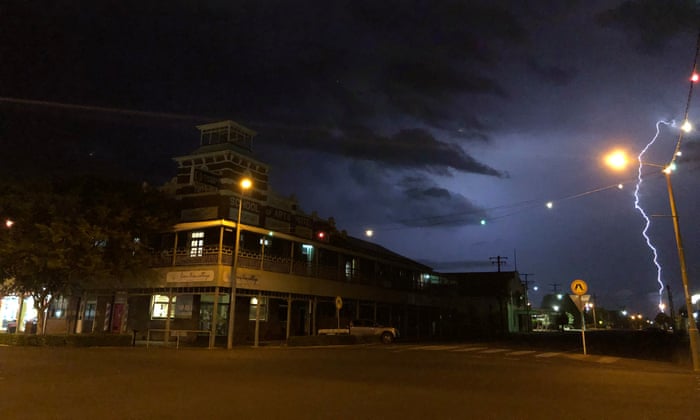
Lightning in Roma, Queensland, heralds the arrival of
the rain in mid-January. Parts of the state’s north
 have had half a metre of rain since.
In NSW “it looks like fire danger is ramping up as we head into the weekend and Saturday will be the peak day,” according to the Bureau of Meteorology’s David Wilke.
Friday would be the peak day in Victoria, bringing high humidity, hotter conditions and winds picking up, senior forecaster Richard Carlyon said.
Temperatures were expected to increase from Wednesday in NSW, rising to the low 40s on the south coast on Saturday and 41C to 43C in the Australian Capital Territory. Western Sydney could experience temperatures of up to 45C.

Read the story from The Guardian by Else Kennedy - “Heatwave to bring 45C days to NSW and Victoria with torrential rain for Queensland.” 

18 January, 2020

To Help Australia, Look to Aboriginal Fire Management

Since September 2019, Australia has been ravaged by bushfires. You know the statistics: about 18 million acres burned, around 2,000 homes destroyed, and nearly 1 billion animals affected. The fires have also affected Aboriginal communities and lands.
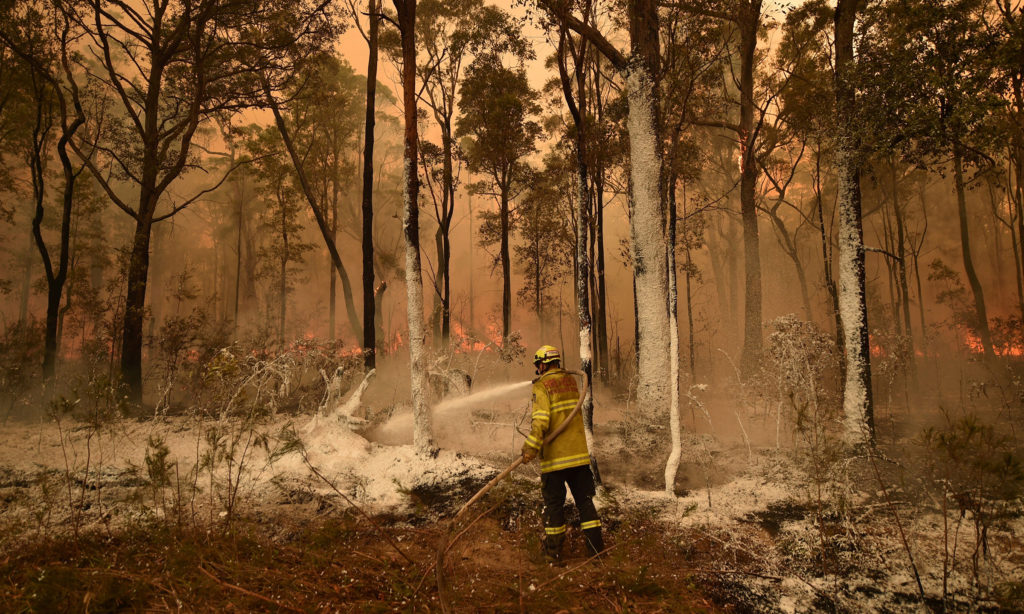
A firefighter sprays foam retardant on a back burn ahead of
a fire front in the New South Wales town of Jerrawangala on Jan. 1, 2020. 
On January 3, the small Aboriginal community of Mogo, New South Wales, was destroyed, including the homes of five members of the local Aboriginal Land Council and the Land Council building. In Victoria, the Aboriginal community of Lake Tyer has been on high alert, as the East Gippsland bushfires burn just 20 kilometers away. Indigenous Protected Areas—reserved areas of land managed by local Indigenous people—have been devastated as well. Russell Irving, project coordinator at the Minyumai Indigenous Protected Area in New South Wales, noted in a November statement that, “We and many of our small-scale farmer neighbours are at threat of becoming members of the rapidly growing number of climate refugees in our own country.”
Historically, bushfires in Australia were a lot less common than they are today. Climate change is partially to blame. Temperatures have risen dramatically in Australia over the last century, causing more extreme droughts and unpredictable fire seasons. But the ongoing impacts of colonialism—including poor land management—is also part of the puzzle. For tens of thousands of years, Aboriginal Australians managed their environment through controlled burns. These fires continue to shape Australia’s landscape. In the Central Arnhem region in northern Australia, for example, a study found kangaroos were more abundant in areas that had been burned by Aboriginal people, because the grass in burned areas was more nitrogen-rich than grass in non-burned areas.

Read the story from Yes! magazine by Abaki Beck - “To Help Australia, Look to Aboriginal Fire Management.”

17 January, 2020

Grief, frustration, guilt: the bushfires show the far-reaching mental health impacts of climate change.

The bushfires that have ravaged large parts of Australia since September 2019 have resulted in a scale of destruction that will take years, if not decades, of recovery.
Evacuation meeting of NSW south coast residents
An evacuation meeting of NSW south coast residents. Loss of
 homes and associated identity as well as poor air quality are
major risk factors for mental illness.
The mammoth task that will be Australia’s national bushfire recovery has garnered financial support from numerous private donors and a $2bn commitment from the federal government, including a $76m package allocated to mental health services for affected persons. So what exactly are the expected mental health impacts of the bushfires?
To try and anticipate the direct mental health impacts from the current bushfires, one can look to research conducted after the Black Saturday bushfires of 2009.

16 January, 2020

Time to step up on emissions

The last thing we need now is a royal commission into the bushfires. We just need all levels of government to bring the fires under control and assist to rebuild lives and communities as required.
A royal commission will be just a ploy to do nothing to address our CO2 emissions until it’s complete.
If the Coalition government wants to show real leadership, it could meet and go beyond our international CO2 reduction commitments by introducing a carbon tax in March.
The task is not insurmountable. It took Australia one day to declare war on Japan after it attacked the United States naval base at Pearl Harbor in 1941.
It’s time for the Coalition government to ‘‘suck it up’’ and move on.

Letter in The Shepparton News from Tatura’s Terry Court - “Time to step up on emissions.”

14 January, 2020

The bushfire crisis is a wake-up call we can't afford to ignore

So far, the lives of more than a billion animals have been extinguished in the bushfires. A billion. Gone. Millions of hectares of native forests are burned, along with tens of thousands of dead livestock. Hundreds of family homes are now ash and dozens of families will forever mourn loved ones who died trying to protect either their homes or their communities.
The fires burning across Australia demand a whole-of-society response. Picture: Dion Georgopoulos
The fires burning across Australia demand a whole-of-society response. 
The loss is almost unfathomable. And summer isn't over yet.
A British MP described the bushfire crisis as a "wake-up call for the world" on global warming, but the Australian government is still asleep at the wheel. 
The Prime Minister was desperately trying to convince everyone that the Coalition government has always acknowledged the link between the bushfires and climate change - while his backbencher Craig Kelly was on Good Morning Britain denying any link. It was only a few weeks ago that our Deputy Prime Minister dismissed anyone who linked climate change and bushfires as "inner-city raving lunatics". 

Read the opinion piece from The Canberra Times by Ebony Bennett - “The bushfire crisis is a wake-up call we can't afford to ignore.”

Australia’s fires have pumped out more emissions than 100 nations combined

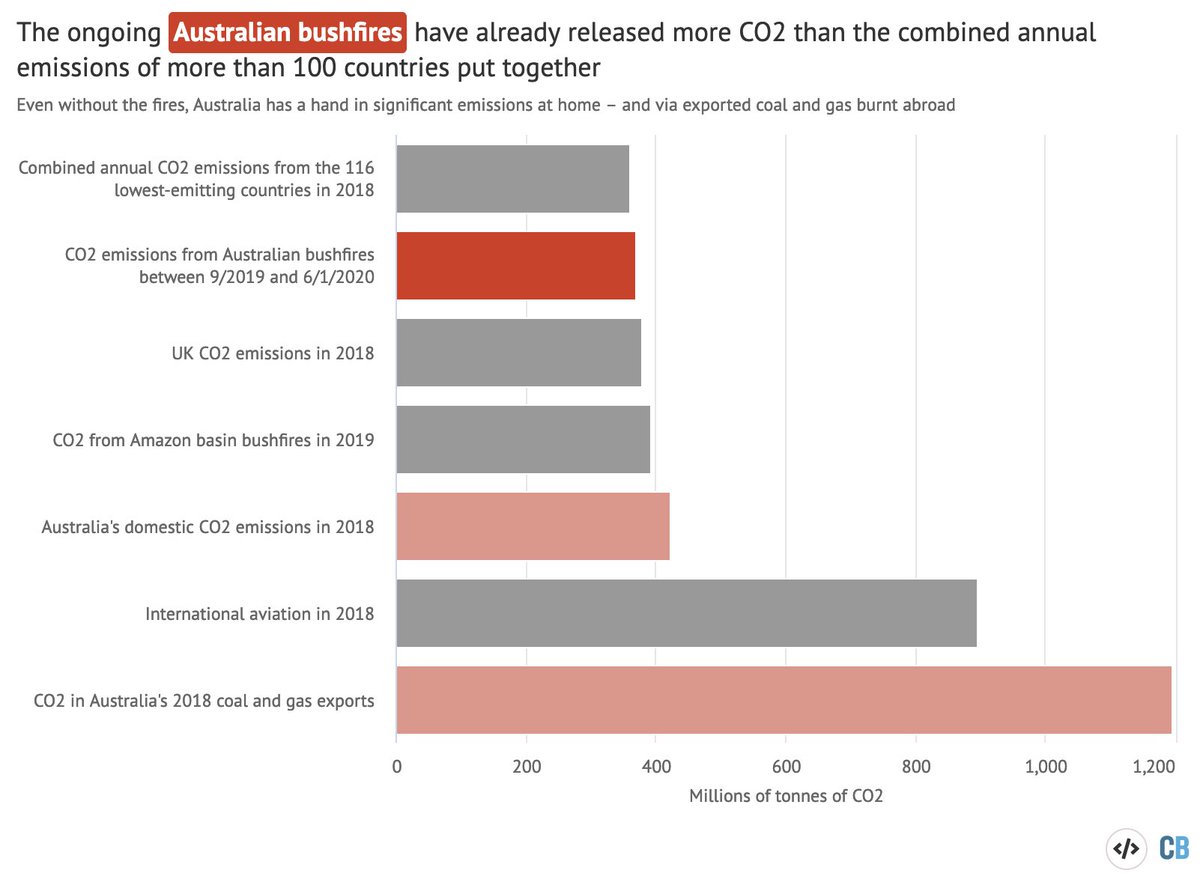
The wildfires raging along Australia’s eastern coast have already pumped around 400 million metric tons of carbon dioxide into the atmosphere, further fueling the climate change that’s already intensifying the nation’s fires.
That’s more than the total combined annual emissions of the 116 lowest-emitting countries, and nine times the amount produced during California’s record-setting 2018 fire season. It also adds up to about three-quarters of Australia’s otherwise flattening greenhouse-gas emissions in 2019.
And yet, 400 million tons isn’t an unprecedented amount nationwide at this point of the year in Australia, where summer bush fires are common, the fire season has been growing longer, and the number of days of “very high fire danger” is increasing.

Read the story from MIT Technology Review - “Australia’s fires have pumped out more emissions than 100 nations combined.”

11 January, 2020

Statement regarding Australian bushfires

The Australian Academy of Science acknowledges the devastating impact the Australian bushfires are having—and will continue to have—on people, our environment and our economy.
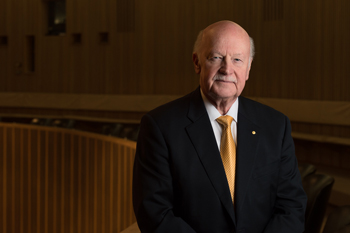
Academy President Professor John Shine.
The scale of these bushfires is unprecedented anywhere in the world.
The Academy extends its support and sympathy to all those who have lost loved ones and whose lives are directly and indirectly impacted. We thank the many volunteers, individuals, leaders and foreign nations for their efforts and contributions.
As an independent and authoritative scientific adviser to the parliament and to the nation, the Academy draws on the scientific expertise of Australia’s leading scientists—the Fellows of the Academy.

Read the story from The Australian Academy of Science - “Statement regarding Australian bushfires.”

03 January, 2020

‘Very abnormal': Red Cross warns mental recovery from fires could take years

The Red Cross has urged people with loved ones affected by the bushfires to listen to them and seek help if necessary.
The Red Cross has urged people with loved ones affected by
the bushfires to listen to them and seek help if necessary.
Lack of sleep, nausea, anger and guilt could be signs a survivor is not coping.
After an intial sense of euphoria at surviving, some people experienced an emotional rollercoaster and struggled to return to everyday life, according to Andrew Coghlan, the Australian Red Cross' head of emergency services.
He said for many survivors, bushfire was “a very abnormal experience” and their reactions were normal. “It’s not something that people are used to seeing or dealing with.”

Read the story from The Age by Carolyn Webb - “‘Very abnormal': Red Cross warns mental recovery from fires could take years.”

31 December, 2019

Army and Navy to join the bushfire fight as Victoria counts the cost

Royal Australian Navy ships will sail to the rescue of Victorian and NSW coastal towns engulfed by the bushfires that plunged both states into crisis on New Years Eve.
Evacuees at Mallacoota Wharf at 10.30am Tuesday.
Evacuees at Mallacoota Wharf at 10.30am Tuesday. 
Thousands of holidaymakers remain trapped by fires in Victoria’s east on Tuesday, with no land route out of the fire zone expected to be open for days, as authorities continued to search for four people still missing in the huge blazes.
Air Force helicopters are expected to be first into action, after Prime Minister Scott Morrison agreed to the states’ requests for help, with the choppers to drop supplies to towns isolated by the smoke and flames, and with fixed-wing aircraft expected to join the firefighting battle soon after.
Mallacoota, in Victoria’s far south-east, and Corryong, in the north-east, were both saved on Tuesday afternoon by changes of wind direction but with “numerous” homes lost on the outskirts of both communities.

30 December, 2019

Last road out: thousands urged to evacuate as Victoria braces for extreme fire conditions

Fears that bushfires could close the Princes Highway on Monday, a day of extreme fire danger across most of the state, have prompted Victoria's Emergency Management Commissioner to urge more than 30,000 holidaymakers to leave East Gippsland while there is still a road out.
Victoria Bushfires: Heatwave could increase fire danger
"The last road out".
At 6am on Monday morning, there was an emergency warning in place for the out-of-control Wingan River bushfire, which has grown rapidly in size and was threatening the townships of Furnell, Tamboon, Tamboon South and Wingan River.
People in those areas are being told to shelter in place as it is too late to leave.
There is another emergency warning in place for the West Side Barmouth Spur bushfire threatening the townships of Brookville, Dogtown, Double Bridges, Ensay, Holstons, Nunniong, Reedy Flat, Stirling, Tambo Crossing, Timbarra, Wattle Circle.

24 December, 2019

Home affairs warned Australian government of growing climate disaster risk after May election

The government was warned by the Department of Home Affairs after the May election that Australia faced more frequent and severe heatwaves and bushfires, and that livelihoods would be affected without effective action on climate change.
A tree burns during the New South Wales bushfires
Home affairs warned Australian government of “more
frequent and severe heatwaves, bushfires, floods, and cyclones”.
The department’s incoming government brief to the home affairs minister, Peter Dutton, warned of “disasters” exacerbated by climate change.
“The physical effects of climate change, population growth, and urbanisation mean that without effective action more Australians’ livelihoods will be impacted by disasters into the future and the cost of those disasters will continue to grow,” the brief stated.

16 December, 2019

Australia took a match to UN climate talks while back home the country burned

I’ve been at the climate summit in Madrid for the past two weeks. The question I was constantly asked was: “What will it take for Australia to treat the climate crisis seriously?” International friends, colleagues and strangers looked on in horror at the effects of the bushfires and outright amazement at the Morrison government’s denial of the link between the fires and Australia’s coal industry, and seeming lack of concern at this extreme impact of climate change.
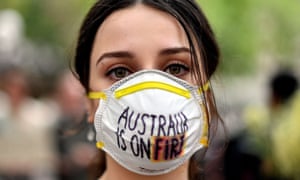
A demonstrator with a mask attends a climate protest rally in Sydney last Wednesday as bushfire smoke choked the city and the Australian government used the COP25 Madrid climate talks in Spain to push for dodgy accounting tricks to halve it climate effort.
A demonstrator with a mask attends a climate rally
in Sydney last Wednesday as bushfire smoke choked
 the city and the Australian government used the
COP25 Madrid climate talks in Spain to push for dodgy
 accounting tricks to halve its climate effort.
Morning after morning I woke to check the news and the “fires near me” app. Seeking updates from friends. Was the Katoomba fire close enough to force evacuation of one? Had another been able to return to their house yet? How was the air pollution in Sydney? Was my partner, who is an asthmatic, coping?

Read the story from The Guardian by Julie-Anne Richards -“Australia took a match to UN climate talks while back home the country burned.”

13 December, 2019

Australia’s bushfires have emitted 250m tonnes of CO2, almost half of country's annual emissions

Bushfires in New South Wales and Queensland have emitted a massive pulse of CO2 into the atmosphere since August that is equivalent to almost half of Australia’s annual greenhouse gas emissions, Guardian Australia can reveal.
Analysis shows the NSW fires have emitted about 195m tonnes of CO2 since 1 August, with Queensland’s fires adding 55m tonnes.
The NSW fires emitted about 195m tonnes of CO2
since 1 August, with Queensland’s bushfires adding
55m tonnes, almost half of Australia’s annual emissions.
Analysis by Nasa shows the NSW fires have emitted about 195m tonnes of CO2 since 1 August, with Queensland’s fires adding a further 55m tonnes over the same period.
In 2018, Australia’s entire greenhouse gas footprint was 532m tonnes of carbon dioxide equivalent.

12 December, 2019

Scott Morrison acknowledges smoke haze concerns as he stands by climate policies

The Prime Minister has sought to reassure Australians he understands community concerns about bushfires and smoke haze as the Federal Government faces criticism for its climate policies.
People walk across a bridge in the Sydney CBD, the sky is orange and hazy with Sydney tower in the background.
Sydney was trapped in an orange haze due to the
 number of fires surrounding NSW at one stage.
Scott Morrison acknowledged that climate change was a factor contributing to increasingly intense bushfire seasons.
But he ruled out strengthening Australia's emissions reduction target, despite New South Wales Government plans to take greater action.
"I know, because I'm a Sydneysider, how unusual it is to see that haze across my city, and I know how distressing that would be, particularly for young people who haven't seen that before," Mr Morrison said.
"So that is why I think it is important to have a sense of calm on these matters on the basis of information."

29 November, 2019

Student climate change protesters take to the streets across the country

A teenager whose family home was destroyed in bushfires has delivered an impassioned plea to the Prime Minister to take action on climate change, saying "thoughts and prayers are not enough".
Shiann Broderick looks a the camera from close range at a climate rally.
Shiann Broderick lost her family home in the Nymboida bushfire.
Shiann Broderick, 18, who lost her home in Nymboida in northern NSW, gathered along with about 500 protesters outside Liberal Party headquarters in the inner-city Sydney suburb of Woolloomooloo.
"Mr Morrison, as Prime Minister your thoughts and prayers are not enough," Ms Broderick said.
"I want climate action. This is a crisis. Act like it."
A series of strikes in cities across the country took place today as part of the School Strike for Climate Australia in response to recent devastating bushfires.