Showing posts with label destruction. Show all posts

17 January, 2020

Grief, frustration, guilt: the bushfires show the far-reaching mental health impacts of climate change.

The bushfires that have ravaged large parts of Australia since September 2019 have resulted in a scale of destruction that will take years, if not decades, of recovery.
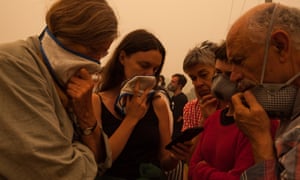
Evacuation meeting of NSW south coast residents
An evacuation meeting of NSW south coast residents. Loss of
 homes and associated identity as well as poor air quality are
major risk factors for mental illness.
The mammoth task that will be Australia’s national bushfire recovery has garnered financial support from numerous private donors and a $2bn commitment from the federal government, including a $76m package allocated to mental health services for affected persons. So what exactly are the expected mental health impacts of the bushfires?
To try and anticipate the direct mental health impacts from the current bushfires, one can look to research conducted after the Black Saturday bushfires of 2009.

15 January, 2020

Economic estimates don't account for tragic bushfire toll

AS THE DEATH and destruction caused by the bushfire catastrophe continue to mount, Westpac has issued estimates suggesting that the associated reduction in gross domestic product (GDP) will be very modest, between 0.2 and 0.5%. There is plenty to argue within the way this estimate has been derived, but the biggest problem is with the use of the GDP concept.
Scott Morrison's Government has prioritised money over the environment.
I’ve pointed out many times that considered as a measure of economic wellbeing, GDP has three major deficiencies: it’s gross, meaning that depreciation (including the destruction caused by natural disasters) is not taken into account; it’s domestic, meaning that it includes output generated in Australia by foreign capital; and it’s a product, when the real interest is in income. 
In the case of the bushfires, the big problem is that GDP is gross. The destruction of houses, businesses and infrastructure by disasters is, in economic terms, a particularly drastic form of depreciation. But, since GDP takes no account of depreciation, it is unchanged.

Read the story from the Independent Australia by John Quiggin - “Economic estimates don't account for tragic bushfire toll.”

11 January, 2020

The truth about Australia's fires — arsonists aren't responsible for many this season

The world has been shocked by the scenes of devastation as the unprecedented destruction of Australia's horror bushfire season rages on.
A helicopter travelling over burning bushland.
A firefighting helicopter tackling a bushfire
in Victoria's East Gippsland region.
And, one big question has appeared in the headlines of late, here and internationally: how much is arson to blame?
While firebugs remain a legitimate and serious threat, they're responsible for about 1 per cent of the more than 5.2 million hectares that have been burned in NSW this season.
It's a similar story in other states.

04 January, 2020

Tackle climate change

With more than five per cent of NSW and close to 1 000 000 ha of Victoria burnt, with the loss of many lives, destruction of the natural environment, property and stock, we now realise what we will have to confront in the future if we don’t act now.
While not experiencing first-hand the dreadful force of wildfire I empathise with the tens of thousands of Australians dealing with such a terrifying event. It is of utmost importance we do everything required to bring the fires under control and ensure everyone is safe as soon as possible.

The links between drought, increased temperatures, wildfire and climate change are indisputable.
It is now time for an all-ofgovernment approach at federal level so we are in a position to act with extreme urgency to combat climate change impacts.
In the past 10 years we have done very little to reduce our CO2 emissions, let alone take advantage of the opportunities that abound in the low-carbon economy. Our lack of direction at federal level over this period is inexcusable.
It is possible with an all-ofgovernment approach that by the end of March we could have agreed climate change and energy policies in place and have established a national bushfire management plan. Some would consider this impossible; however, the government is in a good position to meet this target, as these issues have been discussed to death by five prime ministers over the past 10 years.
The task is not insurmountable. It is time for our federal politicians to put aside party politics and provide the leadership we so desperately need.

Letter fromTatura’s Terry Court in The Shepparton News - “Tackle climate change.”

13 May, 2018

Swaths of native forest near Great Barrier Reef set to be bulldozed

Federal officials plan to back the destruction of almost 2000 hectares of pristine Queensland forest in a move that threatens the Great Barrier Reef and undermines a $500 million Turnbull government rescue package for the natural wonder.
Old growth forest in the vicinity of Kingvale Station,
near rivers that flow into the Great Barrier Reef.
A draft report by the Department of the Environment and Energy recommends that the government allow the mass vegetation clearing at Kingvale Station on Cape York Peninsula. The area to be bulldozed is almost three times the size of the combined central business districts of Sydney and Melbourne.


Read the story by Nicole Hasham from The Age - “Swaths of native forest near Great Barrier Reef set to be bulldozed.”

30 April, 2017

Yes, I am a climate alarmist. Global warming is a crime against humanity

Most of us have wondered about the human context of past crimes against humanity: why didn’t more people intervene? How could so many pretend not to know? To be sure, crimes against humanity are not always easy to identify while they unfold.
‘We are the bystanders who must choose to intervene or be defined by our failure.’ 
We need some time to reflect and to analyze, even when our reasoning suggests that large scale human suffering and death are likely imminent. The principled condemnation of large scale atrocity is, too often, a luxury of hindsight.

I’m a climate alarmist because there is no morally responsible way to downplay the dangers that negligent policies – expected to accelerate human-caused climate change – pose to humankind.
There can be no greater crime against humanity than the foreseeable, and methodical, destruction of conditions that make human life possible – hindsight isn’t necessary.


Read Laurence Torcello’s story on The Guardian - “Yes, I am a climate alarmist. Global warming is a crime against humanity.”

31 October, 2015

Yes, it's time to scare the horses!


(Long have I believed that climate change is such a threat to humanity that it makes most everything else in the modern world redundant.

Subsequently, I frequently referred to the dilemma in my weekly (now fortnightly) newspaper column until several weeks ago when my editor said such references were no longer appropriate and I was asked to steer away from the subject.

Climate change, however, has become such a critical and urgent issue that it was something I could no longer directly avoid and so I wrote this column, which will be published in the Shepparton News on Monday, November 2)

-      Robert McLean

I

t’s time to “scare the horses”.

Great, but what does that mean?

A more than a decade of reading about and listening to some of the world’s best minds and understanding the damage you and I, and our fellows are doing and have done to earth’s atmosphere, the constant, although subtle, message has been not to scare the horses.

Okay, but what does that mean?

The facts about climate change, indisputable and illustrated beyond debate by the world’s scientific community, are so contrary to life that to articulate them, as we must if we are to emerge intact from this dilemma, would freeze people into inaction.

Many have warned of that freeze, along with caveat that many “lectured” to about their behaviour, re-double their resistance, become angry,  even more remote from reason and so increasingly determined to adhere to behaviours that are worsening our troubles and align themselves, emotionally and physically, with values contrary to what the world needs.

Circumstances that manifested themselves in two world wars most certainly scared the horses and although the responses were varied, people, although frightened, unsure and uncertain, broadly and generally responded with a commitment that saw sweeping transformations in behaviour preparing communities around the world for the privations, destruction, costs and deaths of war.

Climate change demands an even more disciplined approach, but unlike a war there is no obvious adversary and so while some are scared and confused, a small, but powerful and massively influential minority whose power and influence rest in maintenance of the status quo, continue to laud what exists and encourage more of the same.

As convincing and as populist as their arguments might sound, they are false and beyond that, what is proposed for United Nations climate talks in Paris later this year can be shown as insufficient to put the world on a path to repair.

Preparations for war illustrated the amazing innovative, inventive and can do nature of people and within that their adaptability, which has taken humans to the top of the food chain, as we stood together to confront a common enemy.

Having a clear understanding of who and where the enemy was simplified affairs as it gave people a focus; somewhere and something upon which to vent their frustrations, fears and anger.

Climate change is a more complex, convoluted and wicked problem as the enemy is “us”, making it difficult and confusing, and somewhat impossible, to be angry with yourself and along with that put yourself, your family and friends, and in fact the whole of society of which you are an active part, in the “enemy” category.

So rather than bolt about like scared horses and be angry and irrational, we need to understand and accept we were wrong, we made a mistake and although time is scarce, we need to bond on a war-like footing, make bold decisions, take equally bold actions and make the great escape.