Showing posts with label long. Show all posts

01 January, 2020

Australia’s Angry Summer: This Is What Climate Change Looks Like.

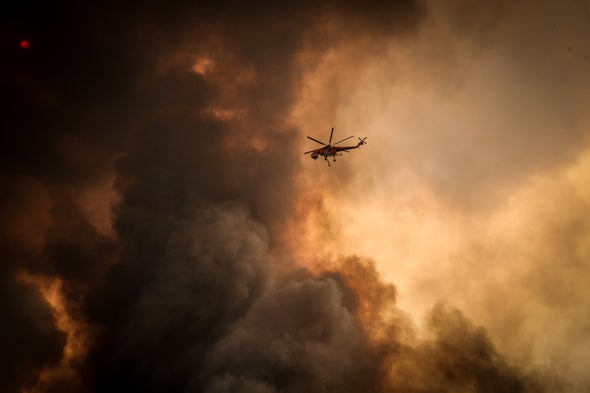
Summer in Australia use to be something we yearned for: long, lazy days spent by the beach or pool, backyard barbecues, and games of cricket with family and friends. But recent summers have become a time of fear: Schools and workplaces are closed because of catastrophic fire danger, while we shelter in air-conditioned spaces to avoid dangerous heat waves and hazardous levels of smoke in the air. Campgrounds have been closed for the summer, and entire towns have been urged to evacuate ahead of “Code Red” fire weather. 
Welcome to our new climate.

Welcome to our new climate.

Of course, unusually hot summers have happened in the past; so have bad bushfire seasons. But the link between the current extremes and anthropogenic climate change is scientifically undisputable.

The fires raging across the southern half of the Australian continent this year have so far burned through more than 5 million hectares. To put that in context, the catastrophic 2018 fire season in California saw nearly 740,000 hectares burned. The Australian fire season began this year in late August (before the end of our winter). Fires have so far claimed nine lives, including two firefighters, and destroyed around 1,000 homes. It is too early to tell what the toll on our wildlife has been, but early estimates suggest that around 500 million animals have died so far, including 30 percent of the koala population in their main habitat. And this is all before we have even reached January and February, when the fire season typically peaks in Australia.


Read the story from Scientific American by Nerilie Abram - “Australia’s Angry Summer: This Is What Climate Change Looks Like.

19 September, 2019

Perhaps we need to explain climate change to politicians as we would to very small children

When I was an undergrad learning geology, the maxim that was thumped into me wasn’t how to build a mine or drill for oil and gas, it was simply: “The present is the key to the past.” The thing that took a while to accept was that the past was really, really, long.

the sun behind electricity pylons
The more heat-absorbing gases in the
atmosphere, the greater the impact.
 It’s really not rocket science, simply
Earth science.
It’s hard to comprehend the scale of geologic time: the timespan for continents to crash together and rip apart, for tiny sea creatures to live, die and condense into kilometres of limestone, or streams to carve epic canyons carrying mountains to the sea. We use comparisons our minds can grasp, such as if all cosmological time was the length of string or compressed into a single year (humans beings appear in the final six hours).

But kids deal with billions of years without a problem – 64 billion is my son’s favourite number. So, when I explained geologic time to my children as we travelled to the last students’ climate rally in Melbourne, they got it: geologically, things happen slowly. And yes, there are exceptions, volcanoes, landslides, earthquakes, to name but a few, but I am talking about the fundamental processes: mountain building, sediment creating, climate changing kind of processes.


Read the opinion piece from The Guardian by Emma White - “Perhaps we need to explain climate change to politicians as we would to very small children.”

24 August, 2018

Get set for early fire season

All indications point to a long, treacherous and early fire season, forcing preparations to be fast tracked, says Shepparton’s Country Fire Authority branch.

The authority is calling on residents to start managing properties ahead of the looming fire season, expected to start up to six weeks earlier than expected.

CFA district 22 operations manager Tony Owen said all indicators from the Bureau of Meteorology and trends from interstate pointed to an early start to the season, fast-tracking preparations.

‘‘If trends continue, it could be three to six weeks earlier than anticipated. The other factor worrying to us is a lot of our district is dry, we haven’t had the rains we usually get,’’ he said.

The CFA’s message to the public was to start their summer preparations now for a long fire danger period.

Mr Owen feared the period could stretch longer than 25 weeks and begin as early as late October. His message was to begin managing vegetation, stressing burning was not the only way to do this. ‘‘Mowing, spraying . . . If they’re going to be pruning the understory of trees, get it done now,’’ he said.

Mr Owen said while the introduction of the fire danger period usually fell late November, and while current cycles were pointing to an early start, spring rain could change things. ● For more information, visit .

This story by Thomas Moir is from The Shepparton News -  “Get set for early fire season.”

23 April, 2018

New Zealand: hot summer leads to a tenfold explosion in rat population

A record-breaking long, hot summer has led to a tenfold explosion in New Zealand’s rodent population, with the country’s urban areas worst hit.
A ship rat attacks a fantail nest in New Zealand. The
country is committed to becoming predator-free by 2050. 
The 2017-2018 summer in New Zealand was the hottest since records began, and fertile breeding conditions have led to a surge in rat and mice numbers.

New Zealand has committed to becoming predator-free by 2050, wiping out all introduced species of rats, mice, possums and stoats in a mere 32 years.

If successful, it would be the first country in the world to be completely pest-free.


Read Eleanor Ainge Roy’s story from The Guardian - “New Zealand: hot summer leads to a tenfold explosion in rat population.”

22 February, 2018

Summer’s sting in the tail: Sizzling temperatures arrive just in time for final weekend

Sydney's long, hot summer shows no sign of wavering in its final days, bringing with it some unwelcome guests.
Blue bottles cover the shore at North Bondi Beach 
as the last weekend of summer approaches. 

Beachgoers who head to the coast to make the most of the last weekend of summer can expect sunny skies and warm temperatures, as mild weather heats up in coming days.
However, they have also been warned to look out for bluebottles, with lifeguards at North Bondi dodging big waves, as well as armadas of the creatures strewn across the sand this week.
Weatherzone meteorologist Kim Westcott said north-easterly winds sweeping through the city would keep a lid on hotter temperatures in the city, but the west was set to swelter.

"For Sydneysiders, the week has been quite cool. It's been a nice reprieve and not too humid.