Showing posts with label natural resources. Show all posts

30 May, 2019

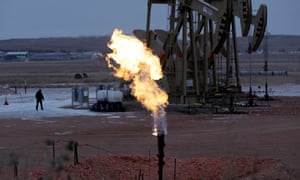
US energy department rebrands fossil fuels as ‘molecules of freedom’

America is the land of freedom, as any politician will be happy to tell you. What you don’t hear quite so often is that the stuff under the land is also apparently made of freedom as well. That is, at least according to a news release this week from the Department of Energy (DoE).
America: land of the freedom ... gas?
America: the land of freedom.
Mark W Menezes, the US undersecretary of energy, bestowed a peculiar honorific on our continent’s natural resources, dubbing it “freedom gas” in a release touting the DoE’s approval of increased exports of natural gas produced by a Freeport LNG terminal off the coast of Texas.
“Increasing export capacity from the Freeport LNG project is critical to spreading freedom gas throughout the world by giving America’s allies a diverse and affordable source of clean energy,” he said.Read the story from The Guardian by Luke O’Neill - “US energy department rebrands fossil fuels as ‘molecules of freedom’.”

(This stuff makes me weak, and weep! - Robert McLean)

29 June, 2017

Turning CO2 into Fuel.

When we hear the word ‘environment’ it conjures images of the natural world – vast forests, rolling hills, pristine waterways and fresh air… but these wonders are under threat from greenhouse gases produced by industrialised activity and fossil fuels. For years scientists have been searching for ways to sustain and protect these natural resources so they can continue to support future generations long after we’ve all checked out.

Artist’s rendition of our fantastic catalyst (not 100% accurate).
 Purple are Ruthenium nanoparticles supported on the
ZrO2 nanoparticles (Zr – blue, O – Red). In reality they are
 in the nanometer range 10-20 nm and are black. 
Like all good stories, there is a baddie in the sustainable environment tale, hell-bent on thwarting our science crusaders. Anthropogenic carbon dioxide (CO2) emissions, the product of combusting fossil fuels, plays this role. When fossil fuels that are solid (coal) or stored underground (petrol and natural gas) are burned to provide energy, they produce CO2 in a gaseous form which is released directly into the atmosphere. And we release a lot of it! We also use natural gas, a fossil fuel that contains mostly methane (CH4), for a lot of our industrial activities.

So how do we solve this problem? How can we have our industrialised world and breathe clean air too?


Read CSIRO Blog story by Ali Green - “Turning CO2 into Fuel.

02 October, 2015

Food industry calls for Paris climate change certainity


O
n Thursday, ten leaders from some of the world’s biggest food companies urged Congress to support a strong global agreement on climate action, in advance of the U.N. climate talks happening in Paris this December.

In a letter published in both the Washington Post and Financial Times, the chief executives from Mars, General Mills, Unilever, Kellogg, Nestle, New Belgium Brewing, Ben & Jerry’s, Clif Bar, Stonyfield Farm, and Dannon asked U.S. and global leaders to “meaningfully address the reality of climate change.”

“The challenge presented by climate change will require all of us — government, civil society and business — to do more with less. For companies like ours, that means producing more food on less land using fewer natural resources. If we don’t take action now, we risk not only today’s livelihoods, but those of future generations,” the letter reads. “We are asking you to embrace the opportunity presented to you in Paris, and to come back with a sound agreement, properly financed, that can affect real change.”

23 September, 2013

Invigorating Shepparton lecture in October


A fellow whose conversations can quickly turn to the cause of climate change and methods of mitigation will speak in Shepparton next month.

Dr Greg Moore.
In town on Thursday and Friday, October 17 and 18, will be Dr Greg Moore, who has an almost unrivalled knowledge of trees in urban areas and re-vegetation.

Dr Moore will visit Shepparton to address the Catchment Management Authority (CMA), but then, the following day he will be talking with a group at the Shepparton University of the Third Age (U3A).

Organizer of the U3A’s Natural Resources group, Mr John Dainton, believes Dr Moore has much to say that will interest those keen to understand more about the implications and complications of climate change and what role trees play in mitigating that eventuality.

The Friday, October 18, U3A event starts at the U3A Hall in Esson St at 10am and even those who are not members are invited to join the event and here what Dr Moore has to say.

A brief outline of Dr Moore’s academic background is listed on the University of Melbourne website.

It says:


Greg Moore was Principal of Burnley College of the Institute of Land Food Resources at Melbourne University from 1988 to 2007. Prior to this he was a Senior Lecturer and Lecturer in Plant Science and Arboriculture at Burnley from 1979. He was Head of the School of Resource Management at the University from 2002 to 2007.

Apart from a general interest in horticultural plant science, re-vegetation and ecology, Greg has a specific interest in all aspects of arboriculture, which is the scientific study of the cultivation and management of trees. He has contributed to the development of Australian Standards in pruning and amenity tree evaluation and has been a major speaker at conferences in Australia, Israel, Hong Kong, USA and New Zealand in recent years. He was the inaugural president of the International Society of Arboriculture, Australian Chapter. He has been a regular on Melbourne radio, particularly with ABC 774 and 3AW.

He has been a member of the National Trust of Victoria’s Register of Significant Trees since 1988 and has chaired the committee since 1996. Greg has been on the Board of Greening Australia (Victoria) since 1989 and has been an active member of various sub-committees. He has chaired Treenet since 2005 and has been on the Board of SGA since 2002. He is a ministerial nomination as a Trustee for the Trust for Nature. He has also served on a number of industry and TAFE sector committees, especially those that deal with curriculum and accreditation matters.

He is currently supervising six post-graduate students and continues to pursue an active research profile in any matters that relate to trees in the urban environment and revegetation. He has written one book, contributed to four others and has had some 120 papers and articles relating to tree biology and management published.