Showing posts with label climate change. Show all posts

02 May, 2020

Australia listened to the experts on coronavirus. It's time we heard them on climate change

We’re already being swamped with ideas about “reforms” needed to recover from the pandemic crisis. But the word reform is like gift wrap – a handy cover for any offering, thought-through or otherwise.

Renewables
‘The energy market operator says Australia could
accommodate levels of up to 75% “instant” wind
and solar penetration in its main grid by 2025.’ 
Perhaps we should ditch the word entirely, and with it the forest of feelpinions about what governments “must” do to advance an author’s previously-held ideological positioning in the post-corona world.

Imagine if we took just two lessons from the way Australian governments responded to the coronavirus: that good decisions are made when they consider the evidence and the best available expert advice; and that policy-making can accommodate reasonable differences of opinion, without becoming a “war”.

Think, as Laura Tingle did in a piece for the ABC’s 7.30 this week, of the difference it would make if interviewers and commentators allowed room for discussion of complex and competing ideas, before demanding that politicians rule them “in” or “out”, or before finding a backbencher who will say they might cross the floor on a policy that conflicts with their ideological prejudice – even if that policy hasn’t yet been outlined.

29 April, 2020

Is saving our planet still possible?

This year is crunch time for determining whether it is still possible to save our planet. In 2020, all major conventions dealing with climate change and biodiversity will meet and decide on the emission levels ambitions that every nation must adopt. 
Earth Day: Saving the planet may cost USD 100 billion per year ...

While leaving no doubt about the urgency of action on climate change, conservationist Aila Keta is optimistic. She sees very encouraging new initiatives coming out of the finance and the banking sector.
The John Sinclair Memorial Lecture 2020 John Sinclair’s voice booms ... Mission Critical. Is saving our planet still possible? was presented by Fraser Island Defenders Organisation. March 7, 2020 
Presenting the lecture is a conservationist who was the founder and President of the Australian Rainforest Conservation Society, Dr Aila Keto AO. 
Listen to the Big Ideas with Paul Barclay on ABC Radio - “Is saving our planet still possible?

25 April, 2020

Do We Need to Go Vegan to Fight Climate Change?

It could help, but you don’t need to completely stop eating animal products to make a difference. Simply cutting down on your meat consumption can have an impact.

Do we need to become vegans to fight climate change?
Another new climate report was just released. This time from the World Meteorological Organization. According to the report, “the year 2019 concludes a decade of exceptional global heat, retreating ice and record sea levels driven by greenhouse gases from human activities.”
Flooding, drought, heatwaves, wildfires. These are just a few of the major impacts climate change is creating today. Scientists agree human activity caused this.
This latest report, like all the others, is so staggeringly dismal, it makes my brain want to stop working. It makes me want to close out of it and go find something fun to read about the Kardashians.
Read the Medium story by Jennifer Geer - “Do We Need to Go Vegan to Fight Climate Change?

There are 10 catastrophic threats facing humans right now, and coronavirus is only one of them

Four months in, this year has already been a remarkable showcase for existential and catastrophic risk. A severe drought, devastating bushfires, hazardous smoke, towns running dry – these events all demonstrate the consequences of human-induced climate change. 
There are 10 catastrophic threats facing humans right now, and ...

While the above may seem like isolated threats, they are parts of a larger puzzle of which the pieces are all interconnected. A report titled Surviving and Thriving in the 21st Century, published today by the Commission for the Human Future, has isolated ten potentially catastrophic threats to human survival. 
Not prioritised over one another, these risks are:
  1. decline of natural resources, particularly water
  2. collapse of ecosystems and loss of biodiversity
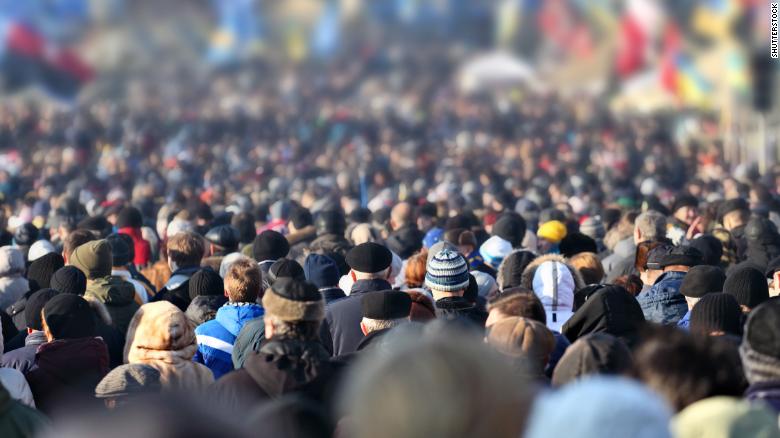
  3. human population growth beyond Earth’s carrying capacity
  4. global warming and human-induced climate change
  5. chemical pollution of the Earth system, including the atmosphere and oceans
  6. rising food insecurity and failing nutritional quality
  7. nuclear weapons and other weapons of mass destruction
  8. pandemics of new and untreatable disease
  9. the advent of powerful, uncontrolled new technology 
  10. national and global failure to understand and act preventatively on these risks.

17 April, 2020

Southwest Drought Rivals Those of Centuries Ago, Thanks to Climate Change

ALBUQUERQUE — A severe drought that has gripped the American Southwest since 2000 is as bad as or worse than long-lasting droughts in the region over the past 1,200 years, and climate change has helped make it that way, scientists said Thursday.
The researchers described the current drought, which has helped intensify wildfire seasons and threatened water supplies for people and agriculture, as an “emerging megadrought.” Although 2019 was a relatively wet year, and natural climate variability could bring good luck in the form of more wet years that would end the drought, global warming increases the odds that it will continue.
“We know that this drought has been encouraged by the global warming process,” said Park Williams, a bioclimatologist at Lamont-Doherty Earth Observatory at Columbia University, and lead author of a study published Thursday in Science. “As we go forward in time it’s going to take more and more good luck to pull us out of this.”
Read the story from The New York Times by Henry Fountain - “Southwest Drought Rivals Those of Centuries Ago, Thanks to Climate Change.”

10 April, 2020

Coronavirus: The immediate effect on climate change

COVID-19 has suspended normality across the globe. With everyone's attention now focused on fighting the virus, what does this mean for the fight against climate change?
COVID-19 has suspended normality across the world, but it
 has had a profound and beneficial impact on the environment.
The pandemic is changing how we live and is subsequently having a profound impact on the environment. An immediate effect the virus has had on the climate is a reduction in global Co2 emissions. 
One silver lining to the current global crisis as a result of COVID-19 is the improvements in air quality due to the drop in pollution from transport.

This was observed first by NASA as satellite images showed a dramatic decline in pollution levels over China, thought to be due to the economic slowdown caused by the outbreak of the virus. On January 23rd, the Chinese government put Wuhan and other major cities on lockdown in an attempt to contain the virus resulting in a standstill of normal life. 
Fei Liu, Air Quality Researcher for NASA’s Goodard space flight centre, told the Guardian: “This is the first time I have seen such a dramatic drop-off over such a wide area for a specific event.”
Read the ClimateAction story by Camilla Watkiss - “Coronavirus: The immediate effect on climate change.”

08 April, 2020

Great Barrier Reef Is Bleaching Again. It’s Getting More Widespread

SYDNEY, Australia — When Terry Hughes surveyed the Great Barrier Reef four years ago from a small plane, mapping the bleaching and death of corals from water warmed by climate change, he hoped such a rare and heartbreaking scene would not be repeated anytime soon.
But rising temperatures sent him back to the air in 2017, when the reef bleached again. Then he returned last month, leading to another devastating conclusion: The reef was being ravaged by bleaching yet again, this time across an even wider area.
“It’s the first time we’ve seen severely bleached reefs along the whole length of the reef, in particular, the coastal reefs,” said Professor Hughes, the director of the ARC Center of Excellence for Coral Reef Studies at James Cook University. “Those are bleached everywhere.”
New aerial data from Professor Hughes and other scientists released on Monday shows example after example of overheating and damage along the reef, a 1,500-mile natural wonder. The survey amounts to an updated X-ray for a dying patient, with the markers of illness being the telltale white of coral that has lost its color, visible from the air and in the water.
Read the story from The New York Times by Damien Cave - “Great Barrier Reef Is Bleaching Again. It’s Getting More Widespread.”

07 April, 2020

Great Barrier Reef's third mass bleaching in five years the most widespread yet

The government’s top Great Barrier Reef scientist says a third mass bleaching event in five years is a clear signal the marine wonder is “calling for urgent help” on climate change.
aerial survey
Aerial surveys of more than 1,000 individual reefs show severe
levels of bleaching occurred in 2020 in all three sections of the
reef – northern, central and southern – the first time this has
happened since mass bleaching was first seen in 1998.
One quarter of the Great Barrier Reef suffered severe bleaching this summer in the most widespread outbreak ever witnessed, according to analysis of aerial surveys of more than 1,000 individual reefs released on Tuesday.
Dr David Wachenfeld, chief scientist at the Great Barrier Reef Marine Park Authority, told Guardian Australia: “My greatest fear is that people will lose hope for the reef. Without hope there’s no action.
“People need to see these [bleaching] events not as depressing bits of news that adds to other depressing bits of news. They are clear signals the Great Barrier Reef is calling for urgent help and for us to do everything we can.”
Read the story from The Guardian by Graham Readfearn - “Great Barrier Reef's third mass bleaching in five years the most widespread yet.”

05 April, 2020

Moving beyond 'us' and ‘them’

From family gatherings to opinion pages - how did we get so 'us' and 'them' about climate change? 
And can we move past this action-quashing rivalry? 
Social scientist and lecturer at the Crawford School of Public Policy from the Australia National University, Dr Rebecca Colvin, was recorded live at Smith’s Alternative in Canberra.
Dr Colvin has some answers. 
Listen to Ockham’s Razor on ABC Radio National - “Moving beyond 'us' and ‘them’."


04 April, 2020

Coronavirus presents us with terrible climate risk - and opportunity

You could hardly conceive of a more potent metaphor for the blow coronavirus has dealt to the world’s fight to reduce carbon emissions and stave off the worst impacts of climate change.
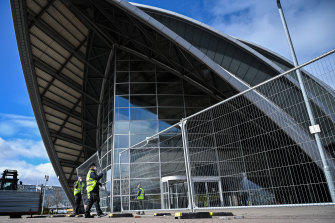
Workmen erect fencing around Glasgow's Scottish Exhibition & Conference Centre as it is turned into a field hospital.
Workmen erect fencing around Glasgow's Scottish Exhibition
& Conference Centre as it is turned into a field hospital
As governments around the world switched focus from what was to have been the most important international climate conference in half a decade, British authorities converted Glasgow's Scottish Exhibition & Conference Centre, where the conference was to have been held, into a field hospital for up to a thousand pandemic victims, complete with testing facilities, laboratories and a morgue.
The now-postponed conference known as COP26 was seen by scientists - and many world leaders - as the last best chance for governments to set in place critical carbon emissions reduction targets.
The goal of the Paris Agreement was to limit warming to beneath a potentially devastating 2 degrees Celsius above pre-industrial levels and to pursue efforts to limit it to 1.5 degrees. But even under the non-binding targets that nations set for themselves in Paris, it was clear by last year that those aims would not be met unless even more ambitious targets were set in Glasgow. This ratcheting effect was how the Paris framework was designed.

Read the story from The Age by Nick O’Malley and Mike Foley - “Coronavirus presents us with terrible climate risk - and opportunity.”

02 April, 2020

Advocate: Preserving farmland could help the climate

In many parts of the U.S., family farms are disappearing and being replaced by suburban sprawl.
Farmland and homes
We need to protect our peri-urban farmland from urban
sprawl as it will help slow the advance of climate change.
“Our estimates are that farmland loss is occurring at an alarming 175 acres per hour,” says Jennifer Moore Kucera of the American Farmland Trust.
She says when farmland is lost to development, it’s not only a problem for agriculture. It can also hinder climate action.
Although many farming methods can make climate change worse, farmers also have the potential to store a lot of carbon on their land through practices like cover crops and minimized tilling.
According to the U.S. Climate Alliance, managing natural and working lands so they store more carbon is a key strategy to limit global warming.

Read the story from Yale Climate Connections - “Advocate: Preserving farmland could help the climate.”

A passionate letter from the heart about our forests.

(Rushworth’s Lou Costa is passionate about protecting our environment and equally passionate about not creating situations that weaken our environmental protection and biodiversity conservation laws. Subsequently, she has written to the Victorian Premier Dan Andrews articulating her feelings and pointing out to the Premier that while humans are suffering because of the present COVID-19 pandemic the environment is benefitting.
Here is a copy of the letter Lou has written to Dan Andrews)
Rushworth's Lou Costa.

Dear Premier Andrews
I am writing to you to strenuously object to the decision that RFA’s (Regional Forestry Agreements) will be extended for another ten years with EPBC (Environmental Protection and Biodiversity Conservation) exemptions.
I couldn’t believe my eyes when I read the news today.
Another ten years of logging? 
Due to the most recent global disaster, it’s easy for some to trivialise the events of Summer past but we must remember that the world watched in horror only a few months ago while our precious forests incinerated; taking with them an immeasurable number of animal lives.
The news of the loss of our unique landscapes and species resonated with tourists from home and abroad as people cancelled their bookings, flights and tours of Australia, afraid there wouldn’t be any natural places left to visit. Many people’s primary concern was the fate of Australia’s animal species.
My husband and I run an eco-retreat in north-central Victoria, far from the nearest fire ground, and even we experienced cancellations and loss of income due to this event which is now being exacerbated by recent COVID 19 restrictions.
Indeed, we promote our business by highlighting Victoria’s natural environment and in a typical year, host guests every single weekend who’s main objective is to be immersed in the natural environment. They all contribute to the local economy while they are here.
Premier Andrews, in November your government made some enlightened and progressive announcements about phasing out logging in Victoria. Protections were given to some areas and hope was given to others. But that was before the bushfires and ‘phasing out’ seemed reasonable.
Now, with so little remaining unburnt forests, especially across the east of Victoria, a decision to continue logging seems ludicrous at best and irresponsible at worst.
We don’t even know yet, what lasting effect the bushfires will have on Victorian biodiversity and the affected ecosystems.
This announcement seems to be more a Liberal government directive than a Labour attitude and an incredible shame that the legacy of a Bob Hawke-style Labour government is not being defended.
I am deeply alarmed by the hypocrisy around your government’s attempts to protect native species affected by bushfires.
A recent statement by Environment Minister, Lily D’Ambrosio leads us to believe that all care is being given to help native species’ recovery.
“While we’re all working hard to slow the spread of coronavirus, it’s good to know our bushfire affected wildlife hasn’t been forgotten and resources are continuing to hit the ground.

The Federal Government has allocated $3 million for a range of projects that boosts the $17.5 million our Government is already investing and will help us continue supporting the recovery of the state’s wildlife and biodiversity through these tough economic times.

We’re partnering with Zoos Victoria to support the captive breeding aspects of population management and long-term resilience should they be needed in the wild. And with Greening Australia and the Royal Botanic Gardens Victoria for reseeding in key areas.”
How can we support wildlife recovery whilst simultaneously destroying its remaining areas of refuge?

We’re spending so much money on piecemeal solutions only to ignore the single most effective way to aid wildlife recovery - to leave it alone to recover naturally and to protect areas of intact, unburnt bushland.
Long term resilience in nature can only be achieved if we don’t interfere.
Indeed you could infer that the coronavirus is an indication of what happens when we do interfere with the natural balance.
Extracted from The Conversation article March 31 2020 - ‘
Coronavirus is a wake-up call: our war with the environment is leading to pandemics.
“The COVID-19 pandemic sweeping across the world is a crisis of our own making.

That’s the message from infectious disease and environmental health experts, and from those in planetary health – an emerging field connecting human health, civilisation and the natural systems on which they depend.

They might sound unrelated, but the COVID-19 crisis and the climate and biodiversity crises are deeply connected.

Each arises from our seeming unwillingness to respect the interdependence between ourselves, other animal species and the natural world more generally.

To put this into perspective, the vast majority (three out of every four) of new infectious diseases in people come from animals – from wildlife and from the livestock we keep in ever-larger numbers.”
Logging cannot be undertaken without upsetting the natural world, no matter how sensitive the technique and many more animals and species will lose their lives if this forestry agreement goes ahead.
Is this the legacy we want to to leave to our children who are already facing a grim future of economic gloom and climate catastrophe?
Premier Andrews, while we’re all working hard to slow the spread of coronavirus, the environment is breathing a sigh of relief.

Humans may be suffering right now but the environment is recovering.

It seems to me to be an excellent opportunity to contribute to that recovery by doing everything we can to ensure the state of the environment is as healthy as possible so that when we come out of this pandemic, we will have a tourism industry to fall back on and an intact environment from which to tackle the even bigger global disaster, climate change.

01 April, 2020

This is what the coronavirus pandemic can teach us about tackling climate change

AT THIS FRIGHTENING stage of the crisis, it’s difficult to focus on anything else. But as the International Agency has said, the effects of coronavirus are likely to be temporary but the other global emergency – climate change – is not.
The coronavirus is likely to be temporary, but the climate crisis won't be.
Stopping the spread of coronavirus is paramount, but climate action must also continue. And we can draw many lessons and opportunities from the current health crisis when tackling planetary warming.

Read the story from Australian Geographic by Natasha Chassagne - “This is what the coronavirus pandemic can teach us about tackling climate change.”

Santos investors to turn up heat on climate change targets

Oil and gas giant Santos is facing significant investor pressure over climate change as influential shareholder advisers recommend defying the board and supporting demands for hard emissions-reduction targets.
Santos' commitments on climate change are set to be questioned at Friday's AGM.
Santos' commitments on climate change are
set to be questioned at Friday's AGM.
Shareholder resolutions to force the ASX-listed energy giant into setting stronger targets for its direct and indirect greenhouse gas emissions and review its links to powerful lobby groups appear likely to gain considerable support at the company's annual general meeting on Friday.
The $55 billion super fund HESTA, which owns shares in Santos, confirmed it had voted in favour of both.
"We have consistently voted for resolutions that seek to ensure alignment between a company's stated climate approach and their support for corporate lobby groups who have pushed to limit policies to address climate change," HESTA chief investment officer Sonya Sawtell-Rickson told The Age and Sydney Morning Herald.

Read the story from The Age by Nick Toscano - “Santos investors to turn up heat on climate change targets.”

28 March, 2020

Walking is Climate Action

We are never going to switch to electric cars in time to make a difference. That's why we have to get out of our cars and walk.
Ken Avidor
Recently we reviewed the UK's Committee on Climate Change report calling for a net zero nation by 2050, and I had some reservations, complaining that they focused on switching the nation to electric cars while pretty much ignoring alternatives. I wrote that "they do mention that 'shifting to more sustainable modes of transport (walking and cycling) could be a cost-effective alternative to private car ownership depending on location,' but never mention building infrastructure to support that, to make it viable for almost every location."
This has been bothering me ever since, because it takes a lot of stuff to build an electric car, generating a lot of what I call upfront carbon emissions. And as I have been also saying forever, it is still a car, needing all that concrete infrastructure and parking.

Read the story form Treehugger by Lloyd Alter - “Walking is Climate Action.”

24 March, 2020

The 75 per cent solution: tourism (repost from 2007)

We won’t be travelling anywhere much  by air for some time to come, so this is a good time to reconsider our whole approach. I thought I’d start by digging out this post from 2007.
A lot of discussion of climate change is based on the implicit or explicit premise that, since we use energy in everything we do, and most energy is derived from carbon-based fuels, large reductions in CO2 emissions will require radical changes in the way we live. Some people welcome this prospect, but most do not.
Having looked at this problem in various different ways, I’m convinced that this premise is wrong, and that quite modest changes, many of which would follow more or less directly from the imposition of a suitable cost on CO2 emissions, could achieve large reductions in emissions. I’ve argued this at the macro level, based on demand elasticity estimates, and also at the micro level in terms of road transport. I thought it might be a good idea to attempt more micro estimates and, while I was visiting Cairns last week, my thoughts naturally turned to long-distance tourism.

Read the report by John Quiggin - “The 75 per cent solution: tourism (repost from 2007).”


22 March, 2020

Q&A: A Harvard Expert on Environment and Health Discusses Possible Ties Between COVID and Climate

Doctors and public health researchers are getting an increasingly accurate and nuanced picture of the many ways climate change damages human health. 
Dr. Aaron Bernstein has witnessed firsthand how
climate change and public health are intertwined. 
Now, questions have arisen about whether climate change contributed to the outbreak of COVID-19, whose spread the World Health Organization declared a pandemic on Wednesday. For example, did habitat loss, driven in part by climate change, make it easier for pathogens to spread among wildlife and for the virus to jump to humans? Does air pollution, mainly from the burning of fossil fuels, make some people more vulnerable to contracting the illness? 
We spoke to Dr. Aaron Bernstein, a pediatrician and Interim Director of The Center for Climate, Health, and the Global Environment at Harvard's T.H. Chan School of Public Health (Harvard C-CHANGE), who has seen firsthand how climate change can harm children, mostly through the burning of fossil fuels. We asked him about the ways that climate change might have played a role in the emergence of COVID-19, about any parallels between "virus denial" and climate denial and about how to prepare for the inevitable next pandemic. A lightly-edited version of our conversation follows.

Read the story from Inside Climate News by Veela Banerjee - “Q&A: A Harvard Expert on Environment and Health Discusses Possible Ties Between COVID and Climate.”

21 March, 2020

The world is coming together to fight coronavirus. It can do the same for the climate crisis

(CNN)While the coronavirus pandemic and climate change are inherently different issues, they share two important characteristics: both are global crises that threaten the lives of millions of people.
Image result for The world is coming together to fight coronavirus. It can do the same for the climate crisis
We have stood together to take on the Coronavirus,
but can we repeat that and tackle the climate crisis.
Yet only one crisis has inspired widespread, drastic action from countries across the globe. 
As Covid-19, the disease caused by the virus, spreads, governments, businesses and individuals around the world have undertaken unprecedented, wartime-esqe measures.

Countries have been put into lockdown, schools closed, events canceled, factories shuttered, millions told to work from home and emergency funds released. No economic cost has been too big to stem the spread of the disease.

Coronavirus is proving that it is possible to make dramatic changes and economic sacrifices to save lives.


18 March, 2020

Why don’t more people care about climate change?

I often find myself upset and frustrated by other people’s reaction, or lack of reaction, to climate change. When the topic is brought up in the lunchroom or over dinner, I can see the eyes glazing over and sense the complete lack of engagement with this issue. It seems as though there is no ‘appropriate’ setting to discuss climate change — it’s always deemed too serious or depressing. This makes me feel reluctant to bring it up at all, and leaves us all ignoring the issue, pretending it’s not there.
"Upset and frustrated" that more people don't care about climate change.
All the people in my life are good people. They are educated, intelligent and have morals. But it never fails to amaze me how these same people refuse to connect on a meaningful level with issues such as climate change. They don’t talk about it, and if they do, it’s quickly brushed off as someone else’s problem. Worse still, displaying any ‘eco behaviours’ in front of them often leads to comments which discount the value of that behaviour, branding it as pointless.
It’s not as though the facts aren’t there for us all to see: the global scientific community has been warning us for years about the potentially catastrophic impacts of climate change, which are linked to our intensive use of fossil fuels. The Intergovernmental Panel on Climate Change has warned of “severe, widespread, and irreversible impacts” if carbon emissions are not halted fast.

Read the Medium story by Fiona McVitie - “Why don’t more people care about climate change?