Showing posts with label outside. Show all posts

26 December, 2018

Carbon Farmers Work to Clean Up the World’s Mess

Outside, there were curving rows of carrots planted in the dark earth. He pulled some out and, after washing off clumps of dirt that were clinging to the roots, handed them to me to taste. They were different colors, and each had its own flavor the yellow was sweeter than the white.
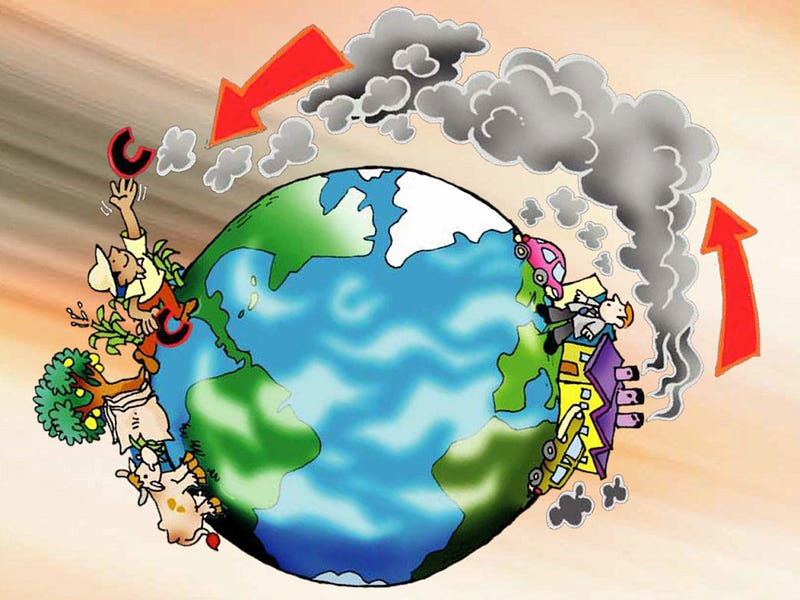


Illustration: Olman Bolaños/CEDECO
It was a bright afternoon in March of 2011 when I met Pedro (a pseudonym) on his organic farm in the mountains of Costa Rica, north of San José. I was there to do research on changing agricultural practices in the country. As we walked around his land, he showed me his greenhouses where lettuce, potatoes, and peppers grew. The warm air smelled earthy and sweet.

There was a slight breeze. The rolling landscape was vibrant and green. And there was carbon in the ground. Pedro knew it was there, and he was talking about it because of climate change.


Read the Sapiens story from Medium by Dàna J. Graef - “Carbon Farmers Work to Clean Up the World’s Mess.”

06 May, 2018

Murray-Darling’s future hangs in the balance

Just outside the north-eastern Victorian town of Benalla, along a turn-off from the Hume Highway, lies an historical aberration that even authorities struggle to explain.
Winton Wetlands, near Benalla, are a reclaimed water
storage that locals hope will become a tourist lure.
The Winton Wetlands, so visitor signage tells us, were formerly Lake Mokoan, a shallow dam built in 1970 and then given back to the environment four decades later.

It is one of few reversals in nature's favour in the entire Murray-Darling river system.


Read Peter Hannam’s story from The Age - “Murray-Darling’s future hangs in the balance.”

12 January, 2018

ANALYSIS: No market for Trump’s huge coastal oil exploration plan

Many energy analysts say flat prices, exorbitant costs, civic opposition, climate concerns and new transportation technology make major new offshore drilling enterprises unlikely, at least outside the Gulf of Mexico.
Image result for drilling rigs in gulf of mexico
Energy analysts say flat prices, exorbitant costs, civic opposition,
climate concerns and new transportation technology make major
new offshore drilling enterprises unlikely.
With characteristic flamboyance, the Trump administration has set in motion a grand scheme to lure energy companies to explore for oil and gas across virtually all of America’s outer continental shelf, a deep marine domain encompassing billions of acres of ocean bottom.
Drawing a distinction from the Obama administration’s concerns about climate change and restricting offshore fossil energy development, Interior Secretary Ryan Zinke cast President Donald Trump’s offshore drilling campaign as a study in American strength. “We’re embarking on a new path for energy dominance in America,” Zinke said. “We are going to become the strongest energy superpower.”


Read the Providence Journal story by Keith Schneider - “ANALYSIS: No market for Trump’s huge coastal oil exploration plan.”

19 November, 2017

What could Australian sustainable cities look like in 2040?

It’s 2040.

As you wake and look outside, things might not look hugely different to 2017 – there aren’t any hoverboards or sky highways – but Australian cities have managed to cut their greenhouse gas emissions by 80 percent.
Many of the technologies required to get
us to a greener future already exists.
 
And how your day unfolds will look very different depending on how we reached this point.

As you step outside some changes are obvious. Renewable energy is now everywhere. You pass bladeless wind turbines, and solar farms on city skyscapers. On your way, you walk through an urban farm and the concrete jungle is greener with roof and vertical gardens throughout the city. But you’ve had to make some concessions in terms of privacy and lifestyle.

So what’s changed? And how did we get here?

These are just some of the questions explored in the final report from the Visions and Pathways 2040 research project which looks at how we can rapidly reduce Australian cities’ emissions to avoid catastrophic climate change as we approach the end of what’s being called the ‘critical decade’.


Read the University of Melbourne Pursuit story - “What could Australian sustainable cities look like in 2040?