Showing posts with label because. Show all posts

28 December, 2019

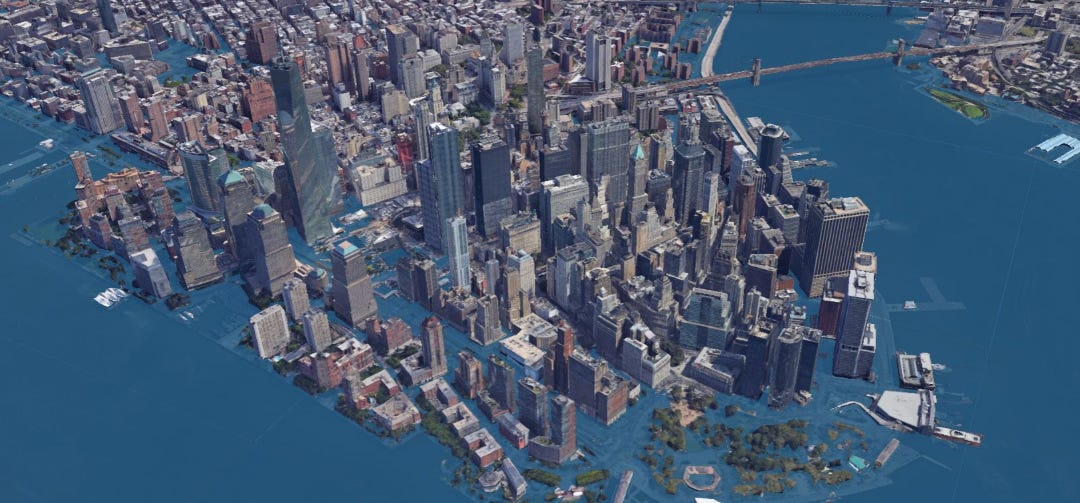
Sea Level Rise: It’s Probably Worse Than You Think

As you know, this newsletter is usually fairly inspiring. But this one is not (overall). And that’s because we really need to talk about sea level rise again.
NYC in 2100 under extreme sea level rise scenario. 
Sorry, but the stakes are insanely high and everyone needs to know about this stuff!
That being said, I do end with an action you can take to help if you so choose! …Or you can just tell your friends about this mind-bending sea level rise predicament. Talking about these things and finding new ways to help together is always good.

07 June, 2019

‘Food Doesn’t Grow Here Anymore. That’s Why I Would Send My Son North.’


NENTÓN, Guatemala — To understand why President Trump’s new sanctions and other flailing to end Central American immigration aren’t working, step into the dark, melancholy hovel of Ana Jorge Jorge.
Ana Jorge Jorge holding a nephew. She sees no future for
 her only surviving son in their Guatemalan village.
She lives in Guatemala’s western highlands in the hillside village of Canquintic, near the town of Nentón, and she’s a widow because of the American dream.

Her husband, Mateo Gómez Tadeo, borrowed thousands of dollars and migrated north to the United States several years ago after his crops here failed. He found work in Alabama cutting flowers but then caught an infection and died, leaving hungry childrenback home and a huge debt hanging over the family.

Read the opinion piece from The New York Times by Nicholas Kristoff - “‘Food Doesn’t Grow Here Anymore. That’s Why I Would Send My Son North.’

01 March, 2019

Climate Hackers - from Foreign Correspondent on ABC TV

For years scientists have been quietly working on extreme, last-ditch solutions to slow global warming - just in case governments worldwide don’t get their acts together.

Cue scientists.
Jason Box, Copenhagen-based ice climatologist and former IPCC lead author.
With the UN warning of climate catastrophe, it’s increasingly looking like a case of when, not if, we will reach for the once unthinkable fix: geo-engineering, or artificially hacking the climate.

We’re in deep shit and we need to dig ourselves out. For better or worse, geo-engineering is part of the mix going forward because we can’t get to where we need to be by conservation alone – Jason Box, Copenhagen-based ice climatologist and former IPCC lead author.

Some climate hacking has moved beyond the research labs. In Switzerland, a start-up builds giant fans that suck carbon from the air. It’s then sold to a greenhouse where it’s absorbed by plants to make them grow faster.

In the not too distant future, imagine sprinkling iron filings into the seas to encourage carbon eating plankton… Or sending armadas of ships to pump sea mist into the sky to diffuse the sun’s rays… Or using high-altitude balloons to scatter sulphur in the atmosphere to lower the temperature – a bit like what happened naturally after the Mt Pinatubo volcano erupted in 1991.

All these and more are on the drawing board.

If anything it’s too cheap, so cheap we’re talking single digit billions of dollars to potentially influence the entire planet’s climate – Harvard University’s Gernot Wagner on his sulphur blocking project.

Because it’s so cheap, it’s very likely to happen sooner or later. Some Indian billionaire or some Saudi billionaire is gonna do it all by himself – Bjorn Lomborg, political scientist.

Geo-engineering scientists know they may be playing God. 

There’s a huge amount of hubris in saying, ‘Let’s fix the problem and we know exactly what’s going to happen.’ Quite frankly, it makes me anxious – Frank Keutsch, Harvard engineering professor.

Apart from some potentially nasty side effects like damaging the ozone layer, there’s also a risk that climate hacking will give government and industry an excuse to run dead on cutting carbon. 

It’s not unlike America’s opioid problem, according to Frank Keutsch.

Like pain killers, this doesn’t fix the problem. We’re just reducing symptoms and then human nature can kick in and say, ‘Well you know, it’s hard to deal with changing the energy infrastructure’ - Keutsch.

The fossil fuel industry is looking to less exotic solutions. In Texas, reporter Eric Campbell tours a “clean coal” power station that’s held up as a model by the Australian Government. The idea is to capture much of the carbon before it’s expelled into the air.

But as Campbell discovers, the technology is not as clean as it seems. It’s also hugely expensive and still in its infancy…

…Which just makes it more likely that the climate hackers, perhaps sooner than you might think, will have their day in the sun.

Watch the Foreign Correspondent story on ABC TV - “Climate Hackers.

18 November, 2018

At the root of the problem: the best books about deforestation

Iceland’s Christmas advert about palm oil’s links with deforestation was banned last week, because it was said that the short Greenpeace-made animation was “political”. But how else to convey the devastation caused by the conversion of rainforest to plantations to provide cheap vegetable oil?
 An orangutan seen through a haze caused
by forest clearing in Borneo, Indonesia.
Veteran US entomologist EO Wilson, a world authority on biodiversity, offers the planetary view. Destroying rainforest for economic gain, he says, is like “burning a Renaissance painting to cook a meal”. In his 2002 book The Future of Life, he asserts that the loss of forest over the last 50 years has been one of the most profound environmental changes in the history of Earth: “The forests are the abattoirs of extinction, shattered into fragments that are then being severed, adulterated or erased one by one. The last frontiers of the world are effectively gone, an Armageddon is approaching.”


Read the story from The Guardian by John Vidal - “At the root of the problem: the best books about deforestation.”

18 April, 2018

How luxury brands suddenly made electric cars desirable

Many Bentley customers believe they have obtained their wealth because of luck. So says Bentley Motors Ltd.'s new chairman and chief executive officer, Adrian Hallmark, during an interview in Geneva.
Mercedes' sold-out electric Project 1.
"I have recognised that a lot of our customers follow a similar thing: They are super-successful. And a lot of them think it's because they're lucky," he says. "That's really important, because they don't think they're above human weakness and frailty.”

Such perceived (and believed) good fortune is spurring the world's millionaires and billionaires to make luxury purchases, based on a system of values such as reduced carbon footprints and sustainability, he adds.

Read Hannah Elliott’s story from The Age - “How luxury brands suddenly made electric cars desirable.”


(Again, we need to urgently get beyond the idea of the ownership of private transport if we are to ever navigate our way to a truly sustainable world. Private transport needs, no demands, an energy-rich infrastructure and is contrary to the gentleness needed to create a world able to thrive within a damaged atmosphere - our future is going to be about quieter, slower and more restrained living, quite the opposite of the image portrayed by the existing motor industry, particularly those manufacturers who consider themselves “luxury brands” - Robert McLean)

10 March, 2018

What grandparents can teach us about reducing food waste

Before the era of supermarkets, seasonal shopping and health buzzwords, our grandparents reduced food waste not because they wanted to, but because they had to.
Cutting waste: Rebecca Sullivan with grandmother Pauline.
With public awareness of food sustainability on the rise, their experience remains as relevant today as it was 70 years ago.

Evacuated during the Second World War from London to a farm in rural Wiltshire, Pauline Tee grew up not taking a single meal for granted.

Ms Tee said meat in particular was a privilege and every scrap would be used.


Read the ABC News story by Dominic Cansdale and Megan Whitfield - “What grandparents can teach us about reducing food waste.”