Showing posts with label beyond. Show all posts

21 September, 2019

The good, the bad and the ugly: the nations leading and failing on climate action

It is almost five years since the landmark Paris deal was struck. Nearly 200 countries agreed to work towards limiting global warming to 1.5℃, beyond which the planet is expected to slide irreversibly towards devastating climate change impacts. 
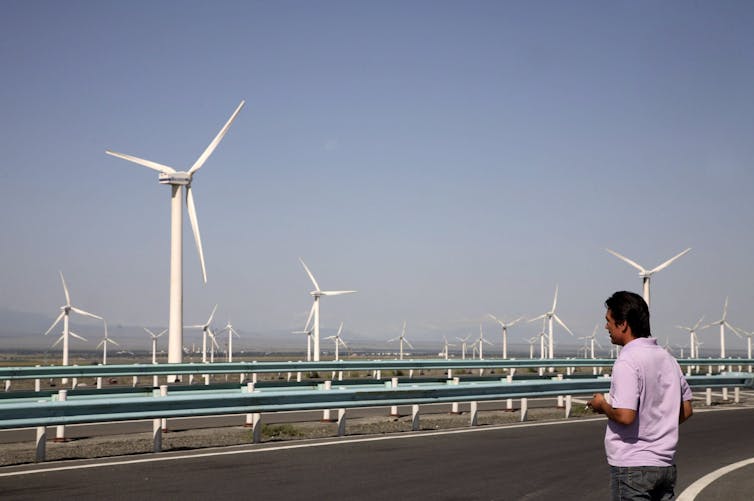
A man standing near a wind farm near Urumuqi, China.
But few nations are on track to reaching this goal. Right now, we’re heading to warming above 3℃ by 2100 - and this will have catastrophic consequences for the planet.

United Nations Secretary-General António Guterres has called a major climate summit in New York on September 23, where countries are expected to announce more ambitious climate targets than they set in Paris, and solid plans to achieve them.

Ahead of the summit, let’s take stock of the world’s best and worst performers when it comes to tackling the climate emergency.


Read the story from The Conversation by the Director of Climate Analytics, Adjunct Professor, Murdoch University (Perth), Visiting scientist, Potsdam Institute for Climate Impact Research, Bill Hare -  “The good, the bad and the ugly: the nations leading and failing on climate action.”

01 October, 2018

The global climate refugee crisis has already begun

When Hurricane Florence struck the shores of North and South Carolina and Virginia, more than a million evacuees fled their homes seeking shelter from the storm. For some, there will be no return home, as their homes are damaged beyond repair or beyond what they can afford to repair. All these displaced people are not simply evacuees fleeing a dangerous hurricane. They are climate refugees.
Climate refugees are already a reality.
There are a couple of reasons why climate change is creating a new category of refugee. First, climate change contributes to rising seas. As ocean water warms, it expands. That, along with simultaneous increased melting of the world’s mountain glaciers and the Greenland and Antarctic ice sheets, contributes to rising sea levels. Sea level rise is already one factor producing climate refugees around the world.


Read the story from The Hill - “The global climate refugee crisis has already begun.”

25 May, 2018

Climate change? There are emojis for that

Emojis have become a regular part of today’s online conversations. Those little pictures have evolved far beyond smiley faces. There are now hundreds of icons to liven up a message, from rainbows and hearts, to tiny koala bears and margaritas.

Emojis for climate change.
And now, you can download a new set of digital icons called “Climoji”. It includes cartoon depictions of the causes and effects of climate change, including power plants, wildfires, and melting glaciers.

Texting or tweeting one of these images might seem trivial. But Marina Zurkow, the artist and New York University professor who leads the Climoji project, says that it’s important to find new ways to communicate about climate change.


Read the story by Jane O’Brioen from Yale Climate Connections - “Climate change? There are emojis for that.”

17 May, 2018

A solution for the recycling crisis: turn plastic into energy

Australia's recycling crisis needs us to look into waste management options beyond just recycling and landfilling. Some of our waste, like paper or organic matter, can be composted. Some, like glass, metal and rigid plastics, can be recycled. But we have no immediate solution for non-recyclable plastic waste except landfill.
A worker separates plastic bottles at a recycling depot in Beijing.
At a meeting last month, federal and state environment ministers endorsed an ambitious target to make all Australian packaging recyclable, compostable or reusable by 2025. But the ministers also showed support for processes to turn our waste into energy, although they did not specifically discuss plastic waste as an energy source.


Read Muxina Konarova’s comment in The Age - “A solution for the recycling crisis: turn plastic into energy.”