Showing posts with label experts warn. Show all posts

15 January, 2020

‘Dystopian future': Climate change to force review of military's role

Climate change poses "a major security challenge for Australia" that experts warn has the potential to rapidly stretch the capability of the military, as demonstrated by the current bushfire emergency.
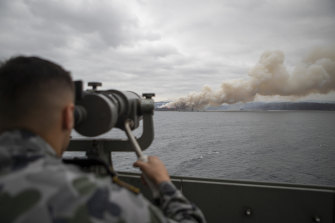
No longer over the horizon: climate change is already creating challenges for Australia's military, including the current bushfire season.
No longer over the horizon: climate change is already
creating challenges for Australia's military, including
the current bushfire season.
Michael Thomas, a retired army major, said "rising emissions will result in a more unstable and insecure world that will have far-reaching human, national and international security consequences", in an article published by the Australian Strategic Policy Institute on Tuesday.
"The bushfire crisis that’s unfolding across Australia provides some insight into what that dystopian world will look like," he said.
Major Thomas, who published a 2017 book on the security risks of climate change, said the fires that caused at least 27 deaths and burnt millions of hectares revealed the limits of Australia's forces to cope with traditional threats abroad and concurrent new ones at home.

Read the story from The Age by Peter Hannam - “‘Dystopian future': Climate change to force review of military's role.”

07 January, 2020

More hazard-reduction burns not the answer, experts warn

Prime Minister Scott Morrison wants to see more action on land clearing and hazard-reduction burns, but experts warn burns are ineffective against extreme fires such as the destructive blazes seen this summer.
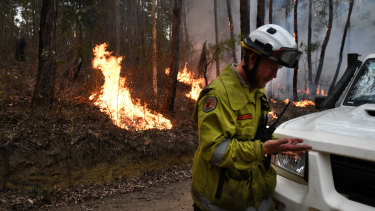
National Parks and Wildlife Service staff burning containment lines ahead of the fire front at Burrill Lake on Sunday.
National Parks and Wildlife Service staff burning containment
 lines ahead of the fire front at Burrill Lake on Sunday.
They also say Australia is carrying out more prescribed burning than in previous decades and to do much more would lead to heavy smoke affecting communities throughout winter.
Speaking at the weekend about the need to reduce fuel loads in forests, Mr Morrison said there was time before the next scheduled meeting of the Council of Australian Governments "to bring forward some immediate steps and for those to be considered by premiers before moving to broader-scale reviews".
"You've got to deal with hazard management in national parks ... this, of course, will be one of the things that we will consider when premiers come together after they've been dealing with the fires," he said.

Read the story from The Age by Mike Foley - “More hazard-reduction burns not the answer, experts warn.”

13 March, 2019

Fossil Fuels’ Dirty Secret: Climate Action or Not, Things Look Bad.

Ten years ago Blockbuster CEO Jim Keyes said he wasn’t worried about digital streaming. “I’ve been frankly confused by this fascination that everybody has with Netflix,” he said. Blockbuster’s head of digital strategy echoed this sentiment, asserting the company was “strategically better positioned than almost anybody out there.” Not long after, Blockbuster went the way of the butter churn, while Netflix became a household fixture. Today, the movie streaming service is worth almost as much as Disney.


To most people, that’s a funny story about the hubris of a technological dinosaur. Imagine, however, if Blockbuster had been a cornerstone of the U.S. economy, that millions of people had been employed in the manufacture and sales of Jurassic Park DVDs, that there were hundreds of cities dotting the South and Midwest where brick-and-mortar video rental was the only job in town. Then, the collapse of Blockbuster wouldn’t be so funny. It would be a catastrophe.

This, experts warn, could be the future of fossil fuels.


Read the NexusMedia story by Jeremy Deaton - “Fossil Fuels’ Dirty Secret: Climate Action or Not, Things Look Bad.

20 December, 2018

‘Greater warming': different species under threat

Entire ecosystems are under threat due to warming oceans with parts of the Australian coast stretching from Sydney to Adelaide experiencing the most stress, experts warn.
Fire weather conditions are worsening, particularly
 in the south and east of the country. 
CREDIT:
Eight of the 10 warmest years of sea surface temperatures have been recorded since 2010 contributing to coral bleaching, oceans acidifying and altering the habitats of different species, a joint study by the Bureau of Meteorology and CSIRO has found.

"The warming has been most noticeable, particularly around the south-east of the continent, and it's not just coral reefs that are impacted but kelp forests and commercial fisheries," the bureau's head of climate monitoring, Dr Karl Braganza, said.


Read the story from The Age by Ben Weir - “‘Greater warming': different species under threat.”