Showing posts with label plastic pollution. Show all posts

26 September, 2019

PM’s claim ocean plastics are 'more immediate threat' disputed by scientists.

Prime Minister Scott Morrison's claim that plastic pollution in the oceans is a more immediate threat than climate change has been trashed by Associate Professor Nerilie Abram, an Australian scientist who helmed the United Nations' report on rising sea levels.
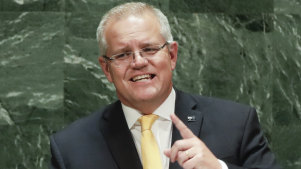
Prime Minister Scott Morrison delivers the Australian National Statement to the United Nations General Assembly in New York.
Australia's PM, Scott Morrison, attempts to distract
people with his discussion about plastics. 
In his statement to the United Nations early on Thursday (AEST), Mr Morrison promised more policies to clean up the ocean, deal with plastics recycling and crack down on illegal fishing.
"To protect our oceans, Australia is committed to leading urgent action to combat plastic pollution choking our oceans, tackle over-exploitation of our fisheries, prevent ocean habitat destruction and take action on climate change," he said.
Mr Morrison had already told reporters: "We need to take action on climate change, but there are actually issues like plastics in our oceans which present even more immediate threats".
Read the story from The Age by Benjamin Preiss - “PM’s claim ocean plastics are 'more immediate threat' disputed by scientists.”


(We would still be in desperate trouble because of the climate crisis even if our oceans were totally free of plastic: plastic is not the problem rather, it is clearly and unequivocally the human caused damage to Earth’s climate system. Scott Morrison is deflecting the conversation and as Australia’s Prime Minister he needs to do better - Robert McLean)

28 May, 2019

Facing our environmental crisis head on

In a recent article, Professor Rick Stafford and Dr Peter Jones, both working in marine conservation at Bournemouth University, questioned if the media, corporate and government attention on plastic pollution actually distracts attention from bigger environmental challenges.
We are changing our planet rapidly, substantially and irreversibly.
As a researcher working across multiple environmental problems, which include climate change and plastic pollution, it’s a question I often ask myself. Like a good doctor, I need to triage so I can prioritise urgent cases. I don’t have an answer, but Professor Stafford and Dr Jones made me think.

Report after report present increasing quantities and quality of evidence that we are changing our planet rapidly, substantially and irreversibly in order to meet human demands for resources – food, minerals, water, timber, fibre and fuel.

For decades, we have justified damage to the planet as the cost of economic development and human wellbeing, but we’ve now come to a point where we can no longer justify business-as-usual as it will disrupt our very civilisation.


Read the Pursuit story by Dr Ee Ling Ng from the University of Melbourne - “Facing our environmental crisis head on.”

03 March, 2018

Spotlight: 'Plastic is more dangerous in the oceans than on land’

Malcolm Doyle is as mad as hell about plastic pollution on our beaches and oceans and, what's more, he's prepared to do something about it. Last year, the 28-year-old spent his annual leave cleaning up 60 beaches from Adelaide to Port Douglas. He estimates two-thirds of the litter was plastic, especially flimsy takeaway bags, beverage bottles and coloured bottle tops that some sea birds mistake as food. "I never felt so positive from the community support and disheartened by the level of waste at the same time," he recalls.
Malcolm Doyle.
Recent headlines warning that our oceans will have more plastic than fish by 2050 may seem incredible, but in reality it may be worse, observes Doyle. The throwaway society has gone global, with plastic production predicted to double in the next 20 years, according to Science magazine. The Plastic Vortex, the swirling mass of garbage bobbing in the north Pacific Ocean, is already twice the size of Texas, according to Greenpeace. Now scientists, who have got better at detecting chemicals in our bodies, are finding that even tiny quantities of plastic toxins can have potentially serious impacts on human health.


Read The Sydney Morning Herald story by Greg Callaghan - “Spotlight: 'Plastic is more dangerous in the oceans than on land’.”