Showing posts with label protest. Show all posts

03 November, 2019

Morrison is being transparently political in targeting climate groups

Condemning a protest is easy. Passing a new law to limit free speech is another matter altogether.
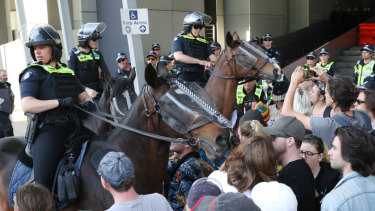
A blockade during a protest against the International Mining and Resources Conference in Melbourne.
A blockade during a protest against the International
Mining and Resources Conference in Melbourne.
Prime Minister Scott Morrison is being transparently political in targeting climate groups like Extinction Rebellion in the hope he can tap into a resentment against activists who disrupt everyday life.
But he is yet to prove he can act on his tough talk when his own side of politics is supposed to stand for individual liberty. Would his own party room approve a law that forbids someone organising a boycott?
Isn't it free speech to urge your fellow citizens to ban a product or boycott a store or transfer their savings to a bank that will not lend to a controversial coal mine?

Read the opinion piece in The Age by David Crowe - “Morrison is being transparently political in targeting climate groups.”

25 May, 2019

Schoolchildren go on strike across world over climate crisis

Hundreds of thousands of schoolchildren across the world have gone on strike in protest at the escalating climate crisis.
Teenage protesters in Warsaw, Poland, hold up placards
calling on politicians to address climate crisis. 
Students from 1,800 towns and cities in more than 110 countries stretching from India to Australia and the UK to South Africa, walked out of lessons on Friday, the organisers of the action said.

This is the latest school climate strike, inspired by teenager Greta Thunberg, who has become a global figurehead since protesting outside Sweden’s parliament in 2018. The young people are demanding politicians take urgent action to avoid catastrophic ecological breakdown.

In London, thousands gathered in the sunshine in Parliament Square chanting, “Where the fuck is the government”, and “This is what democracy looks like”, before staging a sit-down protest outside the department of education.


Read the story from The Guardian by Matthew Tayor - “Schoolchildren go on strike across world over climate crisis.”

29 March, 2019

Labour declares national ‘environment and climate emergency’

Labour has declared a “national environment and climate emergency” amid growing pressure on ministers to take drastic action to preserve the planet.

The move comes after dozens of councils made similar announcements and children across the country skipped school in protest over perceived government inaction on climate change.

Addressing the House of Commons, shadow environment secretary Sue Hayman asked if the Conservatives would join them in their call.


Read the story from the Independent by Josh Gabbatis - “Labour declares national ‘environment and climate emergency’.”

15 March, 2019

Quite suddenly, the politics of climate has changed

Despite the storm clouds there was a thumping turnout at the second climate strike in Sydney today, and the same riot of colour and shouting as last time. The message of the protest, which was the same as it was last time and will be the next, and the time after that, is this: “What do we want? Climate action. When do we want it? Now.” Some among us grown-ups hanging towards the back were feeling a little teary, as the truth of this protest is that we have utterly failed the next generation, and bequeathed them a diabolical mess to fix. Among those grown-ups was Tim Flannery, head of the Climate Council, with his young school-age son. Something has changed in the politics around climate, Flannery agrees, which carries hope even for a scientist who has been researching and writing on the subject for a quarter of a century.
"So to see people out getting angry and
demonstrating is bloody fantastic" - Tim Flannery.
“I’m just so happy to see them out there and doing it,” says Flannery. “The amount of despair that young people feel today with this crisis can be immobilising. So to see people out getting angry and demonstrating is bloody fantastic.”


Read the story from The Monthly Today by Paddy Manning - “Quite suddenly, the politics of climate has changed.”

21 February, 2019

‘Belongs in a museum': Greta Thunberg condemns politician against school strike

The Swedish teenager whose lone protest against climate change spurred a global youth movement has told an Australian state education minister his words “belong in a museum” after he warned students against attending an upcoming protest.
 Since Thunberg’s lone protest outside the Swedish parliament,
student-led climate marches have been held around the world.
The New South Wales education minister, Rob Stokes, appeared on Sky News earlier this week, warning students and teachers against attending rallies planned across Australia for Friday 15 March, as part of the school climate strike movement.

“These are on school days, school children on school days should be at school,” Stokes said during an interview with the Sky News host Chris Kenny.

“You simply can’t strike if you don’t have a job … the law is very clear, this is a notified school day, kids should be at school.”


Read the story from The Guardian by Josephine Tovey - “‘Belongs in a museum': Greta Thunberg condemns politician against school strike.”

20 February, 2019

School climate strikes: what next for the latest generation of activists?

School students across the UK (and the world) went on strike on February 15, leaving their lessons to protest the lack of effective action on climate change. Coordinated school strikes may be a novel tactic, but mass environmental activism isn’t. So will things be any more successful this time around?

The first big global wave of ecological concern began in the late 1960s and involved fears of overpopulation, air and water pollution and the extinction of species. It peaked with the 1972 Stockholm Conference on the Human Environment, which kicked off international environmental politics.

The next mass movement began in the late 1980s with concerns over the ozone hole, Amazonian deforestation and newly-voiced fears of climate change – then known as the “greenhouse effect”. That wave peaked with the 1992 Rio Earth Summit, which sought to tackle both global warming and biodiversity, and marked the beginning of coordinated climate action through the UN. 


Read the piece from The Conversation by a PhD Candidate from the Sustainable Consumption Institute at the University of Manchester, Marc Hudson - “School climate strikes: what next for the latest generation of activists?

01 December, 2018

‘Rioting is not one of the three Rs': Liberals say protesting students should give up ice creams

Liberal MPs have attacked the "rioting" students who took a day off school to protest the government's climate change policies, with one challenging them to swear off ice-cream to lower emissions.
Students hold placards during Friday's climate protest in Melbourne.CREDIT:
An estimated 15,000 students marched in cities and regional towns around the country on Friday - despite warnings they could face disciplinary action for not attending school.

Liberal senator James McGrath identified a spelling error in a placard held by one student at the protest, circling it in a photograph he posted on his Facebook page. The sign, which targeted Prime Minister Scott Morrison directly, misspelt "jealous" as “jelous".


(Those critical of the protesting students just don’t get it - Robert McLean)

30 November, 2018

Striking students defy PM to protest at inaction on climate change

Up to 5000 Sydney students have defied the Prime Minister's instruction to stay in the classroom by going on strike to protest against the federal government's climate change policies.
Thousands of students are protesting in Sydney's
 Martin Place against the government's inaction on
climate change.
CREDIT:
Organisers said 15,000 students took part in major nation-wide strike events held in every capital city and in 20 regional towns on Friday.

Students packed the Martin Place amphitheatre in Sydney's CBD, waving placards and chanting loudly.

"What do we want? Climate action. When do we want it? Now," they sang.


Read the story from The Sydney Morning Herald by Josh Dye - “Striking students defy PM to protest at inaction on climate change.”

15 April, 2018

Environmental advocate dies after setting himself on fire in New York

New York City: A prominent gay rights lawyer has died after setting himself on fire in a New York park to protest against pollution and the use of fossil fuels.
The lawyer David Buckel in New Jersey Supreme
Court during a 2006 case about same-sex marriage.
The body of David Buckel was found in Brooklyn's Prospect Park early Saturday. He left a note in a nearby shopping trolley that he also emailed to several news outlets including The New York Times.

"Pollution ravages our planet, oozing inhabitability via air, soil, water and weather," he wrote in the email sent to the Times.


14 November, 2015

12 October, 2015

Countries rush to 'ink' trading deals, oblivious they take us close to catastrophic climate change


N

ations around the world are rushing to “ink” trading arrangements claiming those deals are the balm needed for many of the world’s troubles.

Countries rush to sign-up trade deals
 looking for growth, seemingly
 oblivious that growth is  something we
need to stop if catastrophic climate
change is to be avoided.
Interestingly the intention of the arrangements, greater profits, are contrary to what is really needed in a world that should be stepping away from growth, rather than doing all it can to encourage it.

Climate change can be attributed to many things, but chief among them is our excessive use of fossil fuels and it has been the cheap energy from those fossil fuels that has allowed the exponential growth post the Industrial Revolution about 200 years ago.

Addicted to the benefits of growth, and unable to see or understand the implications for the world’s climate arising from unbridled growth, many countries, including Australia, rush to the table, pen in hand, to sign up to another deal in which they believe is embedded is a panacea for the world’s ills.

Many fear these so-called “free-trade” arrangements benefit a few and change little on the landscape of life for most and, worst of all, worsen the circumstances that are manifesting as climate change.

Today’s Melbourne Age, tells about unrest over such deals in the story - “Hundreds of thousands protest in Berlin against EU-US trade deal.”