Showing posts with label subsidies. Show all posts

09 July, 2019

G20 countries triple coal power subsidies despite climate crisis

G20 countries have almost tripled the subsidies they give to coal-fired power plants in recent years, despite the urgent need to cut the carbon emissions driving the climate crisis.
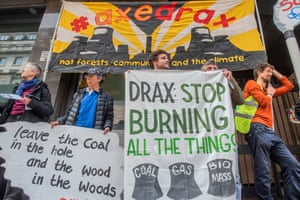
A protest against Drax, said to be the biggest carbon emitter and coal power station in the UK.
A protest against the Drax power station in North Yorkshire.
The bloc of major economies pledged a decade ago to phase out all fossil fuel subsidies.

The figures, published in a report by the Overseas Development Institute (ODI) and others, show that Japan is one of the biggest financial supporters of coal, despite the prime minister, Shinzo Abe, having said in September: “Climate change can be life-threatening to all generations … We must take more robust actions and reduce the use of fossil fuels.” The annual G20 meeting begins in Japan on Friday.


Read the story from The Guardian by Damian Carrington - “G20 countries triple coal power subsidies despite climate crisis."

07 October, 2017

It is fossil fuels, not renewable energy, most supported by US public policy

The coal industry and its allies in the Trump administration have recently devoted considerable energy to arguing that subsidies to renewable energy have distorted energy markets and helped drive coal out of business. “Certain regulations and subsidies,” says Rick Perry, “are having a large impact on the functioning of markets, and thereby challenging our power generation mix.” You can guess which regulations and subsidies he’s talking about.
This is nothing new, of course. It is in keeping with a long conservative tradition of challenging the economic wisdom and effectiveness of energy subsidies.
At least, uh, some energy subsidies.

Energy analysts have made the point again and again that fossil fuels, not renewable energy, most benefit from supportive public policy. Yet this fact, so inconvenient to the conservative worldview, never seems to sink in to the energy debate in a serious way. The supports offered to fossil fuels are so old and familiar, they fade into the background. It is support offered to challengers — typically temporary, fragmentary, and politically uncertain support — that is forever in the spotlight.


14 September, 2017

Tony Abbott calls for end to all energy subsidies, including on coal

Tony Abbott has used the second anniversary since losing the top job to declare he’s intent on looking forward, not backward – and has again weighed in to the government’s fraught energy debate to call for an end to all subsidies.

Former Australian prime minister Tony Abbott marked two
years since he was ousted from the top job by
calling for an end to energy subsidies.
The former prime minister told 2GB on Thursday he welcomed signs from Malcolm Turnbull that the government was moving away from the clean energy target recommended by the chief scientist to what he is characterising as a “100% reliable energy target.”

“I welcome these signs that we are moving away from a clean energy target to a reliable energy target, and, frankly, nothing less than a 100% reliable energy target will do because we’ve got to keep the lights on all the time ... if we are to be a first-world country,” Abbott said.

Read Katharine Murphy’s story on The Guardian - “Tony Abbott calls for end to all energy subsidies, including on coal.”

(This position taken by Tony Abbott is sheer political trickery, it’s dog whistling to his fossil fuel friends and ignores the fact that the damage done to the Earth’s atmosphere because of carbon dioxide emissions makes every other argument presented by Mr Abbott and his compatriots redundant. Climate change and its array of complexities fall well beyond any traditional market -driven answers or solutions and the way ahead demands a clean break with what was and whole new way of thinking; thinking that is not driven by economic concerns, but the broader, deeper and more important welfare of people - Robert McLean)

10 September, 2017

Nationals party votes to remove all subsidies for renewable energy

The Nationals have voted to remove all subsidies for renewable energy providers over a five-year period and to freeze them at their current level for the next year.

Barnaby Joyce: "We have no problem in coal fire power."
The vote at the party's federal conference in Canberra on Saturday marks the start of a new campaign among party members against renewables, as energy policy gets set to dominate Parliament again when it resumes this week.

Renewable energy sources such as wind and solar are set to receive subsidies of up to $2.8 billion a year up to 2030, according to research by economic consultancy BAEeconomics commissioned by the Minerals Council of Australia.

The Australian Energy Market Operator is forecasting a crippling 1000 megawatt energy shortfall in 2022, as Australia's coal power plants begin to shut down, potentially leading to power shortages and rising prices for consumers.


Read Eryk Bagshaw’s story in today’s Melbourne Age - “Nationals party votes to remove all subsidies for renewable energy.”

(Madness is afoot in the National Party. Personal experience illustrates that the renewable energy industry is already alive with new jobs; jobs that will replace most of those that disappear as the fossil fuel industry dissolves because of scientific evidence and good sense - Robert McLean)

14 May, 2014

'This way?' 'That way?' Budget takes Australia the wrong way


Dr Liz Hanna.
A healthy and prosperous future for Australia is “this way”, but driven by last night’s Federal Budget, the Tony Abbott lead coalition is headed “that way”.

Concerns about the coalition’s disruptive decisions that will ultimately disable Australia have been voiced by the Melbourne-based Climate and Health Alliance (CAHA).

In a story on Medianet headed: “Federal budget an investment in climate and health damages” the alliance has expressed alarm at the removal of important policies with health, social and environmental benefits.

However, although the budget has disabled those for health, social and environmental benefits, it has maintained subsidies for polluting industries and even expanded some.

CAHA President Dr Liz Hanna said: “The budget would be better served if the federal government reversed its decision to scrap policies such as a price on carbon pollution, or by taxing the profits of mining companies.