Showing posts with label Canberra. Show all posts

09 February, 2020

Australia’s burn-me cities: urban sprawl and our new climate of fire

“In Australia, rain hasn’t fallen on the eastern half of the country for a decade. Most of the land is now desert. Canberra, long since abandoned, is home only to the occasional band of kangaroos, which some people argue is no change at all … Along what remains of the eastern seaboard, moth-eaten as it is by the rising oceans, only the very wealthy remain, mostly elderly, living under enormous synthetic bubbles ... Petrol is now $20 a litre. Water half that or more, [and] comes by tanker and by trans-continental aqueduct. Air, on most days still too toxic to breathe, is filtered through special solar-power pores in the bubble’s skin.”
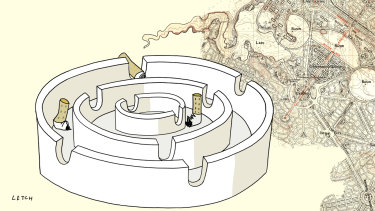
Illustration: Simon Letch
I wrote that in 2006, for my book Blubberland: The Dangers of Happiness. Then, it seemed a distant warning. Now it’s freakily plausible. As we cough our way through the Black Summer of 2020, watching endless footage of houses and fire-trucks aflame, of engine blocks melted and firestorms rampaging through the heavens, as we wonder whether this is summer redefined, we should also rethink how we make our cities.

Read the story from The Age by Elizabeth Farrelly - “Australia’s burn-me cities: urban sprawl and our new climate of fire.”

01 February, 2020

‘Worst day' of Canberra's Namadgi bushfire arrives, sparking memories of 2003 firestorm

The Orroral Valley bushfire in the Namadgi National Park has now burned one-eighth of the ACT, but the fire front has been kept away from Canberra
Smokes rises from a valley full of flames.
The blaze seen this morning from Williamsdale,
one of several villages that may be hit today.
The out-of-control fire was downgraded to watch and act level overnight but is expected to intensify and spread rapidly today.
ACT Chief Minister Andrew Barr said this week the blaze posed the greatest risk to Canberra since the deadly 2003 bushfires.
Today is expected to be the "worst day".
"The combination of extreme heat, wind and a dry landscape will place suburbs in Canberra's south at risk," Mr Barr said yesterday.


26 January, 2020

Sustainability advocate Madeline Diamond takes climate change message to Australian of the Year awards

When Madeline Diamond took to the stage for the Australian of the Year awards in Canberra last night she wanted to empower young people to "step up and make their voices heard". 
Madeline Diamond stands between a man and woman with Climate Justice written on her upper chest above her blue top
Madeline Diamond makes a statement at
 the 2020 Australian of the Year awards.
The ACT Young Australian of the Year attended the televised awards ceremony at the National Arboretum with the words "climate justice" written across her chest. 
"I just wanted to send a message to young people that we don't always have to follow the rules when we're trying to get work done to secure our future," she said. 
"Climate change is a really urgent issue so to always do what you're told and play by the rules, it's not going to get us anywhere. We do have to step outside of the boundaries sometimes."


01 January, 2020

Monash air quality station records index almost 20 times above hazardous level

The new year has brought thick smoke haze to Canberra and some of the highest levels of air pollution ever seen in the nation's capital. The air quality in Tuggeranong on Wednesday morning was almost 20 times above hazardous levels. 

The War Memorial barely visible from a thick smoke haze that has impacted Canberra. Picture: Megan Dingwall
The War Memorial barely visible from a thick
smoke haze that has impacted Canberra.
The thick smoke haze descended on Canberra on Tuesday night from fires burning at the South Coast. Authorities said the haze was likely to remain well into Wednesday.

Acting chief health officer Dr Paul Dugdale said all Canberrans were advised to avoid physical activity outside during periods of heavy smoke.
"We are strongly advising people who are sensitive to smoke, especially those with pre-existing heart and lung conditions, to take extra care during these conditions," he said.

Read the story from The Canberra Times by Lucy Bladen - “Monash air quality station records index almost 20 times above hazardous level.”

02 October, 2019

Australia’s capital city switches to 100% renewable energy

The Australian capital, Canberra, will become the first city outside Europe to shift from fossil fuel to 100% renewable energy.


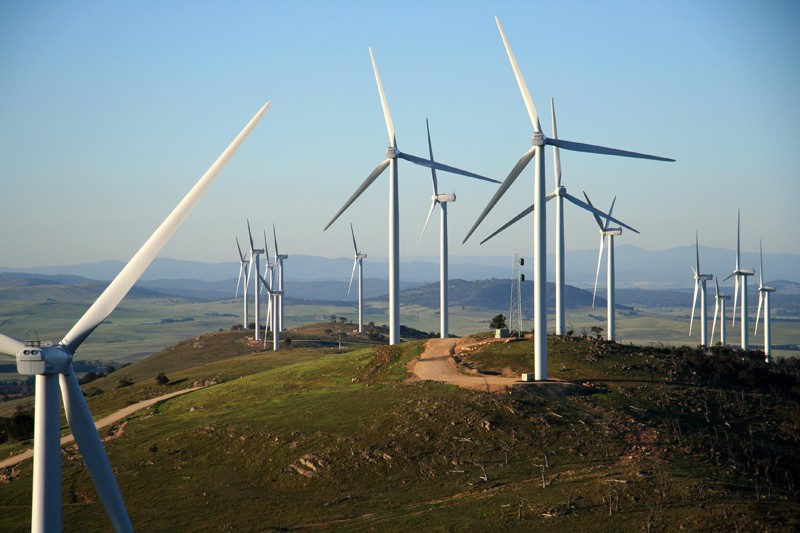
Capital wind farm New South Wales, Australia.
Wind farms provide some of Canberra’s renewable energy.
From 1 January 2020, Canberra will join seven other districts around the world that produces or purchase the equivalent of their total electricity consumption from renewable sources, according to a report released on 18 September by policy think tank the Australia Institute in Canberra. 
The report analysed data on more than 500 regions around the world with populations greater than 100,000 people.
The district of Rhein-Hunsrück in Germany became the first area to go 100% renewable, in 2012; two German states, three states in Austria and one region in Spain followed.
The analysis used information from the CDP, a non-governmental organization in London that gathers mostly self-reported environmental-performance data from local governments and companies.
Read the Nature story by Bianca Nogrady - “Australia’s capital city switches to 100% renewable energy.”

22 June, 2019

Australia’s energy future: the real power is not where you’d think

In Canberra, a month on from Scott Morrison’s election victory, there is talk of feasibility studies for a new Queensland coal plant, and a nascent nuclear debate. But if we shift our vantage point to Adelaide, Australia’s near-term energy outlook looks very different.
Solar farm in Queensland.
Australia’s states can dictate an energy
framework even if the commonwealth resists.
Dan Van Holst Pellekaan, the Liberal energy minister, is talking about South Australia hitting 100% net renewables by the 2030s. When asked to explain what that means, he tells Guardian Australia “producing more renewable energy in South Australia than we need for our own consumption and exporting the surplus”.
There is no talk of coal, apart from the inevitability of its displacement.
The South Australian renewables export plan relies on a new interconnector with New South Wales. Van Holst Pellekaan says if the proposed interconnector is approved, there are opportunities to construct large-scale solar and wind farms in the north-east of the state, on pastoral land, adjacent to the transmission equipment.

Read the story from The Guardian by Katharine Murphy - “Australia’s energy future: the real power is not where you’d think.”

08 June, 2019

“Our house is burning”

Greta Thunberg won’t be hitting Canberra any time soon. Beijing and Washington too are off limits. The sixteen-year-old environmental prophet, whose weekly sit-downs outside Sweden’s parliament since last August have inspired a transnational “school strike for climate,” shuns air travel. That, and becoming vegan are modest steps in the change she is sure the world must make to avert ecological breakdown. Her family has taken her lead, at some cost to the career of her mother, an opera singer who — somehow, inevitably — once represented Sweden in the Eurovision song contest.
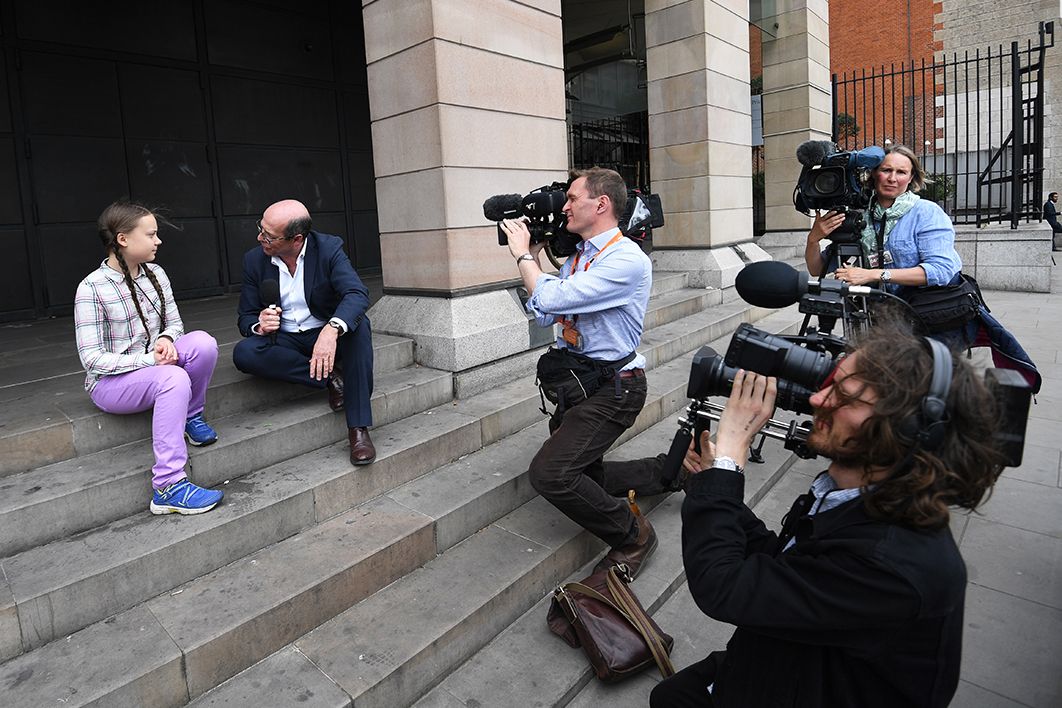
Swedish climate activist Greta Thunberg speaks to
BBC television journalist, Nick Robinson outside
the Houses of Parliament in London on 23 April 2019. 
Yet judging by her March–April procession through Berlin, Strasbourg, Rome and London — all journeys made by rail — Thunberg also needs to go (or at least talk) to those capitals and their hinterlands if her message that “our house is burning” is to take effective hold. This is but one paradox in a meteoric rise that seems already to hold both room for lasting good and risk of early burn-out.

Read the Inside Story by David Hayes - “Our house is burning”.”

02 November, 2018

2018 among hottest and driest years so far in parts of Australia

As a bushfire burned out of control south-west of Canberra and temperatures in Sydney climbed towards the high 30s, new data showed 2018 had so far been among the hottest and driest years on record for parts of Australia.
 A water bombing airplane drops fire retardant at
the Pierces Creek bushfire near Canberra on Friday. 
The months from January to October were some of the driest on record for New South Wales, Victoria and the Murray Darling basin regions, despite the recent rainfall.

The monthly drought statement from the Bureau of Meteorology (Bom) also says Australia’s maximum temperatures so far this year have been the second warmest on record – 1.41C above average.

New South Wales had its hottest January to October period on record at 2.2C above average, and Victoria equalled its 2014 record of 1.48C above average.


Read the from The Guardian by Lisa Cox - “2018 among hottest and driest years so far in parts of Australia.”

30 June, 2018

‘We've turned a corner': farmers shift on climate change and want a say on energy

Out in the bush, far from the ritualised political jousting in Canberra, attitudes are changing. Regional Australia has turned the corner when it comes to acknowledging the reality of climate change, says the woman now charged with safeguarding the interests of farmers in Canberra.
 Fiona Simson on climate change: ‘Farmers have
 come quite a long way in their attitude.’
Fiona Simson, a mixed farmer and grazier from the Liverpool plains in northern New South Wales, and the president of the National Farmers’ Federation, says people on the land can’t and won’t ignore what is right before their eyes. “We have been experiencing some wild climate variability,” Simson tells Guardian Australia’s politics podcast. “It’s in people’s face”.


Read Katharine Murphy’s story from The Guardian - “‘We've turned a corner': farmers shift on climate change and want a say on energy.”

25 February, 2018

Canberra hit by heavy rain, flash flooding inundates homes.

A deluge has brought parts of Canberra to a standstill and left some residents counting the cost as their homes flooded.

Cars under water at an apartment complex's car park in O'Connor

After a night of high winds and rain, Canberrans woke up on Sunday to more wet weather, which caused flash flooding through the morning.

Sixty millimetres of rain were recorded in the space of an hour at Sullivan's creek, just off Lake Burley Griffin, according to the Bureau of Meteorology (BOM).

Just before 1:30pm, BOM cancelled the severe thunderstorm warning in place for the ACT, but warned Port Macquarie, Taree, Orange, Bathurst, Walgett and Dubbo could experience flash floods.


Read the ABC News story by Jon Healy - “Canberra hit by heavy rain, flash flooding inundates homes.”

15 October, 2017

Failure to act now on energy policy will only trigger Groundhog Day

Katharine Murphy.
While politics never sleeps, and the verbiage from Canberra never stops, there has been a strange sense of suspended animation about the last couple of weeks, apart from a mild frenzy on Friday, as rumours circulated of early elections, cancelled parliamentary sittings, and general plague and pestilence.

The reason for Friday’s startle reflex is, of course, the return of the federal parliament for the blockbuster spring session next week.

The reasons for the period of suspended animation before the startle reflex are also obvious.
All the controversial issues the government has been spinning its wheels on for months, or warily circling, will hit between now and Christmas.


Read Katharine Murphy’s story on The Guardian - “Failure to act now on energy policy will only trigger Groundhog Day.”

06 October, 2017

Finding hope amid the hopeless doom of climate change

After another frigid Canberra winter, I've welcomed the warmer weather with joy. Yet it's increasingly too warm to leave a lasting smile. We are told to brace for punishing summers.

In a new book, Blueprints for a Post-Anthropocene Greenhouse Earth, the Australian National University's Dr Andrew Glikson says there's no turning back the greenhouse clock. He foresees mass extinctions and a breakdown of civilisation. In his book, Defiant Earth, Clive Hamilton of the Canberra-based Centre for Applied Philosophy and Public Ethics foresees something even worse: the possibility of our own extinction by an untameable Earth.

Hamilton writes it will probably be hundreds of thousands of years before most of the large reserves of carbon released during the human age can be rendered immobile again. People have rivalled the great forces of nature so much that we have changed the functions of the planet for an era. The Arctic is vanishing as is the Greenland ice sheet. This won't be reversed for tens of thousand of years.

While drifting into unparalleled catastrophe, I want to cling to hope, be slow to admit that all the facts are in, that all the doors have been tried and all is defeated. But how?


Read the comment by Toni Hassan in today’s Melbourne Age - “Finding hope amid the hopeless doom of climate change.”

24 September, 2017

Hume Highway cut by bushfire, temperature records tumble as east coast swelters

The main highway between Sydney and Canberra was cut by a bushfire and parts of New South Wales reached 40 degrees Celsius in September for the first time on record.

The grassfire at Paddys River near Wingello
 is causing lengthy traffic delays
The New South Wales Rural Fire Service (RFS) said the blaze at Paddy's River, near Wingello, crossed the highway but the threat to property had eased. It was downgraded to Advice level at 6:00pm.

After several hours of closure about 160 kilometres west of Sydney and east of Canberra, the Hume Highway has reopened.

Meanwhile, temperature records are being broken as the east coast swelters through a heatwave.
In Sydney's west, it was 36.4C at Richmond, and records were set in other parts of the state.

10 September, 2017

Nationals party votes to remove all subsidies for renewable energy

The Nationals have voted to remove all subsidies for renewable energy providers over a five-year period and to freeze them at their current level for the next year.

Barnaby Joyce: "We have no problem in coal fire power."
The vote at the party's federal conference in Canberra on Saturday marks the start of a new campaign among party members against renewables, as energy policy gets set to dominate Parliament again when it resumes this week.

Renewable energy sources such as wind and solar are set to receive subsidies of up to $2.8 billion a year up to 2030, according to research by economic consultancy BAEeconomics commissioned by the Minerals Council of Australia.

The Australian Energy Market Operator is forecasting a crippling 1000 megawatt energy shortfall in 2022, as Australia's coal power plants begin to shut down, potentially leading to power shortages and rising prices for consumers.


Read Eryk Bagshaw’s story in today’s Melbourne Age - “Nationals party votes to remove all subsidies for renewable energy.”

(Madness is afoot in the National Party. Personal experience illustrates that the renewable energy industry is already alive with new jobs; jobs that will replace most of those that disappear as the fossil fuel industry dissolves because of scientific evidence and good sense - Robert McLean)

18 August, 2017

Hundreds of flights cancelled as wild weather hits east coast

Wild winds battering Australia's east coast have left travellers stranded with dozens of flights from Melbourne to Sydney and Canberra cancelled.

Pedestrians in Sydney struggle in the windy conditions. 
And Victorians won't be spared Mother Nature's wrath with snow, thunderstorms and rain heading for the state.

Hundreds of flights have been cancelled at Sydney Airport from Adelaide, Melbourne, Brisbane and Canberra with the city's train services also in chaos as gusts of than 100km/h wreak havoc on the city's harbour. 

Qantas, Jetstar and Virgin have all had to cancel or delay flights to Sydney and Canberra due to strong winds.


Read Melissa Cunningham’s story in the Melbourne Age - “Hundreds of flights cancelled as wild weather hits east coast.”

09 August, 2017

Malcolm Turnbull has little chance of keeping energy bills under control


It's never my policy to feel sorry for any politician, so let's just say I wouldn't like to be in Malcolm Turnbull's shoes when he meets the electricity retailers he's summoned to Canberra on Wednesday.

His hope is to persuade them to do more to help their customers find the best prices on offer, so that any savings customers make reduce, to some extent, the further big price rises that are on the way.
Illustration: Andrew Dyson 
Trouble is, it's long been the practice of many big businesses – telcos, internet service providers, electricity retailers – to make it as hard as possible for their household customers to find the "plan" that meets their needs most economically, and also to take advantage of any trusting customer on a more expensive plan than they need.

So, whatever noises they make after their meeting with the Prime Minister, I can't see the likes of Energy Australia, Origin Energy and AGL – which between them have about 70 per cent of the retail market – volunteering to help their customers pay less.


Read the comment piece by Ross Gittins in today’s Melbourne Age - “Malcolm Turnbull has little chance of keeping energy bills under control.”

13 June, 2017

New coal tech would gain approval under clean energy target: Finkel

Labor has increased the pressure on Prime Minister Malcolm Turnbull to shut down pro-coal MPs in his party room ahead of a crucial meeting in Canberra on Tuesday in which the Finkel Review will be canvassed at length.
Dr Alan Finkel on the ABC's Q&A program last night.
While Tony Abbott has warned against anything that would become a carbon tax equivalent by shifting costs to consumers, observers within the government and opposition are hopeful of ending the climate policy war that has led to political crises and a lost decade of investment in electricity generation.

Arguments over the science of global warming and the policy settings needed to address it have resulted in an abundance of arguments, and a dearth of investment certainty.

Coalition MPs will hold their first discussion of the Chief Scientist's keenly anticipated recommendations when Parliament returns for the final fortnight before the long winter break.


Read Mark Kenny’s story in today’s Melbourne Age - “New coal tech would gain approval under clean energy target: Finkel.”

28 May, 2017

Federal Labor feels the heat over Adani, and Coalition is sweating too

When it comes to the Adani Carmichael coalmine, the spotlight this week has been trained on Queensland as the state government battled an internal split on whether to give the project a royalties holiday. There have also been murmurings in Canberra, where Labor MPs are starting to express public opposition to a project many have been privately wringing their hands about.

 ‘One Labor figure puts the problem for his party this way:
It is talismanic; It’s the litmus test.’ 
But to fathom the next phase in the political battle against the project, we need to train our eyes a bit further south.

Over this past week in Victoria, the Greens have launched a new fundraising drive to produce placards which will begin appearing shortly around the electorates of Melbourne, Batman, Wills and Melbourne Ports.


Read Katherine Murphy’s story on The Guardian - “Federal Labor feels the heat over Adani, and Coalition is sweating too.”

23 March, 2017

Former Greens leader Bob Brown to launch alliance to oppose Adani coalmine

The former Greens leader Bob Brown will launch a new alliance of 13 environmental groups opposed to Adani’s Carmichael coalmine on Wednesday in Canberra.
The former Australian Greens leader Bob Brown
says the Adani coalmine will be the most
dangerous in Australia’s history and increase
carbon pollution when it needs to be cut. 

The Stop Adani Alliance will lobby against the coalmine in northern Queensland, citing new polling that shows three-quarters of Australians oppose subsidies for the mine when told the government plans to loan its owners $1bn.

The alliance’s declaration argues the mine will “fuel catastrophic climate change” because burning 2.3bn tonnes of coal from the mine over 60 years of operation would create 4.6bn tonnes of carbon dioxide. It states the project would “trash Indigenous rights”, citing the fact Adani does not have the consent of the Wangan and Jagalingou people.


05 February, 2017

Turnbull's new climate and energy adviser worked for coal industry lobby group

Sid Marris - it seems the PM has put the
 fox in charge of the henhouse.
Malcolm Turnbull’s next climate and energy adviser will be Sid Marris, who is leaving his role as head of climate and environment at the coal industry lobby group, the Minerals Council of Australia.

The appointment comes amid a push from the Turnbull government for new coal-fired generators to be built, a suggestion enthusiastically welcomed by the Minerals Council.

Marris has worked for the Minerals Council since 2008, after spending 16 years at the Australian newspaper, filling roles including Canberra bureau chief, online political editor and economic correspondent.

The chief executive of the Minerals Council, Brendan Pearson, said: “Sid is a high-quality professional with very strong analytical and policy skills. We will miss him and wish him well.”

But the pressure group 350.org said the move raised further questions about government links to the coal industry.

Read Michael Slezak’s story on The Guardian - “Turnbull's new climate and energy adviser worked for coal industry lobby group.”