Showing posts with label politics. Show all posts

11 December, 2019

Scott Morrison and the Coalition are fiddling as Australia burns

Let’s start by acknowledging a few things. December, for prime ministers juggling agendas and commitments on multiple fronts, can be trying. Parliament is over for the year and people want things to be quiet, but politics in the run down to Christmas is about as orderly and elegant as a bus hurtling in the direction of a hairpin bend.
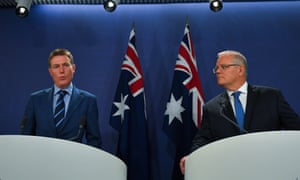
The attorney general, Christian Porter, and the prime minister, Scott Morrison, release a second version of the proposed religious freedom laws amid the bushfire crisis
The attorney general, Christian Porter, and the
prime minister, Scott Morrison, release a second
 version of the proposed religious freedom laws
 amid the bushfire crisis.
So this is my way of saying Scott Morrison is a busy bloke with a lot on his mind. He’s got a minister under police investigation. He’s got the midyear economic forecast next week. On Monday, cabinet was wrestling with big issues, like the location of defence work and the price regulations governing airports – and that was before a volcano eruption in New Zealand loomed shockingly into view.

The prime minister also managed to avert what would have been a full-on brawl in his party room last week by kicking the release of the latest iteration of the government’s religious discrimination bill into this week. The price for deferring an unseemly fight at an inconvenient juncture was coughing up the new version of that proposal, pronto – hence Tuesday’s hey presto press conference.

While the country was burning.


Read the story from The Guardian by Katharine Murphy - “Scott Morrison and the Coalition are fiddling as Australia burns.”

14 April, 2019

Adani coalmine: can Labor get away with choosing ambiguity over integrity?

When it comes to the controversial Adani coalmine, and the politics surrounding it, politics that will thunder throughout the election contest, it’s useful to start with first principles.
‘There’s no straight answer on whether Labor would
 review the Adani mine groundwater decision if Bill
Shorten wins the election.’ 
The first thing to understand is that this issue isn’t binary. Queensland doesn’t love Adani and loves coal, unlike the rest of Australia, which doesn’t love coal and loves renewables. It’s often presented that way when the issue is viewed through the political lens, but that’s not reality.

The reality is that views about the project are mixed, both inside Queensland and outside the state. MPs in central Queensland say their constituents want the jobs associated with the project. MPs in metropolitan Brisbane say their constituents, at least the people who worry about climate change, have similar views to people in Sydney or Melbourne, meaning negative views, because this project has become a proxy for inaction on climate change.


Read the story from The Guardian by Katharine Murphy - “Adani coalmine: can Labor get away with choosing ambiguity over integrity?”

02 May, 2018

It will take decades, but the Murray Darling Basin Plan is delivering environmental improvements

Amid the politics, it’s sometimes easy to forget that the Murray-Darling Basin Plan was originally designed primarily to restore the rivers’ environment. While questions have been raised over the plan’s governance, economics, and political commitment by the states, it is important to note that, more than five years after the plan’s adoption, the environmental benefits are slowly but surely being seen.
The Murrumbidgee River is one of several sites in
 the Murray-Darling Basin where improvements
are being detected.
The Long-Term Intervention Monitoring Project began in 2014 to monitor and evaluate environmental outcomes from Commonwealth environmental water – the water being delivered into the Murray-Darling Basin by the plan.

We are leading independent teams of researchers and consultants in monitoring seven selected areas across the Murray-Darling Basin, and then scaling up those results to deduce the health of the basin as a whole.


31 March, 2018

Sorry, Matt Canavan, no one believes coal magic means everyone wins

Matt Canavan has an economics degree, graduating from the University of Queensland with first class honours. The Nationals senator and federal minister for resources worked at the Productivity Commission before he entered politics, first as a staffer for his colleague and friend Barnaby Joyce, before being elected to the Senate himself.
 Matt Canavan at the National Press Club on Wednesday. 
The economic pointy head backstory makes Canavan an unconventional National, a fact that doesn’t go unnoticed among his party room colleagues. It also makes some of his public commentary this week just that bit harder to get your head around.

In a busy week, where the government prosecuted but lost an attempt to steer its big business tax cut through the Senate, where Tony Abbott was so desperate for a “look at me” moment he launched Pauline Hanson’s new book, where the nation roiled inconsolably about the behaviour of our cricketers – Canavan fronted the National Press Club to try and generate a couple of headlines of his own.


Read Katherine Murphy’s story from The Guardian - “Sorry, Matt Canavan, no one believes coal magic means everyone wins.”

15 March, 2018

The Koch Brothers Get Their Very Own Secretary of State

In the Republican wave election of 2010, when Charles and David Koch emerged as defining figures in American politics, the greatest beneficiary of Koch Industries largesse was a political newcomer named Mike Pompeo. After his election to the House eight years ago, Pompeo was referred to as the “Koch Brothers’ Congressman” and “the congressman from Koch.”
Mike Pompeo testifies before the Senate Intelligence Committee on February 13.
Now Pompeo is positioned to become a Koch brothers–influenced secretary of state.

After serving for a little more than a year as Donald Trump’s top yes-man at the Central Intelligence Agency, Pompeo is Trump’s pick to replace Rex Tillerson, the administration’s listless placeholder at the Department of State.

In a measure of the extent to which Trump and Tillerson had disengaged from one another, the outgoing secretary of state apparently learned of his firing via Twitter Tuesday morning—when an aide showed the nation’s top diplomat a tweet from the president announcing the transition. A statement from the department indicated that Tillerson was “unaware of the reason” for his removal.


Read The Nation story by John Nichols - “The Koch Brothers Get Their Very Own Secretary of State.”

17 January, 2018

Climate action in 2018: expect same, but different

As I predicted a year ago, 2017 was another vicious and bloody-minded year in Australian climate politics. Yet the political bickering belied the fact that it was actually a great year for green energy.
Illustration by Andrew Dyson.
Nowhere was that more in evidence than in South Australia, which got its big battery inside a 100-day deadline, with the world’s biggest solar thermal plant set to begin construction this year. Elsewhere, Prime Minister Malcolm Turnbull talked up the prospects of the Snowy 2.0 hydro storage project.

Yet the politics remain as rancorous as ever. The federal government unveiled its National Energy Guarantee (NEG) in November, after Chief Scientist Alan Finkel’s Clean Energy Target proved too rich for some in the Coalition. Just before Christmas, the long-awaited climate policy review was released, and was immediately branded as weak.

Both issues are unresolved, and are set to loom large on the landscape this year. But what else is on the horizon?


Read Marc Hudson’s comment in today’s Melbourne Age - “Climate action in 2018: expect same, but different.”

01 January, 2018

‘We didn't know exactly what we needed to do': The climate change battle in 1994

The Keating government wrestled with the politics and policies of climate change, not least in terms of how Australia might retain its leverage in international forums where its reputation was slipping through 1994.
A Queensland farmer and his dog stand alongside a dried up dam in November 1994.  
It also dawned on Cabinet that the cost for Australia to meet climate change commitments was far higher than those faced by European and North American nations.

Cabinet was advised in September that the commitments in the 1992 United Nations Framework Convention on Climate Change were already proving insufficient to stabilise atmospheric greenhouse gas concentrations "at a level that would prevent dangerous human interference with the climate system".

Further, international pressure was mounting to strengthen those commitments. Yet even within the formula negotiated to recognise its status as an "emissions-intensive" economy, Australia was "only likely to achieve 46 to 53 percent" of its target by 2000.

Read Damien Murphy’s story in today’s Melbourne Age - “‘We didn't know exactly what we needed to do': The climate change battle in 1994.”

31 October, 2017

How Climate Change Fueled The Far-Right’s Rise And Why We Need To Stop Both

The notion of changing climates influencing politics in nations that have barely felt the effects of it and have the advanced technology and basic infrastructure to weather its worst effects may seem absurd at first glance. In every discussion of rising global temperatures, we’re talking about diseases and food shortages in the developing world, or political unrest in fragile and failing states while wealthy nations adapt and overcome, and isn’t that what has been happening? Yes, it has. All those assumptions are right. But because those assumptions are correct, the West is being indirectly, but very deeply affected by the effects of all this turmoil, and things are bound to get worse unless we do something serious about climate change.
Newly arrived Somali refugees wait outside a UNHCR
processing center at the Ifo refugee camp outside
Dadaab, eastern Kenya, 100 kilometers (62 miles)
from the Somali border. Human-induced climate
 change contributed to low rain levels in East Africa in
2011, making global warming one of the causes of
Somalia’s famine and the tens of thousands of
deaths that followed, a new study has found. 
You see, borders are not supernatural boundaries that allow nations to live in a vacuum and pretend that what happens in another country will always stay there. A painful transition to a post-industrial knowledge economy marked by wild inequalities and disparity in opportunities taking place in the West has created a lot of toxic strain between rural and exurban communities and their urban counterparts in the developed world. It’s arguably the defining struggle of these societies right now. Tens of millions began to feel as if the world was leaving them behind and changing into something they didn’t understand or really want to learn much about because it was too new, too scary.


15 October, 2017

Failure to act now on energy policy will only trigger Groundhog Day

Katharine Murphy.
While politics never sleeps, and the verbiage from Canberra never stops, there has been a strange sense of suspended animation about the last couple of weeks, apart from a mild frenzy on Friday, as rumours circulated of early elections, cancelled parliamentary sittings, and general plague and pestilence.

The reason for Friday’s startle reflex is, of course, the return of the federal parliament for the blockbuster spring session next week.

The reasons for the period of suspended animation before the startle reflex are also obvious.
All the controversial issues the government has been spinning its wheels on for months, or warily circling, will hit between now and Christmas.


Read Katharine Murphy’s story on The Guardian - “Failure to act now on energy policy will only trigger Groundhog Day.”

26 September, 2017

Baffled by baseload? Dumbfounded by dispatchables? Here’s a glossary of the energy debate

Australia’s energy market is a prominent fixture in our daily news cycle. Amid the endless ideology and politics swirling around the sector, technical terms such as “baseload power” and “dispatchable generation” are thrown around so often that there is a danger the meaning of these terms can get lost in the public debate.
High-voltage power lines stand near an electricity substation on the outskirts of Sydney.
The term “energy crisis” is bandied around quite loosely with some confusion around whether the crisis is about prices or security of supply. The politics of this are infernal and largely avoidable if all sides of politics had paid consistent and principled attention to energy policy over the 20 years since the formation of the National Energy Market.

It’s worth setting the record straight on the meaning of some of these terms and how they relate to climate policies, new technologies and the progression of market reform and regulation in Australia.
This glossary, which is by no means exhaustive, is a first step.


10 August, 2017

Bozeman monthly luncheon group airs differences on climate

The letters to the editor in Montana’s Bozeman Daily Chronicle are probably similar to those in other small-town newspapers. People worry about the growth of the town, complain about dog poop, and debate the politics du jour.


This past January, when Quresh Latif wrote a letter defending climate science, the online comments devolved into the usual tit-for-tat vitriol. But unlike the relative anonymity of social media commenters, these came from his neighbors. Dismayed by the unproductive toxicity, Latif sought a better way to exchange ideas.
“I have pretty strong emotions on this topic,” says Latif, an ecologist and father of two young girls. “I have difficulty meeting my own ideals when talking to skeptics of mainstream science.” Like many other Americans, Latif is troubled by our society’s deepening polarization. “After Trump got elected, I felt like I needed to make a concerted effort to practice conversation with people who are outside my bubble.”


Read Karen Kirk’s story on Yale Climate Connections - “Bozeman monthly luncheon group airs differences on climate.”

19 June, 2017

How Australia's climate policies came to be poisoned by pragmatism

It might seem a million miles from the climate policy debate of today but Australia’s decade-long climate wars arguably began with perfect being the enemy of good.

A coal-fired power station near Muswellbrook. Alan Finkel’s report
recommended a clean energy target, rather than an emissions trading
 scheme or an emissions intensity scheme.
On at least three occasions, the chance for Australia to have relatively strong emissions policies were squandered, leaving many people in politics, industry and the environmental movement today wishing that something weaker – but therefore more politically feasible – had been instituted when it was possible.

That legacy has meant a culture of extreme pragmatism has taken over the climate policy debate in Australia. Second-best policies have become the preferred option, until they’ve been ruled out, and suddenly third-best policies are considered the only feasible option.

This pragmatic turn has infected not only the political parties and some NGOs but also official, independent government offices, and left Australia with virtually no genuinely independent advice in the climate policy space.


Read Michael Slezak’s story on The Guardian - “How Australia's climate policies came to be poisoned by pragmatism.”

12 February, 2017

Hard facts unmask the fiction behind Coalition's 'coal comeback’

Watching politics builds a high tolerance for hypocrisy and humbug, but even I am aghast at the Coalition’s antics this week – fondling a lump of coal in parliament while accusing the opposition of an “ideological approach to energy” and negligence in policy planning.

Seriously. There’s a long list of blame and shame for Australia’s threadbare climate and energy policy, and the failure to plan for an energy market crisis that experts have warned about for years. But Malcolm Turnbull’s Coalition takes out first place.

Arguably all sides of politics have made mistakes or miscalculations to get us to this point of omni-failure – high prices, blackouts and an inability to reduce electricity sector emissions – and yes, ideology has played a part: mostly the climate-change denying, renewables-are-a-socialist-plot ideology espoused by sections of the Liberal and National parties that once upon a time, a long time ago, Turnbull also railed against.


Read Lenore Taylor’s story on The Guardian - “Hard facts unmask the fiction behind Coalition's 'coal comeback’.”

28 July, 2016

The Remarkable Inconsistency Of Climate Denial

This is a year of politics. That means everyone has opinions about where the world should be headed and how we should get there.

No matter how weird this political season has been, however, there remains a key difference between opinions and facts. That difference comes into the starkest relief when people must face their own inconsistencies in reconciling the two domains.

And nowhere is the gap between opinions and facts more apparent than the subject of climate change. As a recent action by the American Association for the Advancement of Science (AAAS) demonstrates, for climate deniers there is a chasm between what is said and what is done.

The basic dilemma of climate denial is that, for decades, science has pointed to two very clear conclusions. First is the overwhelming evidence that the planet is warming. Second is the overwhelming evidence that the warming is due to human activity (mostly in the form of greenhouse gas emissions from fossil fuel use).

Read Adam Frank’s story on NPR - “The Remarkable Inconsistency Of Climate Denial.”

12 January, 2015

Inequality - a root cause of climate change


Inequality is among the root causes of climate change.

The spectrum of wealth that leads to inequality is so broad that the divergence between the haves and have-not is such that it escapes comprehension.

Some of our number struggle to survive on $2 or less a day, while many, and the number is increasing all the time, garner that much every second.

Those at the lower end of the curve consider only survival, while those give the curve its obscenity, do little more than consume.

And of course, it is the careless consumption of carbon-intensive goods that has unbalanced and disrupted earth’s atmosphere resulting in climate change.

Writing on Alternet, Dave Johnson has considered the concentration of wealth in America and within that the effect is has on the country’s politics, its democracy and its people.

He argues in the story: “9 Photos That Reveal America's Obscene Division of Wealth”, that if people understood how wealth worked and what it meant, they would be demanding that politicians did something about it.

04 December, 2014

We need to get beyond economics to some truly 'wicked problems'


Most everything in Australian politics is considered in terms of economics.

The fiscal world is alive with strategic thinking, but in reality that same thinking and effort should be made when considering the environment for it is the foundation of everything economic.

Australia21 has just released the report - “Considering the environment in national strategic thinking” - prepared for the Department of Agriculture on behalf of Australia21 by Steven Cork, drawing on notes from Michele Barson, Nicky Grigg, Clare Kerr, and Adrienne Ryan.

It says: “Australia faces many ‘wicked problems’ (complex problems that are hard to define and analyse, are interpreted differently by different parts of society, and often lead to conflicting views on solutions).

“Many have major environmental components. Examples include: population; water management; support for Indigenous Australians; immigration; food security; national security; environmental management and conservation,” it says.

Environmental and social issues will need to become top of mind if Australia is to play its part in both understanding and mitigating climate change.

22 October, 2013

Well done to the Melbourne Age


Well done to the Melbourne Age – in an editorial headed: “Action on climate is a duty above politics”, it argues that science is being sacrificed in the name of politics.

10 January, 2013

Australia's heatwave reaches Great Britain


Australia’s present heatwave is of sufficient intensity to have reached Great Britain.

George Monbiot.
A recent edition of the Guardian newspaper included an article by George Monbiot headed: “Heatwave: Australia's new weather demands a new politics”.

In the article Monbiot takes on Opposition leader, Tony Abbott, asking what he would say now that the country is being ravaged by a record heatwave,

Mr Abbott has repeatedly questioned the science and impacts of climate change, insisting that "the science is highly contentious, to say the least" and demonstrates what some say is a wilful ignorance.