Showing posts with label heatwave. Show all posts

30 January, 2020

Heatwave brings dangerous fire conditions to bushfire-ravaged Australia.

Large swathes of Australia’s eastern and southern coasts are set for a heatwave from Thursday, bringing dangerous fire conditions to the bushfire-ravaged states of New South Wales, Victoria and South Australia.
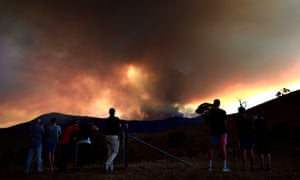
A bushfire south-west of Canberra
A bushfire south-west of Canberra, where smoke is
expected to linger on Thursday. Weather forecasters
warn that a heatwave will bring dangerous fire
conditions to NSW, Victoria and South Australia.
As dozens of fires continue to burn across the country, the Bureau of Meteorology has forecast a top of 39C in Melbourne on Thursday, while people in Adelaide (42C) and Canberra (37C) are also set to swelter.
The NSW government has also announced an inquiry into the unprecedented bushfire crisis on Thursday, which the premier, Gladys Berejiklian, pledged would “leave no stone unturned”.
It comes as three firefighters have been injured, while another has escaped unharmed, after a tree fell on to their truck in the Australian Capital Territory.
The crew were working to slow the spread of the 15,000-hectare Orroral Valley fire on Wednesday night when the tree crashed on to the tanker.

Read the story from The Guardian by Luke Henriques-Gomes - “Heatwave brings dangerous fire conditions to bushfire-ravaged Australia.

02 August, 2019

The most beautiful apocalypse you could imagine

This week I read that “the Arctic is on fire”. It’s literally true, and visible from space, apparently. And it’s burning in a way it hasn’t for at least 10,000 years. It seems the heatwave currently scorching Europe is also melting Arctic ice in frighteningly rapid ways. And you know what? I felt almost nothing.
Greenland's icebergs.
I’m not asking to be absolved for that, but you know I’m far from alone. And that, in miniature, captures the great hopelessness of climate change: that while we might occasionally feel overwhelmed into inaction by the sheer size and seriousness of the problem, it’s probably more honest to say that, as a society, we have simply ceased to be emotionally engaged by it.


Read the story from The Age by Waleed Aly - “The most beautiful apocalypse you could imagine.”

03 July, 2019

Climate change and the European heatwave: It's complicated

As Europe recovers from a heatwave with temperatures impressive even by Australian standards, there's one big issue on everyone's lips — climate change.
A girl cools off in the fountain in front of the Eiffel Tower.
Records tumbled late last week and over the weekend
but temperatures have now eased for western Europe.

How has the 'omega' jet stream influenced events and was climate change to blame?

First, it requires working out what went on.


Read the ABC News story by Kate Doyle -  “Climate change and the European heatwave: It's complicated."

28 February, 2019

No reprieve from heat yet

Another heatwave and potentially dangerous bushfire conditions are on the way for the rest of the week and into early March, according to the Bureau of Meteorology.

While temperatures are not expected to reach the record-breaking maximums of January, when Shepparton overshot its hottest temperature twice — climbing to 44.6°C and later in the month hitting 46.2°C — other factors could increase the fire danger.
Heat returns: The Bureau of Meteorology is predicting
a hot climax to summer and dry weather continuing into March.

BoM senior meteorologist Richard Carlyon said temperatures in the region should remain high into the weekend, with little hope of a reprieve from an expected cool change.

‘‘From (yesterday) onwards we’re likely to see northerly winds extend right across the state which will see temperatures climb quite quickly. So, (from today) we’ll see temperatures in the mid-to-high 30s across most of the state,’’ he said.

Shepparton is expected to reach maximums of 37°C and 38°C from today through to Sunday.

The conditions, coupled with a dry, hot start to the year, will exacerbate dangerous bushfire conditions, according to Mr Carlyon.

‘‘We’ve had a hot January and February and that’s allowed the fuel to dry out. It is ready to burn, and we are seeing these northerly winds increasing over the next few days,’’ he said.

‘‘So, we’ll have the high temperatures, increasing northerly winds. It won’t be a humid northerly air stream, but not a completely dry one either. Fire dangers will be nudging very high to severe over the next few days.’’
January saw only 6.6 mm of rain captured at the Shepparton observation station, with the exact same amount having fallen in February to date.

A predicted cool change for the south of Victoria on Sunday is not expected to reach the region.

The unusually dry conditions should also continue, according to Mr Carlyon.

‘‘(The predicted Sunday cool change will be) another mainly dry change moving through with no link to the tropics (and) no major rain bands,’’ he said.

Minimum temperatures are also expected to be at the high-end for the next few days, sitting above 20°C.

‘‘We have seen some cool mornings recently, but with that heat building, the minimum temperatures should be particularly high as well.’’

March is predicted to continue with the hot, dry conditions.

‘‘Normally March is a dry month with warm conditions persisting, but this March will be quite a hot start,’’ Mr Carlyon said.


The story “No reprieve from heat yet” by Myles Petterson is from The Shepparton News.

18 January, 2019

Last night was Australia's hottest on record

The record for Australia's all-time highest overnight temperature was smashed last night, just one of the marks to fall in what is becoming a heatwave for the history books.
There may be some respite from the heat
over the weekend before ramping back up.
Dr Blair Trewin, senior climatologist at the Bureau of Meteorology, said a minimum of 35.9 degrees Celsius was recorded at Noona, between Wilcannia and Cobar in western New South Wales, while 35.6C was measured at Borrona Downs.

"Both of those broke the previous record which was 35.5C set in 1982 in Arkaroola, South Australia, and was equalled in 2003 at Wittenoom in WA.”

He said the current heatwave was shaping up as one of the most significant on record in inland New South Wales.


Read the ABC News story - “Last night was Australia's hottest on record.”

05 January, 2019

National records melt in 'prolonged spell of heat' with more to come.

A huge swathe of Australia baked in mid-40 degree heat on Friday, with more records likely to be broken at the tail-end of a heatwave that set a slew of national highs last month.
A view of the sun rise from Newport beach in Sydney's
north on December 28, 2018 - the warmest night on
 record for Australia for that month.
CREDIT:
The mercury was tipped to reach at least 45 degrees over a region stretching from northern Western Australia into Victoria and the NSW Riverina.


Read the story from The Age by Peter Hannam - “National records melt in 'prolonged spell of heat' with more to come.

14 December, 2018

Special Climate Statement 67—an extreme heatwave on the tropical Queensland coast

A heatwave affected the north tropical and central coasts of Queensland from 24 November 2018. Numerous locations reported their highest daily maximum temperature on record for November, or for any month, with some locations breaking their previous record by a large margin.

A deep low to the east of southern New South Wales directed a warm and dry westerly airflow across Queensland, enabling several days of well above average maximum and minimum temperatures. Extreme heatwave conditions were observed in an area from Lockhart River to Shoalwater Bay on the Capricornia coast, extending to adjacent inland districts. Strong westerly winds, high temperatures and low humidity brought elevated fire danger.


05 August, 2018

Could the heat and extreme weather shift climate change denial?

London: Huge, deadly wildfires in Greece and California, forest fires out of control across Sweden, a record-setting heatwave in northern Europe, heatstroke deaths up fourfold in a baking Tokyo … and British academic Dr Rupert Read got a call.
The heatwave grips the UK - will it budge
 the thinking of climate change deniers?
BBC Radio Cambridgeshire wanted the Green House think tank chairman to debate climate change on air with a climate science denier.

He's done it before. This time he got a bit hot under the collar.

"I said NO," Read said, in a Tweet that has since been retweeted tens of thousands of times.

"I told them it was a disgrace that they still give climate deniers airtime at a time like this. I won't be part of such charades any longer.”


Read the story from The Age by Nick Miller - “Could the heat and extreme weather shift climate change denial?

18 April, 2018

Australia’s climate of fire

A big bushfire skirting the suburbs of Sydney, Australia, was made more likely by the preceding hot and dry start to autumn. The fire season has been extended by several weeks as summer heat kept recurring.
Australia's autumn heatwave is attributed to a
changing climate by scientists expert in the field.
This sort of heatwave, during spring or autumn, shows a greater divergence from the long-term average than a summer or winter heatwave.

"I would bet my house on it, that there's a climate change signal in this most recent heatwave," said Sarah Perkins-Kirkpatrick, climate scientist at the University of New South Wales.

Read the Aljezeera story - “Australia’s climate of fire.”

30 January, 2018

Daniel Andrews lashes power companies over blackouts

Premier Daniel Andrews vowed to take energy distributors to task as the government announced a review into a major power outage that left more than 90,000 households without electricity at the peak of the state’s weekend heatwave.
Victorian Energy and Environment Minister Lily D'Ambrosio.
Unprecedented demand for a Sunday exposed the distributors as unprepared when fuses blew at local power substations, leaving tens of thousands without cooling on one of the hottest January nights on record.


Read the story in today’s Melbourne Age by Cole Latimer and Rachel Dexter - “Daniel Andrews lashes power companies over blackouts.”

25 January, 2018

Don’t shoot the climate change messenger.

Today, when our weather forecasters tell us a heatwave is coming, we can be quietly confident of the time it will arrive and the temperatures that will be reached. When western Sydney broke records on January 7, hitting 47 degrees, the Bureau of Meteorology had warned us, enabling individuals and organisations to prepare. While analysis of this event is ongoing, researchers at the Australian Research Council's Centre of Excellence on Climate Extremes found a similar Sydney heatwave last year was twice as likely due to the climatic impacts of humans.
Once thriving wetlands close to the Murray River at Mildura in north-west Victoria.
The role of forecasting is to use the best information available at the time to predict conditions, and give us time to prepare, adjust or change course. When we're talking about tomorrow's, or even next week's, weather everyone plans accordingly, without a second thought. Using seasonal forecasts, based on predictions of the El Nino Southern Oscillation (ENSO), industries and governments routinely respond months in advance to forecast patterns of rainfall and wind.


Read the story from The Sydney Morning Herald - “Don’t shoot the climate change messenger.

01 December, 2017

Electricity grid operator hits emergency button to avoid system overload

Victoria's heatwave has prompted the electricity grid operator to activate its emergency plan to avoid the risk of blackouts on Thursday evening.
Victoria's heatwave prompted emergency action.
A lack of reserve capacity in the state's electricity grid has prompted it to make the rare move.

It is the first time in several years that the Australian Energy Market Operator has taken this step in Victoria as a way to avoid the risk of involuntary load shedding caused by overwhelming demand. 

The action comes after months of warnings that Victoria's energy reserves would be stretched tight this summer, following the closure of the Hazelwood coal-fired power plant in March.


Read Adam Carey’s story in today’s Melbourne Age - “Electricity grid operator hits emergency button to avoid system overload.”

21 November, 2017

Melbourne to swelter through longest November heatwave in 150 years

Melbourne's spring weather has sent records tumbling, with forecasters predicting the longest November heatwave in more than 150 years.

People enjoy hot weather at St Kilda beach in November this year. 
The city has sweltered through its first taste of summer early this year, and if temperatures stay as high as predicted, it will be Melbourne's first seven-day spell of temperatures higher than 28 degrees in November since official records began in 1862.

Melbourne is halfway though its hot streak, and unless you plan on being poolside for the rest of the week, there's not much relief in sight.

The mercury hit 34 degrees on Tuesday and Melburnians are expected to toss and turn through another sticky night with the temperature not expected to drop below 22 degrees. 


Read Melissa Cunningham’s story in the  Melbourne Age - “Melbourne to swelter through longest November heatwave in 150 years.”

16 March, 2017

Melbourne apartments unable to withstand heatwave conditions, fail to keep residents safe

Melbourne’s apartments would fail to keep residents safe during a heatwave because they do not meet international health standards for indoor temperature levels, according to a new report.

Australia has no best practice standards
for internal thermal comfort or overheating.
Unlike France, Germany, the UK and the US, Australia has no best practice standards to protect the health of apartment residents. The six common Melbourne building models tested without cooling systems by the University of Melbourne were found to fail each of those country’s measures.

After a severe heatwave hit Europe in 2003, resulting in more than 14,000 deaths in France alone, the government introduced a “summer comfort” requirement to their building code. It stipulates that indoor rooms must not surpass 28 degrees for more than 3 per cent of the year without airconditioning. This, along with those standards of UK, Germany and America were what researchers compared their results to.


Read Alexandra Sponge’s story in today’s Melbourne Age -  “Melbourne apartments unable to withstand heatwave conditions, fail to keep residents safe.”

02 March, 2017

Spy agency Australian Signals Directorate forced to operate on generators during heatwave

Australia's electronic spy agency was forced to rely on diesel backup generators when the nation's power supply came under intense pressure during last month's heatwave.
The Australian Signals Directorate
in Canberra. 

The Turnbull government claims the nation's cyber security was put in jeopardy when the Department of Defence - which houses the shadowy Australian Signals Directorate - was asked to help with load shedding during soaring temperatures on February 10.


Read Adam Gartrell’s story in today’s Melbourne Age - “Spy agency Australian Signals Directorate forced to operate on generators during heatwave.”

28 February, 2017

Severe heatwaves show the need to adapt livestock management for climate

During the recent heatwave in New South Wales, which saw record-breaking temperatures for two days in a row, 40 dairy cows died in Shoalhaven, a city just south of Sydney.
Cows don’t do well in the heat. 

Climate change doubled the likelihood of this kind of record-breaking heatwave. And even the higher minimum temperatures we’ve recently experienced may soon be the “new normal” for this time of the year.

Farmers that already find it difficult to make a profit will need to adapt to these changing conditions, ensuring they mitigate the effects on their livestock. This could take the form of more shade and shelter, but also the selection of different breeds to suit the conditions.


23 February, 2017

Victorian cities faced power cuts to ensure NSW made it through big heatwave

As NSW suffered through its record-breaking heatwave this month, with power supplies stretched to breaking point, the head of Australia's main electricity grid faced a choice: keep the airconditioning running in Sydney, or keep the lights on in Victoria.
NSW had a near miss earlier this month as
heatwave conditions strained the state's
electricity supplies.

Tony Marxsen, chairman of the Australian Energy Market Operator (AEMO), picked up the phone to the Victorian government on the afternoon of Friday February 10 to warn that people in western Victoria might have to endure blackouts to ensure a key transmission line to NSW could keep operating at full capacity.


Read Peter Hannam’s story in today’s Melbourne Age - “Victorian cities faced power cuts to ensure NSW made it through big heatwave.”

12 February, 2017

Unprecedented fire danger for NSW as heatwaves continue across south-east

Swimmers escape the heat at the Nepean
River Reserve in Sydney. Meteorologists
are predicting what could be the hottest
three-day spell ever for the city.
Firefighters are warning Sunday will present an unprecedented fire danger for New South Wales, as the prolonged heatwave creates conditions worse than Black Saturday.

The heatwave across south-east Australia continued to break records on Saturday. Parts of Western Sydney reached 47C on Saturday afternoon, including Penrith, which experienced its hottest day on record.

The outback town of White Cliffs, in NSW’s north-west, broke the record for the hottest minimum overnight temperature. Residents endured a stifling night with a low of only 34.2 degrees.


Read Christopher Knaus’s story in The Guardian - "Unprecedented fire danger for NSW as heatwaves continue across south-east.”

10 February, 2017

This One Photo Proves Australia Is Actually The Portal To Hell

Australia - the portal to hell?
Australia is entering a MONSTER of a heatwave that has made the country look like an actual portal to hell.

Check out the BuzzFeed pictures - “This One Photo Proves Australia Is Actually The Portal To Hell.”

26 January, 2017

NSW heatwave: Records tumble in Moree, while Sydney set to swelter with top of 40C

Moree, in northern NSW, is in
the midst of a record heatwave.
As the mercury soars in Sydney today, spare a thought for the people of Moree in northern New South Wales, who are in the midst of a record-breaking heatwave.

The town's residents have sweltered through 27 consecutive days where the temperature has exceeded 35 degrees Celsius — a state record.

The previous benchmark was 17 days, and the bad news is, there is no respite in sight.

Rob Taggart from the Bureau of Meteorology said the string of sweaty weather in Moree was unprecedented, even for summer.

"This is unheard of," he said.

"The previous record was 17 days in a row of 35 degrees or more and that was set in the summer of '81 and '82.


(Shepparton, it has been predicted, will have a maximum of 41 degrees Celsius on Monday)