Showing posts with label humans. Show all posts

10 May, 2019

We must rip up our environmental laws to address the extinction crisis

Humans are causing the Earth’s sixth mass extinction event, with an estimated one million species at risk of extinction.
The Christmas Island pipistrelle (Pipistrellus murrayi) became extinct in 2009.
Addressing this crisis requires transformative change, including more effective environmental law and implementation.

Improved legislation is one of five main levers for realising change identified in the recent United Nation’s global biodiversity report and the key lesson arising from the Senate’s interim report into Australia’s faunal extinction crisis.


01 March, 2019

99.9999 percent chance we're the cause of global warming, study says

There's a 99.9999 per cent chance that humans are the cause of global warming, a new study reported Monday.
 There's a 99.9999 per cent chance that humans are the cause of global warming.
This means we've reached the "gold standard" for certainty, a statistical measure typically used in particle physics. 

Humanity burns fossil fuels such as oil, coal and gas, which release carbon dioxide (CO2) into the Earth's atmosphere and oceans. CO2 is the greenhouse gas that's most responsible for warming.

Study lead author Benjamin Santer of the Lawrence Livermore National Laboratory told Reuters that “the narrative out there that scientists don’t know the cause of climate change is wrong." 


Read the USA Today story by Doyle Rice - “99.9999 percent chance we're the cause of global warming, study says.”

03 January, 2019

Three Things We Don’t Want To Understand About Climate Change

Thinking about climate change is not something that comes naturally to humans — or ‘consumers’ as we have called ourselves for decades. It is not only emotionally unpleasant but mentally extremely challenging.


I argue that most of us do not grasp how immediate this situation has become, how fast it is progressing and what the scale of change needed is to reach the stabilization targets of the Paris Agreement.

I also argue that after individuals, nations, and corporations understand the urgency and the rate, they should be honest about what the scale of action needed is to avoid the collapse of the biosphere and thus civilization.


Read the Medium story by Aarne Granlund - “Three Things We Don’t Want To Understand About Climate Change.”

30 December, 2018

Cities don’t cause global warming but must adapt to it

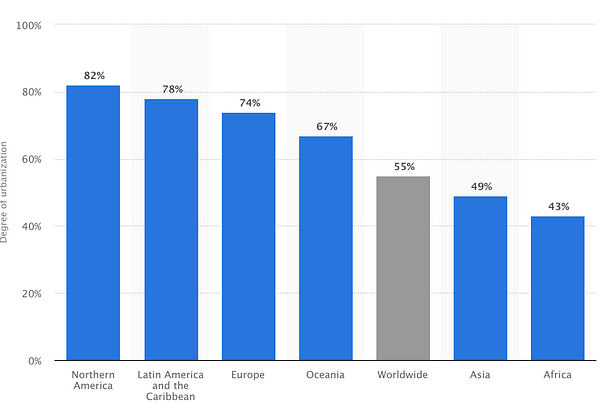
Humans have been urbanizing in earnest since the beginning of the Industrial Revolution. Worldwide, 55% of humans live in urban areas, and the ratio is much higher in the Americas. This trend is only accelerating, with automation of agriculture and resource extraction reducing rural labor needs, while the information and service economies of cities continue to increase labor needs.
Degree of urbanization (percentage of urban
 population in total population) by continent in 2018 
Statista
As an example, the Appalachias of 1910 had close to 800,000 people employed in the coal industry, and that number is around 60,000 today. By comparison, New York City had under 5 million residents in 1910 vs 8.6 million today.
Global warming caused by humans since the beginning of the Industrial Revolution has a correlation with urbanization. Automation allowed and required the work force to leave rural areas and congregate in much more efficient cities which produced much more value. Urbanization is one of the factors which allowed more humans to survive and hence the population to grow. Cities were integral to the success of the Industrial Revolution, and without them humanity wouldn’t have changed the climate as much. But there are dozens of other factors, so it can’t be stated that cities are the cause of global warming, just a factor in the system which led to global warming.


Read the Medium story by Michael Blanchard - “Cities don’t cause global warming but must adapt to it.”

22 December, 2018

Study: The More Trees We’re Surrounded By, The Lower Our Stress Levels

Lining city streets with trees reduces physiological symptoms of stress in humans. The thicker the tree cover, the lower the stress levels, study finds.
More trees, less stress, and lower temperatures.
We all know that a walk in nature can help slow the maddening pace of modern life and bring us back into the moment, but a recent study tells us just how many trees are necessary to keep us calm.

Researchers put people in stressful situations and then showed them 3-D videos of various “city”scapes, each with different densities of tree cover.

The thicker the tree-cover, the lower the subjects’ stress levels dropped.


08 August, 2018

‘Many parts of Earth could become uninhabitable': Study's grim warning

Many parts of Earth could become uninhabitable for humans, with the planet at risk of entering an irreversible "hothouse" climate.
Professor Will Steffen - many parts of the world will become uninhabitable.
That's the alarming warning from an international team of scientists, including Australian National University professor Will Steffen, in a study published on Tuesday.

As large parts of eastern Australia battle drought and Europe is gripped by a heatwave, Professor Steffen said current efforts to combat global warming would not be enough to meet the emission-reduction targets set by governments in the Paris Agreement, which may be insufficient to prevent the dangerous scenario anyway.

The study warns that Earth is already more than halfway towards the point of no return.


Read the story by Blake Foden from The Age - “‘Many parts of Earth could become uninhabitable': Study's grim warning.”

10 July, 2018

Humanity Has Killed 83% of All Wild Mammals and Half of All Plants: Study

When it comes to planet Earth, humans are very tiny.
Humans may be insignificant in many ways, but is has killed
off 83% of all wild animas and half of all plants.
The weight of all 7.6 billion humans makes up just 0.01% of all biomass on Earth, according to a report published in the Proceedings of the National Academy of Sciences on Monday.

Bacteria, by comparison, make up 13% of all biomass, plants account for 83%, and all other forms of life make up 5% of the total weight, according to the report.

23 April, 2018

Helping farmers and reducing car crashes: the surprising benefits of predators

Whoosa vicious helpful
predator? You are! Yes you are.
Humans may be Earth’s apex predator, but the fleeting shadow of a vulture or the glimpse of a big cat can cause instinctive fear and disdain. But new evidence suggests that predators and scavengers are much more beneficial to humans than commonly believed, and that their loss may have greater consequences than we have imagined.

Conflict between these species and people, coupled with dramatic habitat loss, is causing unprecedented predator and scavenger declines. Nearly three-fourths of all vulture species are on a downward spiral. African lions are projected to lose half of their range in the coming decades and leopards have lost upwards of 75% of their historic range. Many bat species are facing extinction.

In a recent paper in Nature Ecology & Evolution, we summarised recent studies across the globe looking at the services predators and scavengers can provide, from waste disposal to reducing car crashes.


10 April, 2018

Is climate change really too hard to understand?

It’s a big subject, all right. And a difficult one to address. But too big to understand it isn’t. Quantum physics is too big to understand. Climate change is simple. I’ll put it in one sentence: There are known heat-trapping gasses, and if we add too much of them to the atmosphere, it will cause large, foreseeable damage to humans and natural environments. That is not too big to understand.A lot of people wonder why we are doing so little to prevent the slow-motion catastrophe of climate change. One theory is that it’s too big a subject to understand.


And a majority of people understand it just fine. They are making the assumption that the political process will work normally and that the government will take the steps necessary to deal with it. Like government did with smog, and with polluted water, and with acid rain, and with ozone depletion. The thing that is hard to understand is how people in positions to do something about it do nothing. Or rather, do everything in their power to stop action.


Read the opinion piece from The Washington Post by Tom Toles - “Is climate change really too hard to understand?”

30 March, 2018

The Energy 202: Scott Pruitt's climate message is now official EPA guidance

Environmental Protection Agency chief Scott Pruitt has long insisted it is difficult for scientists to precisely measure the extent to which humans cause climate change.
Chief of the US Environmental Protection Agency, Scott Pruitt,
insists it is too difficult for scientists to precisely measure the
extent to which humans cause climate change.
Now EPA's regional staff engaging with local communities and Native American tribes have been instructed to push the same message too.

This week, EPA staffers received an email instructing them to underscore the uncertainties about how human activity contributes to climate change.


Read Dino Grandoni’s story from The Washington Post - “The Energy 202: Scott Pruitt's climate message is now official EPA guidance.”

09 February, 2018

Unearthing the Capitalocene: Towards a Reparations Ecology.

Settled agriculture, cities, nation-states, information technology and every other facet of the modern world have unfolded within a long era of climatic good fortune. Those days are gone. Sea levels are rising; climate is becoming less stable; average temperatures are increasing. Civilization emerged in a geological era known as the Holocene. Some have called our new climate era the Anthropocene. Future intelligent life will know we were here because some humans have filled the fossil record with such marvels as radiation from atomic bombs, plastics from the oil industry and chicken bones.

What happens next is unpredictable at one level and entirely predictable at another. Regardless of what humans decide to do, the twenty-first century will be a time of “abrupt and irreversible” changes in the web of life. Earth system scientists have a rather dry term for such a fundamental turning point in the life of a biospheric system: state shift. Unfortunately, the ecology from which this geological change has emerged has also produced humans who are ill-equipped to receive news of this state shift. Nietzsche’s madman announcing the death of god was met in a similar fashion: although industrial Europe had reduced divine influence to the semi-compulsory Sunday-morning church attendance, nineteenth-century society couldn’t imagine a world without god. The twenty-first century has an analogue: it’s easier for most people to imagine the end of the planet than to imagine the end of capitalism.


Read the Roar story by Jason W. Moore and Raj Patel - “Unearthing the Capitalocene: Towards a Reparations Ecology.”

25 January, 2018

Don’t shoot the climate change messenger.

Today, when our weather forecasters tell us a heatwave is coming, we can be quietly confident of the time it will arrive and the temperatures that will be reached. When western Sydney broke records on January 7, hitting 47 degrees, the Bureau of Meteorology had warned us, enabling individuals and organisations to prepare. While analysis of this event is ongoing, researchers at the Australian Research Council's Centre of Excellence on Climate Extremes found a similar Sydney heatwave last year was twice as likely due to the climatic impacts of humans.
Once thriving wetlands close to the Murray River at Mildura in north-west Victoria.
The role of forecasting is to use the best information available at the time to predict conditions, and give us time to prepare, adjust or change course. When we're talking about tomorrow's, or even next week's, weather everyone plans accordingly, without a second thought. Using seasonal forecasts, based on predictions of the El Nino Southern Oscillation (ENSO), industries and governments routinely respond months in advance to forecast patterns of rainfall and wind.


Read the story from The Sydney Morning Herald - “Don’t shoot the climate change messenger.”

27 December, 2017

Keep calm: reasons to head for the park not the beach

My father was always disapproving of people who excused their failure to turn up to his Sunday meeting by saying they'd been "worshipping God in the great outdoors". But the older I get, and the more I read, the more I think it's not such a bad idea.

Illustration: Andrew Dyson.
I'm much attracted by the American biologist Edward O. Wilson's hypothesis of biophilia, that humans have an innate tendency to seek connection to nature, for its calming effects.


Read the piece by Ross Gittins in today’s Melbourne Age - “Keep calm: reasons to head for the park not the beach.”

16 December, 2017

Nature never rests, but we need to

Nature never rests.


Strangely, humans, who have disrupted nature, do need rest and so Beneath the Wisteria will be taking a break, having a rest, this month.

Subsequently, we will not gather Beneath the Wisteria in Shepparton’s Maude St mall and so our next gathering will be on Saturday, January 27,  2018, at 11:00 am - hopefully, we will see you then.

And, in the meantime, enjoy whatever it is you are doing and take care.

Summing up this year, 2017, from a climate change point of view, it is worth noting that there has been, in my view, a significant shift in attitudes toward climate change with people being much more conscious of the dilemma and so eager to hear about what they can do to mitigate our carbon dioxide emissions and adapt to the inevitable unfolding societal changes.


Please join us on January 27 discuss 2017 and consider what might eventuate in 2018.

26 November, 2017

Some bad actors': Coal burning found to release possibly toxic nanoparticles

Coal combustion, already one of the main sources of pollution, has also been found to release nano particles of titanium that are potentially harmful to humans and other life forms, researchers say.

Researchers in the US discovered the titanium
suboxides when examining a coal ash spill.
US-based scientists accidentally discovered the tiny traces of the metal – in the form of titanium suboxides measuring in the billionths of a metre – when studying a coal ash spill in the Dan River in North Carolina in 2014, Science Daily reported earlier this year.

The substance had previously been considered rare, located in mudstones in a small area of western Greenland, moon rocks and in some meteorites.

It turns out, however, that forms of titanium oxides "are essentially a ubiquitous accessory phase in all coals worldwide", the researchers said in a paper published in Nature Communications.


Read Peter Hannam’s story in today’s Melbourne Age - “‘Some bad actors': Coal burning found to release possibly toxic nanoparticles.”

05 November, 2017

US government reports humans cause climate change, contradicting Trump officials

Washington: Directly contradicting much of the Trump administration's position on climate change, 13 federal agencies have unveiled an exhaustive scientific report that says humans are the dominant cause of the global temperature rise that has occurred since the start of the 20th century, creating the warmest period in the history of civilisation.

Protesters gather outside a meeting where an EPA
 climate change report was to be released last month.
Over the past 115 years, global average temperatures have increased 1.8 degrees Fahrenheit, leading to record-breaking weather events and temperature extremes, the report says.

The global, long-term warming trend is "unambiguous," it says, and there is "no convincing alternative explanation" that anything other than humans - the cars we drive, the power plants we operate, the forests we destroy - are to blame.

The report was approved for release by the White House, but the findings come as the Trump administration is defending its climate change policies on several fronts, with US President Donald Trump having declared the "war on coal" to be over.


Read Lisa Friedman’s story in today’s Melbourne Age - “US government reports humans cause climate change, contradicting Trump officials.”

04 November, 2017

US report finds climate change 90% manmade, contradicting Trump officials

A comprehensive review by 13 US federal agencies concludes that evidence of global warming is stronger than ever and that more than 90% of it has been caused by humans.

The 477-page report said it’s ‘extremely likely’ that global warming is manmade.
The conclusion contradicts a favorite talking point of senior members of the Trump administration.

A 477-page report released on Friday said it was “extremely likely” – meaning with 95 to 100% certainty – that global warming is manmade, mostly from carbon dioxide through the burning of coal, oil and natural gas.

The energy secretary, Rick Perry, and Environmental Protection Agency chief, Scott Pruitt, have said carbon dioxide is not the primary contributor to global warming.

Since 1900, the report says Earth has warmed by 1C and seas have risen by 8in. Heatwaves, downpours and wildfires have become more frequent. 


Read the Associated Press story on The Guardian - “US report finds climate change 90% manmade, contradicting Trump officials.”

04 October, 2017

Humans experimenting with climate's 'playing nice’

Like “rats inside the experiment,” Neils Bohr Institute glaciology professor Jorgen Peder Steffensen says of us humans when he considers the risks of a sudden reconfiguration of global circulation which could, among other things, cause long-term drying across America’s breadbasket states.


“That’s going to impact the entire world,” Steffensen cautions in recognizing that the 11,000 years of the interglacial period since the last ice age “has been unreasonably stable. And we don’t know why” or how long that stability may persist.

Steffensen, in exceptionally eloquent and straightforward language, acknowledges that models consistently point to a gradual global increase in temperatures as a result of the continue widespread combustion of fossil fuels and increased emissions of carbon dioxide. “But that’s assuming the climate plays nice,” he says.


Read/watch the Yale Climate Connections story - “Humans experimenting with climate's 'playing nice’.”

25 September, 2016

'Can humanity survive the 21st century?' - Julian Cribb

Julian Cribb - asking whether of not
 humanity can survive the 21st Century?
Humans are facing the greatest test in the million-year ascent of our kind. But this isn’t a single challenge, like a famine or disease outbreak. It is a constellation of ten huge man-made threats, which are now coming together to imperil our existence.

Society often regards these risks – ecological collapse, resource depletion, weapons of mass destruction, global warming, global poisoning, food insecurity, population and urban expansion, pandemic disease, dangerous new technologies and self-delusion – as separate issues. In reality, they are deeply intertwined: each affects the others. This means they cannot be dealt with one at a time, but must be solved in conjunction – and at species level.

Over recent years I have encountered many well-educated, well-informed people – scientists, grandparents and young people especially – who expressed the fear that we may be entering the end game of human history. That civilisation, and maybe even our species, will not survive the compound dangers we are accruing for ourselves. Surviving the 21st Century (Springer 2017) is my attempt to discover whether they are right or not.

Read Julian Cribb’s story on Millennium Alliance for Humanity and the Biosphere  (MAHB)  website - “Can humanity survive the 21st century?”

05 November, 2015

Remote places, but of critical importance to life on earth


T
he remote location of the Antarctic and Greenland polar ice sheets may leave us with the impression that developments in these regions have little effect on the climate and life in the temperate zones of the Earth, where most of us live.

We may therefore be forgiven for asking why should we care when these changes are projected to unfold over tens to hundreds of years.

However, the stability of the polar regions is critical for maintaining a planet with the conditions that allowed the emergence of humans, agriculture and civilisation, as well as many other species. The polar ice sheets serve as “thermostats” of global temperatures from which cold air and cold ocean currents emanate, moderating the effects of solar radiation. The ice sheets regulate sea levels, store volumes of ice whose melting would raise sea level by up to 61 metres.

Read the piece by Earth and paleo-climate scientist at the Australian National University, Andrew Glikson, published on The Conversation - “Melting Antarctic ice sheets and sea level rise: a warning from the future.”