Showing posts with label plastics. Show all posts

09 April, 2018

A billion kilograms of recycling in need of a new home

The scale of Australia's recycling crisis is twice as bad as initially feared, with new figures showing that well over a million tonnes of metal, paper and plastics previously sent to China now has to be accommodated elsewhere.
Chris Philp, general manager of Wheelie Waste,  amongst a
day's worth of recycling from the Victorian town of
Kyneton, population approximately 7000.
Such a vast amount of rubbish is hard to wrap your head around, so we've converted the figures to regular household recycling items. The illustrations are indicative only, because the range of materials recycled in each category is much broader and includes building waste, industrial packaging and many other types.

But this should give you some indication of the amount of rubbish we're talking about. Remember, this is material that was once exported to China that is now, largely, piling up at Australian waste centres.


Read the story by Mark Solomon from The Age - “A billion kilograms of recycling in need of a new home.”

12 February, 2018

Recycling crisis: True goal is zero waste going to landfill

After years of doing the right thing by separating our garbage so that our glass bottles, newspapers and plastics can be recycled, Victorians are now being told that all that recycling could be, well, a waste of time.
We are facing a potential waste crisis – and a totally predictable one, too.
According to the Municipal Association of Victoria, a decision by China to place a ban on the import of recycling materials from outside the country has resulted in several councils having their recycling contracts cut back by our waste companies.


Read the comment by Richard Fine in today’s Age - “Recycling crisis: True goal is zero waste going to landfill.”

09 February, 2018

Unearthing the Capitalocene: Towards a Reparations Ecology.

Settled agriculture, cities, nation-states, information technology and every other facet of the modern world have unfolded within a long era of climatic good fortune. Those days are gone. Sea levels are rising; climate is becoming less stable; average temperatures are increasing. Civilization emerged in a geological era known as the Holocene. Some have called our new climate era the Anthropocene. Future intelligent life will know we were here because some humans have filled the fossil record with such marvels as radiation from atomic bombs, plastics from the oil industry and chicken bones.

What happens next is unpredictable at one level and entirely predictable at another. Regardless of what humans decide to do, the twenty-first century will be a time of “abrupt and irreversible” changes in the web of life. Earth system scientists have a rather dry term for such a fundamental turning point in the life of a biospheric system: state shift. Unfortunately, the ecology from which this geological change has emerged has also produced humans who are ill-equipped to receive news of this state shift. Nietzsche’s madman announcing the death of god was met in a similar fashion: although industrial Europe had reduced divine influence to the semi-compulsory Sunday-morning church attendance, nineteenth-century society couldn’t imagine a world without god. The twenty-first century has an analogue: it’s easier for most people to imagine the end of the planet than to imagine the end of capitalism.


Read the Roar story by Jason W. Moore and Raj Patel - “Unearthing the Capitalocene: Towards a Reparations Ecology.

27 December, 2017

$180bn investment in plastic factories feeds global packaging binge

The global plastic binge which is already causing widespread damage to oceans, habitats and food chains, is set to increase dramatically over the next 10 years after multibillion-dollar investments in a new generation of plastics plants in the US.
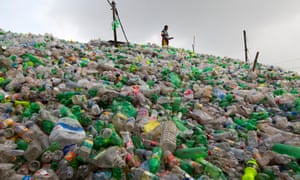
One million plastic bottles are bought around the world every minute, with most ending up in landfill or in the sea.
One million plastic bottles are bought around the world every
 minute, with most ending up in landfill or in the sea. Photograph:
Fossil fuel companies are among those who have ploughed more than $180bn since 2010 into new “cracking” facilities that will produce the raw material for everyday plastics from packaging to bottles, trays and cartons.
The new facilities – being built by corporations like Exxon Mobile Chemical and Shell Chemical – will help fuel a 40% rise in plastic production in the next decade, according to experts, exacerbating the plastic pollution crisis that scientist warn already risks “near permanent pollution of the earth.”


Read Matthew Taylor’s story on The Guardian - “$180bn investment in plastic factories feeds global packaging binge.”

06 August, 2017

American petro-topia

“The genius and hubris of plastic has been absorbed by every living thing. Is it a curse or evolution’s next step?”

Rebecca Altman.
I knew it was late to be calling him. But that night, with the first warm breezes rustling the curtains, I could sense the coming spring and realised he would turn 73 soon.

For more than a decade, my father and I had talked about returning to the place where he made plastics before I was born. The plant had exerted an inexplicable pull on me for longer than I can remember, since before I had kids, and even before I entered graduate school to study environmental legacy – what is passed from one generation to the next.

So I dialled. He answered quickly. When I asked whether he’d like to go with me, he didn’t hesitate. Within minutes, we had set a date. Two months later, in May 2013, we stood on the grounds of the former Union Carbide plant in Bound Brook, New Jersey, the birthplace of modern plastics.


Read the Aeon story by Rebecca Altman - “American petro-topia.

21 July, 2017

In a world swamped by plastic waste there's a tonne for every single one of us

More than 9 billion tonnes of plastic has been produced since 1950, and almost all of it is still around.
Bad diet: This  seabird was a victim of plastic pollution.
Bad diet: This seabird was a victim of plastic pollution. 
A new study that tracked the global manufacture and distribution of plastics since they became widespread after World War II found that only two billion tonnes of that plastic is still in use.

A small amount is eliminated in incinerators, leaving seven billion tonnes  stuck on Earth as garbage in landfills, recycled rubbish or pollution in the environment, including the deep oceans, where it's been discovered in the mouths of whales and the bellies of dead seabirds that mistook it for food.


Read the story in today’s Melbourne Age by Darryl Fears - “In a world swamped by plastic waste there's a tonne for every single one of us.”