Showing posts with label China. Show all posts

12 April, 2020

We don’t want to return to normal – we want better

There is, of course, an upside to this virus and the disruption it brings to our lives.
Reports from China indicate that within a few days of their extreme “lock-down” the skies cleared and people blinked under an unfamiliar blue sky. In Venice rivers are running clean as the discharge of industrial pollution stopped and tourist ships stopped emptying their waste into the local waterways.
The slowdown in the economy will challenge our concept of normal. Employers who for years have resisted calls to allow people to work from home have suddenly found ways to make that work, thus significantly reducing transport emissions across the country.
Read the story from the EcoPortal’s Living Lightly by Graham Parton - “We don’t want to return to normal – we want better.”


01 April, 2020

Carbon emissions will drop, but experts fear 'revenge pollution’

As the virus spread and the lockdowns began, factories went silent and the skies emptied of aeroplanes and then, in the industrial heartland of China, of smog itself.
The grounding of much of the world's passenger aircraft is one of the more obvious reductions in global greenhouse gas emissions - at least for the short term.
The grounding of much of the world's passenger aircraft
is one of the more obvious reductions in global greenhouse
 gas emissions - at least for the short term. 
NASA published satellite images and heat maps of the skies over Wuhan and Milan, the industrial capital of northern Italy, clear of nitrogen dioxide — the gaseous residue of fuel burnt in cars and trucks, factories and power plants — for the first time in memory.
As though buoyed by the faintest of good news in the unfolding catastrophe, people around the world began sharing photographs of wildlife returning to environments suddenly cleared of pollution — swans and dolphins in Venice’s canals, elephants drunk on pilfered rice wine in Yunnan province. Sadly, as National Geographic reported, a few of the images weren't quite what they seemed. The swans had always been there; the dolphins had been filmed elsewhere.
Similarly, though the sudden drop in carbon emissions is real and measurable, few experts who spoke to this masthead believe the economic shutdown caused by the coronavirus will have any lasting positive impact on curbing climate change. Some fear it might eventually even hamper efforts to reduce carbon.
Read the story from The Age by Peter Hannam and Nick O’Malley - “Carbon emissions will drop, but experts fear 'revenge pollution’.”

09 February, 2020

The USA is more responsible for climate change than any country

When you can get conservatives and libertarians to admit that global warming is real, serious, and caused by humans, almost inevitably they start pointing fingers at India and China. What is the reality of the USA’s contributions to global warming vs the rest of the world’s?
Putting things in balance.
It’s worth casting our eyes back over different points in history with visualizations from Our World in Data’s site CO and other Greenhouse Gas Emissions to help answer this question. Let’s start at the turn of the 20th Century.
Which countries were already racking up big emissions? The UK was in the lead with 17.7 billion tons as befits its status as origin of both the steam locomotive and the Industrial Revolution. The USA wasn’t far behind at 11.4 billion tons. Germany was lagging at 6.73 billion tons. China? 95 thousand tons.
But things have changed since then, right? Oh, yeah. Let’s fast forward to 1966.

Read the Medium story by Michael Barnard - “The USA is more responsible for climate change than any country.”

27 August, 2019

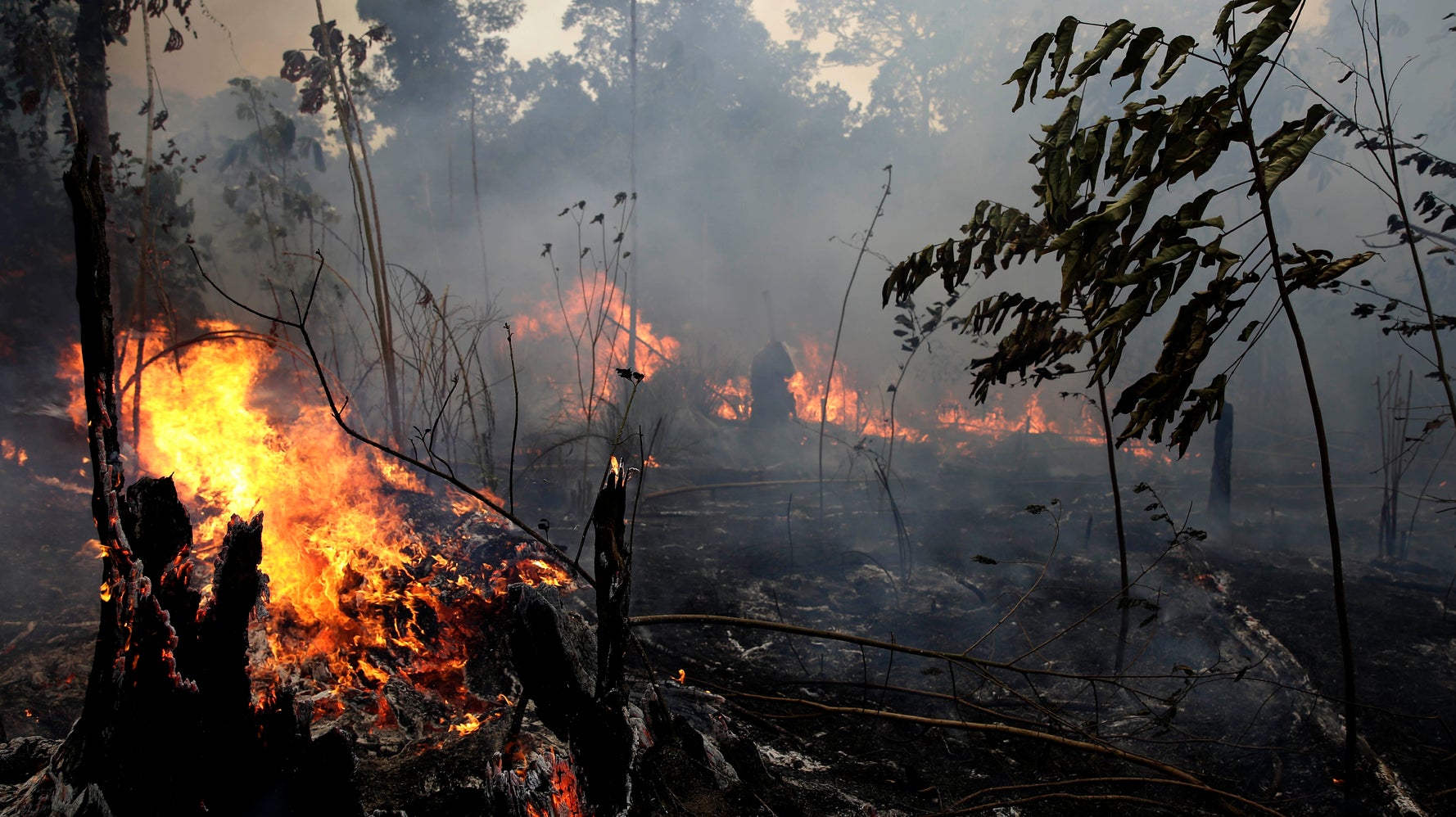
Trump’s Trade War Linked To Amazon Rainforest Destruction

As unsold U.S. soybeans are stored in silos across the farm belt, Brazilian farmers and corporations scramble to satisfy the voracious Chinese market. The push to break new ground amid President Donald Trump’s trade war with China is putting increasing pressure on the Amazon rainforest and is likely linked to the region’s devastating fires, according to experts.

Image result for Trump's Trade War Linked To Amazon Rainforest Destruction

The Amazon burns as the trade wars ramp up.

“There is concern that market pressures related to the disruptions in global trade contributed to the fires in the Amazon,” Paul Murphy-Spooner, the spokesperson for the American Soybean Association, said in an email to HuffPost. 

Brazil is America’s biggest soybean competitor and has stepped up its production now that China has slashed its purchases of U.S. crops in retaliation for Trump’s tariffs on Chinese imports. Soy shipments from Brazil jumped 27% from 2017 to 2018. Chinese imports from Brazil in the 12 months through April amounted to 71 million tons — nearly as much as China imported from the entire world in 2014, according to Bloomberg. 


Read the Huffpost story by Mary Papenfuss - “Trump’s Trade War Linked To Amazon Rainforest Destruction.”

16 August, 2019

Australia left in the shade over coal

Funafuti, Tuvalu: Pacific leaders have left Australia isolated over the future of coal in the region after a marathon summit meeting on Thursday night, as fears grow that China will seek to exploit diplomatic differences in the region over climate change.
Kiribati's President Taneti Maamau, Cook Islands Prime Minister Henry Puna, Tonga's Prime Minister Akilisi Pohiva, Scott Morrison and Solomon Islands Prime Minister Manasseh Sogavare.
Kiribati's President Taneti Maamau, Cook Islands
 Prime Minister Henry Puna, Tonga's Prime Minister
Akilisi Pohiva, Scott Morrison and Solomon Islands
 Prime Minister Manasseh Sogavare. 
Representatives from Beijing will address the Pacific Island Forum in Tuvalu on Friday after a tense and lengthy leaders' retreat where Prime Minister Scott Morrison attempted to persuade his counterparts against a joint declaration of a climate emergency.
Global heavyweights will turn the international focus on the 18-nation meeting when US Secretary of the Interior David Bernhardt speaks with leaders, followed by China's special envoy to the Pacific Islands, Wang Xuefeng.

Read the story from The Age by Rob Harris - “Australia left in the shade over coal.”

11 July, 2019

The Myth of a Fossil Fuel Phase-Out

BRUSSELSHow the world uses energy is a hot topic for a warming planet, and fears of pollution and resource strain have produced a virtual arms race of energy-efficiency strategies. From the European Union to China, economies are vowing to reduce their energy intensity with the help of technological innovations and legislative changes.
Rumaila natural gas powerstation, north of the southern Iraqi port of Basra. 
Yet, despite these promises, consumer demand for energy is forecast by the International Energy Agency to rise until at least 2040. With the world’s energy needs growing, how can policymakers guarantee supply?

To put it bluntly, the world has nothing to worry about when it comes to reserves. After 40 years of fearing energy shortages, we have entered an era of abundance. We need to guard against false narratives, not scarce resources.

The culprit of this storyline is the Club of Rome, a global think-tank that, in the 1970s, spurred energy anxiety with its absurd prophecies derived from questionable models. As devoted followers of Thomas Malthus and Paul Ehrlich, the club argued that bad things come from exponential growth, and good things from linear growth. This idea fueled the prediction that the world would run out of oil by 2000.


Read the Medium story by Samuele Furfari - “The Myth of a Fossil Fuel Phase-Out.”

07 July, 2019

Climate change and the public health dilemma in India

India is the second largest country in the world by population and is rapidly catching up to China. At the best of times, a lack of adaptive capacity coupled with limited resources to help bolster health infrastructure have made it extremely challenging for the country to cope with the spread of illness and disease. Climate change is now making things far worse. India is an especially fascinating case study in this regard due to its diverse array of temperate zones. From the Himalayas in the far north, to coastal megacities, to deserts where the 50° Celsius mark is regularly breached, the nation is consistently ranked as one of the most vulnerable to climate change. 
Climate change is making life in India particularly difficult.
This paper explores the implications for human health arising from these vulnerabilities. It argues that the extreme temperatures being seen across India are rendering some areas entirely uninhabitable, with the further risk of death following exposure even for several hours. This is compounded by the increasing number of people with respiratory diseases resulting from air pollution, in turn stemming from the country’s single-minded pursuit of economic growth predicated on fossil fuels. Moreover, malaria and cholera epidemics are expected to continue, with easy access to dirty water and increased temperatures creating expanded breeding grounds for disease-carrying vectors. Severe mental health consequences will also be discussed.

Read the story from the Climate Institute by Marcus Arcarnjo - “Climate change and the public health dilemma in India."

13 April, 2019

China targets nuclear fusion power generation by 2040

Hefei:  China aims to complete and start generating power from an experimental nuclear fusion reactor by around 2040, a senior scientist involved in the project said, as it works to develop and commercialise a game-changing source of clean energy.
Workers walk past Qinshan No. 2 Nuclear Power Plant,
China's first self-designed and self-built national commercial
 nuclear power plant in 2005.
It is preparing to restart its stalled domestic nuclear reactor program after a three-year moratorium on new approvals, but at a state laboratory in the city of Hefei, in China's Anhui province, scientists are looking beyond crude atom-splitting in order to pursue nuclear fusion, where power is generated by combining nuclei together, an endeavour likened by sceptics to "putting the sun in a box”.


Read the story from The Age by David Stanway - “China targets nuclear fusion power generation by 2040.”

07 April, 2019

Trump’s Budget Could Have Chilling Effect on U.S. Clean Energy Leadership

At the Ames Laboratory, a national energy lab in the heart of Iowa, scientists and engineers are developing low-cost substitutes for the rare-earth metals used in electric-vehicle batteries and solar cells to reduce the need for imports from geopolitical rivals like China.
It's the kind of foundational research and development being
 carried out at national labs across the country that has helped
 to dramatically lower energy technology costs and pushed
clean energy toward a tipping point.
But that renewable energy work and its local economic impact are at risk in the Trump administration's budget proposal for the coming year.


Read the story from Inside Climate News by David Gearino - “Trump’s Budget Could Have Chilling Effect on U.S. Clean Energy Leadership.”

16 February, 2019

Plans for first Chinese solar power station in space revealed.

Beijing: China is taking its renewable energy push to new heights, with scientists revealing plans to build the first solar power station in space.
The sun photographed by NASA's Extreme Ultraviolet Imaging Telescope.CREDIT:
A solar power station orbiting the earth at 36,000 kilometres could tap the energy of the sun's rays without interference from the atmosphere, or seasonal and night-time loss of sunlight, Chinese media reported.

Construction of an early experimental space power plant has begun in the inland city of Chongqing, China's Science and Technology Daily reported on its front page.

A researcher from the China Academy of Space Technology Corporation, Pang Zhihao, said a space solar power station held the promise of providing "an inexhaustible source of clean energy for humans”.


Read the story from The Age by Kirsty Needham - “Plans for first Chinese solar power station in space revealed.

17 September, 2018

Nature’s furies batter Asia and the United States

Hong Kong: Death tolls are expected to rise as the two storms that have lashed the Philippines and China and North Carolina continue to wreak havoc.
A police officer carries a girl in rain during a No 10
 Hurricane Signal raised for Typhoon Mangkhut in
Hong Kong on Sunday.
Typhoon Mangkhut battered Hong Kong and threatened the southern coast of China on Sunday, after cutting a destructive path through the Philippines and killing dozens of people there.


Read the story from The Age - “Nature’s furies batter Asia and the United States.”

12 July, 2018

What we can learn from China’s fight against environmental ruin

A good news story about China’s environment is something you don’t hear every day. But a major review published today in Nature has found that China has made significant progress in battling the environmental catastrophes of the past century.
Hukou Waterfall of Yellow River, China.
Our team, which included 19 scientists from 16 Australian, Chinese and US institutions, reviewed China’s 16 major programs designed to improve the sustainability of its rural environment and people.


Read the story from The Conversation - “What we can learn from China’s fight against environmental ruin.”

06 July, 2018

Hidden in plain sight: what the recycling crisis really looks like

The recycling industry has been in crisis mode in Australia since January when China, which previously bought 50% of the recycling we collect, implemented a ban that cut out 99% of what we used to sell.
The The recycling industry is in crisis, yet for most Australians
 it’s out of mind beyond the rattle of the recycling bin
pickups each week. So what does this crisis really
 look like? Guardian Australia visited three processing
sites to find out what happens to bins once they leave the kerb
Recycling companies had relied on this export revenue stream to stay afloat – the amount of waste recycling we create exceeds the demand we have to buy and use within Australia. Without an outlet, some companies began stockpiling recycling or sending it straight to landfill.

Now the industry is in an uneasy state as it moves to fix the problem, and what happens to our waste depends mostly on which bin it ends up in. 


09 April, 2018

A billion kilograms of recycling in need of a new home

The scale of Australia's recycling crisis is twice as bad as initially feared, with new figures showing that well over a million tonnes of metal, paper and plastics previously sent to China now has to be accommodated elsewhere.
Chris Philp, general manager of Wheelie Waste,  amongst a
day's worth of recycling from the Victorian town of
Kyneton, population approximately 7000.
Such a vast amount of rubbish is hard to wrap your head around, so we've converted the figures to regular household recycling items. The illustrations are indicative only, because the range of materials recycled in each category is much broader and includes building waste, industrial packaging and many other types.

But this should give you some indication of the amount of rubbish we're talking about. Remember, this is material that was once exported to China that is now, largely, piling up at Australian waste centres.


Read the story by Mark Solomon from The Age - “A billion kilograms of recycling in need of a new home.”

25 March, 2018

Australia risks being crushed by Antarctic rivals Russia and China, scientists say

Australia risks ceding its influence in Antarctica to nations such as Russia and China because drastic cuts to scientific research are eroding its credibility in the region, respected scientists say.
Australia is losing ground in Antarctica, scientists warn.
They include the Australian Academy of Science, comprising more than 500 of the nation’s leading scientists, which has warned of Australia’s diminishing ability to address its Antarctic interests including its geopolitical claim, sustainable fishing in the Southern Ocean, climate change research and international Antarctic governance.

Australia has sovereignty over 42 per cent of Antarctica – almost six million square kilometres. It has traditionally played a commanding role in the affairs of the continent, largely due to its infrastructure assets and capability.


Read the story from today’s Age by Nicole Hasham - “Australia risks being crushed by Antarctic rivals Russia and China, scientists say.”

15 March, 2018

China’s latest energy megaproject shows that coal really is on the way out

China has some of the worst air pollution in the world. In several cities, thick layers of smog are common, resulting in thousands of deaths every year.
The floating solar power station in Anhui province, China. 
According to a 2016 study, the top contributor of air pollution-related deaths in China is the burning of coal. The team of Chinese and American researchers behind the study said that pollution from coal caused 366,000 premature deaths in 2013.

To improve the country's air quality, the Chinese government vows to spend at least $360 billion on clean energy projects and create 13 million new renewable energy jobs by 2020. China is already one of the world's biggest investor in alternative energy sources like solar, wind, and hydropower.


Read the Business Insider story by Leanna Garfield - “China’s latest energy megaproject shows that coal really is on the way out.”

29 November, 2017

Can China actually lead on climate change?

China is in the "driving seat" when it comes to "international co-operation" on climate, said President Xi Jinping at a major political meeting in Beijing ahead of the UN-led climate talks in Bonn last week, the first annual meeting of the negotiations since President Donald Trump announced his intention to withdraw from the agreement.
Shifting the Chinese economy away from fossil
fuels puts jobs in carbon-intensive sectors at risk.
Mr Trump's decision had left a power vacuum: the historic accord reached in 2014 between then president Barack Obama and Mr Xi, leading the world's two largest economies, which together account for about 40 per cent of global emissions, had underpinned the consensus reached by the international community in late 2015 in Paris. Could China alone fill that vacuum?

China certainly made its presence felt at the talks, but often in its traditional stance as defender of the developing countries, arguing that rich countries must shoulder the greater burden of decarbonisation, a position reportedly described by Greenpeace East Asia campaigner Li Shuo as "an inevitable result of international climate diplomacy in the post-US era”.


Read Sam Geall’s story on the ABC News - “Can China actually lead on climate change?

20 October, 2017

Pollution kills 9 million people each year, new study finds

Dirty air in India and China. Tainted water in sub-Saharan Africa. Toxic mining and smelter operations in South America. Pollution around the globe now contributes to an estimated 9 million deaths  annually — or roughly one in six — according to an in-depth new study published Thursday in the Lancet. If accurate, that means pollution kills three times more people each year than HIV/AIDS, tuberculosis and malaria combined, with most of those deaths  in poor and developing countries.


Traffic moves at dusk in New Delhi, home
 to some of the world’s most polluted air. 
“Going into this, my colleagues and I knew that pollution killed a lot of people. But we certainly did not have any idea of the total magnitude of the problem,” said Philip Landrigan, dean of global health at the Mount Sinai School of Medicine and co-chair of the commission behind the report. “I think all of us were really surprised when we saw this.”

The two-year project, which relied on data from researchers in more than 130 countries documenting the causes of disease and premature deaths in recent decades, found that poor air quality was the most significant pollution-related killer. That includes both outdoor pollution tainted by mercury, arsenic and other harmful particulates, and household air dirtied by the burning of wood, dung and other organic materials. The result: An estimated 6.5 million deaths in 2015 from heart disease, strokes, lung cancer and other respiratory problems.


Read The Washington Post story by Brady Dennis - “Pollution kills 9 million people each year, new study finds.”

12 September, 2017

China’s indication to ban sale of non-electric cars a 'tipping point' for global industry

The world's largest car market, China, has indicated it will follow countries like France and Britain in moving to ban the sale of new petrol and diesel engines.

Industry analysts say China could implement the
 ban much sooner than European markets.
The Chinese Government has not said when the full ban on petrol and diesel car sales would take effect, but other countries like the UK and France aim to do it by about 2040.

The decision could see China, which makes and buys more cars than any other country, send shockwaves across the global auto manufacturing sector.

"The message would be out there, and all the other the manufacturers in the world that want to sell in China desperately will realise that the writing is on the wall," industry analyst Gary Glazebrook said.


12 July, 2017

From waste to energy: Danish plant flexes the power of wastewater

LONDON (Thomson Reuters Foundation) - Since a Danish wastewater plant produced more energy than it needed last year becoming a "green power station", engineers from Serbia to China have been lining up to learn how it has managed to turn wastewater into a valuable energy source.

Magdalena Mis tells how a waste water
plant produces more energy than it needs.
Most water treatment plants - that convert wastewater and sewage into something that can go back into the water cycle - are energy hogs, with the race on to find technologies to cut electricity usage to save costs and the environment.

So international interest was piqued when the Marselisborg Wastewater Treatment Plant in Aarhus, Denmark's second largest city, generated nearly 70 percent more energy than it needed in 2016 following a 3 million euro ($3.2 million) upgrade.

This put Aarhus on track to become the first city in the world to provide and pump fresh water to all its citizens from energy created solely from household wastewater and sewage, escalating interest in how to make wastewater into a resource.

Read the Reuters story by Magdalena Mis - “From waste to energy: Danish plant flexes the power of wastewater.”