Showing posts with label continue. Show all posts

25 November, 2019

We push fossil fuels with the zeal of a drug lord – we do not care about the misery we are creating

The Coalition is too closely linked to the fossil fuel industry to be able to contemplate a future without coal, oil or gas. As climate change-induced crises continue through Australia, they must distance themselves from the industry associations and their lobbyists, and face up to a future which is different from the past, one that can be both exciting and beneficial to all Australians.
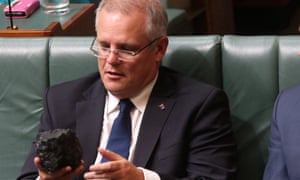
Then treasurer Scott Morrison with a lump of coal during question time in the house of representatives in parliament house, Canberra, 9 February 2017
‘The problem, as we are now seeing, is that
 the industry associations are also heavily
invested in our political processes,
to the detriment of us all.’
While unprecedented bushfires burn across the country – first in New South Wales and Queensland, then in Western Australia and now in South Australia and Victoria – it is worth pausing for a moment on the word “unprecedented” to let it sink in. Unprecedented does not mean unexpected. At BP, over 20 years ago, we acknowledged climate change and what it would bring and that we needed to reduce emissions. Our acknowledgment brought cries of foul from industry associations and many peer companies.

30 August, 2019

Australia’s carbon emissions rise again, largely thanks to LNG industry

Australia’s greenhouse gas emissions continue to rise despite the Morrison government claiming it is taking “sensible, responsible action” to address the climate crisis, the latest official data shows.
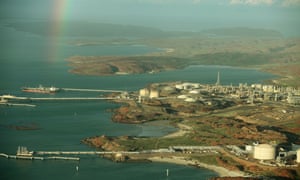
LNG industry in Western Australia
Part of the LNG projects in the north of Western Australia.
 The growth of the industry is primarily responsible for
 the recent rises in Australia’s greenhouse gas emissions.
National emissions increased by 3.1m tonnes in the year to March to reach 538.9m tonnes, a 0.6% jump on the previous year, the report released on Friday revealed.

Carbon dioxide emissions from electricity generation continue to decrease, reflecting the falling cost of solar and wind energy, but this is being more than cancelled out by the growth in emissions from the liquefied natural gas (LNG) export industry, mostly in northern Western Australia. Emissions from LNG were up 4.7m tonnes over the year.


Read the story from The Guardian by Adam Morton -  “Australia’s carbon emissions rise again, largely thanks to LNG industry.” 

17 September, 2018

Nature’s furies batter Asia and the United States

Hong Kong: Death tolls are expected to rise as the two storms that have lashed the Philippines and China and North Carolina continue to wreak havoc.
A police officer carries a girl in rain during a No 10
 Hurricane Signal raised for Typhoon Mangkhut in
Hong Kong on Sunday.
Typhoon Mangkhut battered Hong Kong and threatened the southern coast of China on Sunday, after cutting a destructive path through the Philippines and killing dozens of people there.


Read the story from The Age - “Nature’s furies batter Asia and the United States.”

14 May, 2018

Gas boom fuels Australia's third straight year of rising emissions

Australia’s greenhouse gas emissions continue to soar, increasing for the third consecutive year according to new data published by the Department of Environment and Energy.
Greenhouse gas emissions were driven by an
 increase of 17.6% in natural gas production.
The Turnbull government published new quarterly emissions data late on Friday which reveals Australia’s climate pollution increased by 1.5% in the year to December 2017.

The expansion in LNG exports and production is identified as the major contributor to the increase, but the data shows a jump in emissions across all sectors – including waste, agriculture and transport – except for electricity, the one area that recorded a decrease in emissions.

Read the story bye Lisa Cox from The Guardian -  “Gas boom fuels Australia's third straight year of rising emissions.”

09 April, 2018

Record temperatures forecast as unseasonable heatwave hits southern Australia

Record-breaking temperatures will continue in southern parts of Australia this week, with Adelaide set to cop the brunt of the heat today.
Beachgoers can expect temperatures in the mid-30s early this week in Adelaide.
Temperatures have peaked in the mid-30s in Adelaide and an April heatwave record looks set to be broken in the state capital.

Extreme heat in early April is not abnormal, but with 34 degrees Celsius in Adelaide on Sunday, 35C forecast for today and 33C on Tuesday, a significant record is in danger.


Read the story by Camron Sleesor from ABC News - “Record temperatures forecast as unseasonable heatwave hits southern Australia.”

25 February, 2018

Sea levels could rise an extra 60cm if emission reductions are delayed until 2035, study finds

Global sea levels will continue to rise until at least 2300 regardless of how much we reduce our greenhouse gas emissions, according to new research published today.
Scientists say sea levels will continue to rise until at least 2300.
But for every five years until 2035 that we delay reaching net-zero carbon emissions, as committed to under the Paris agreement targets, sea levels will rise by about an extra 20 centimetres, the researchers found as part of the study published in Nature Communications.

They estimated average global sea levels would be between 0.7 and 1.2 metres above 2000 levels by 2300, depending on how quickly we can reduce our emissions.

The Paris agreement, to which Australia is a signatory, has a core aim of limiting global temperature rise this century to "well below" 2 degrees C above pre-industrial levels, and to pursue efforts to keep the rise below 1.5 degrees.


28 January, 2018

Hot and humid: Melbourne is about to get very muggy

Melburnians are going to continue sweating for another two days, with a forecast of 39 this afternoon and muggy conditions settling in.
Melburnians were getting their exercise in early at the Tan
 before the temperature hits a high of 39 degrees. 
The humid conditions are not expected to ease until Tuesday.

Saturday night was warm and sticky, with a minimum temperature of 22.7 at 3.10am and humidity around 91 percent. 

Don't bother changing the sheets yet though. Sunday night is going to be even hotter with a predicted minimum of 27 degrees and continuing high humidity.


Read the story by Jan Gilmore from today’s Melbourne Age - “Hot and humid: Melbourne is about to get very muggy.”

14 January, 2018

How Much Does Climate Change Cost? Try $1.5 Trillion (and Counting)

The Trump administration, and its allies in Congress, are fighting a losing war. They continue to press forward for the development of oil, gas, and coal when the rest of the world understands the implication of that folly. Global warming is the most pressing issue for our time. Period.
The thing is governments really have two choices when it comes to managing the impact on its people from global warming: spend money on trying to reduce the problem or spend money on cleaning up the catastrophes.
Firefighters clear debris from a mudslide in Los Angeles,
California on January 9, 2018. The deadly rain storm claimed
 the lives of 13 people in Santa Barbara County. Flash
flooding also occurred in the recently burned areas
of Ventura and Los Angeles counties.
The Trump administration is on the hook for the catastrophe. A report released Monday by The National Centers for Environmental Information pegged the total cost this year at $1.5 trillion, including estimates for Hurricanes Harvey, Irma, and Maria. (And that doesn’t even begin to count the human toll, lost lives, lost jobs, lost opportunity.)

I witnessed firsthand the impact of Hurricane Maria on the island of Dominica last month. We keep hearing stories about the power grid being down (similar to Puerto Rico) and you think, Why? It’s been months. Why aren’t the lights on? Then you see nearly every electrical pole on the island sideways. The entire grid needs to be rebuilt (or better, rethought) and that’s decades of infrastructure. So the figure of $1.5 trillion is far short of what will be needed. Nearly every electrical line, every other house, the damage was so widespread it’s impossible to overstate. And that’s just one island. Multiple the effect across the region. The planet.


Read Mark Trahant’s story on Yes! Magazine - “How Much Does Climate Change Cost? Try $1.5 Trillion (and Counting).”

18 December, 2017

Approaches to Food and Farming Sustainability

In principle, a truly sustainable agriculture system would be able continue indefinitely into the future without degrading its resource base. Since we — humanity — have already done a huge amount of damage to the world’s farmlands and soils, we need more than just sustainable agriculture, we need to create a regenerative farming system that builds soils, fixes carbon, and increases bioproductivity and diversity.

If we apply our ecological understanding of the carrying capacity and evolutionary dynamics of ecosystems, to the question what would a sustainable or regenerative agriculture system look like, we would pay attention to its resource base and how it is regenerate through natural cycles and closed loops. What is the resource base of an agricultural system?


Read Daniel Christian Wahl’s Medium story - “Approaches to Food and Farming Sustainability.”

06 October, 2017

Dehydration, death and power cuts: What 50C days would look like in Australia

Australia is hot. But future extreme hot weather will be worse still, with new research predicting that Sydney and Melbourne are on course for 50 degrees Celsius summer days by the 2040s if high greenhouse emissions continue.

That means that places such as Perth, Adelaide and various regional towns could conceivably hit that mark even sooner.

This trend is worrying, but not particularly surprising given the fact that Australia is setting hot weather records at 12 times the pace of cold ones. But it does call for an urgent response.

Most of us are used to hot weather, but temperatures of 50℃ present unprecedented challenges to our health, work, transport habits, leisure and exercise.


Read the piece from The Conversation by Liz Hanna of the Australian National University as published by ABC News - “Dehydration, death and power cuts: What 50C days would look like in Australia.”

24 September, 2017

Abrupt Climate Change: In Hurricane Harvey, Texans Reap What They Sow.

After 25 years of writing regarding looming abrupt climate change and biosphere collapse, nonetheless I find no succor that my predictions have come true with Hurricane Harvey. Firstly, my heart-felt sympathy goes out to the hardy Texans who continue to weather nature’s wrath on the Gulf Coast. I have had the fortune to spend some time in Port Aransas and Rockport areas visiting family and it is a beautiful spot full of warm, generous people.

“Hurricane Harvey is abrupt climate change. And it shows collapse of the atmosphere and ecosystems that threatens to destroy the biosphere and end being… Texas’ war against science and the natural world must draw to an end. Like waking up after a long drinking binge, it is time for Texans to sober up and accept their living large – as if the land, water, and air have no value – has brought them to the edge of utter ruin.” — Dr. Glen Barry

However, let there be no mistake (now comes the “tough love” part). Hurricane Harvey is a man-made disaster that has directly resulted from Texans’ oil addiction, anti-science denial, disdain for common sense regulations, and super-sized lifestyles.

So where did all that rain come from anyway? It’s global warming stupid.


The basics of climate science have been known for 100 years. Simply, what has occurred in the Gulf of Mexico with Hurricane Harvey is all about heat, which is growing because of fossil fuel emissions (the greenhouse gases that are released trap heat), including by Texans. Since 1970 the average temperature in the South has risen 3.3° F. Galveston Texas set a shocking 33 record temperatures since Nov. 1st of last year. Across Texas temperatures have been averaging 10° F warmer than usual.

Read the EcoInternet story by Dr Glen Barry - “Abrupt Climate Change: In Hurricane Harvey, Texans Reap What They Sow.”