Showing posts with label Australia. Show all posts

06 May, 2020

Garnaut: Australia will lose competitive advantage if no clean energy transition

A strong future Australian economy can be created by embracing a low emissions economy, and risks sacrificing much of its economic advantages if its doesn’t, according to one of Australia’s leading economists.
Garnaut: Australia will lose competitive advantage if no clean ...
Ross Garnaut - we need to accelerate our transition to renewable energy.
Addressing the Stimulus Summit co-hosted by the Smart Energy Council and RenewEconomy, leading economist Professor Ross Garnaut said that there is an increasing appreciation of the benefits of acting on climate change, and the opportunities that exist in accelerating the transition to a clean energy economy.
Expressing optimism about the opportunities that exist in a transition to zero net emissions, Garnaut said that the transition provides a way for Australia to invest in future industries, while also supporting the economy to recover after the impacts of Covid-19.
Read the story from RenewEconomy by Michael Mazengarb - “Garnaut: Australia will lose competitive advantage if no clean energy transition.”

29 April, 2020

Think of coronavirus as a test run: Australian military leaders warn we must prepare for worse

As Australia was swept by panic buying and medical shortages this year, the scenes were eerily familiar for one of the country's most senior military planners.
Portrait of a woman, close up.
Cheryl Durrant was the Department of Defence director of preparedness
 and mobilisation and warns Australia must do more to prepare for crises.
In a secret meeting only a year earlier, the Defence Department's director of preparedness Cheryl Durrant and a group of Australian industry leaders had predicted a strikingly similar scenario.
"We predicted the unpredictable," says Ms Durrant, who left the department in January.
"We knew the problems, we knew this might be coming, we knew that various things needed to be done."
The ABC has obtained a confidential report prepared for Defence just a year before the COVID-19 outbreak, which provides a forecast of Australia's vulnerabilities in a global crisis.
Read the ABC News story by Sean Rubinsztein and Kate Taylor - “Think of coronavirus as a test run: Australian military leaders warn we must prepare for worse.”

28 April, 2020

Here are 5 ways to flatten the climate change curve while stuck at home

After the horrors of the last bushfire season, climate action in Australia seemed to have new momentum. But then coronavirus struck. All of a sudden, the public was preoccupied by a different catastrophe.
Here are 5 ways to flatten the climate change curve while stuck at ...
Flattening the climate change curve while stuck at home.
But one positive has emerged from the devastation wrought by coronavirus: our ability to radically shift social and economic systems when needed. It shows real action on climate change is possible, and should encourage us to work towards that even as we stay at home.
I must note here that for some people right now, the focus is on simply surviving. Increased domestic violence risk, housing insecurity, unemployment, mental health issues and other forms of marginalisation means many have little energy for activism. 
Read the story from The Conversation by a Lecturer from the School of Media, Creative Arts and Social Inquiry art the Curtin University, Sky Crosier -  “Here are 5 ways to flatten the climate change curve while stuck at home.”

Government’s gas-led economic recovery plans questioned

Australia should follow the example of New Zealand and a growing number of European nations and design a long-term green stimulus package that both rebuilds the economy and cuts emissions, says the chairman of the Australian Renewable Energy Agency, Martijn Wilder.
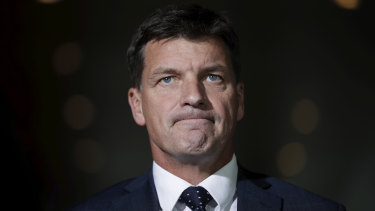
Energy and Emissions Reduction Minister Angus Taylor.
Energy and Emissions Reduction Minister, Angus Taylor.
“New Zealand policymakers have taken the view that since they are borrowing money [for stimulus] from future generations the manner in which it is spent has to serve those generations,” he said.
So far 17 European Union nations have signed on to a European Green Deal, agreeing to shape their recovery around policies designed to speed up their efforts to reach net-zero emissions.
A letter outlining the plan describes it as, “a new growth strategy that aims to transform the EU into a fair and prosperous society, with a modern, resource-efficient and competitive economy where there are no net emissions of greenhouse gases in 2050 and where economic growth is decoupled from resource use.”
Read the story from The Age by Nick O’Malley and Mike Foley - “Government’s gas-led economic recovery plans questioned.”

17 April, 2020

Land-Based Carbon Dioxide Removal Options for Victoria

This paper considers land-based carbon dioxide removal (CDR) approaches for Australia, looking specifically at Victoria in the context of considering how the land sector can contribute to a net-zero emissions goal under the Victorian Climate Change Act 2017.

While emissions from agricultural land have remained relatively stable for decades, emissions from land use, land-use change, and forestry activities in Australia have fluctuated dramatically, from a source in the 1990s and 2000s to a net sink today. However, this net sink is projected to decline over the next decade.
For Australia’s land sector overall to make a major contribution to climate mitigation through CDR, land clearing and deforestation would need to be further reduced, while the CDR potential of other activities (forest management, reforestation, farm forestry, plantations, soil management) is enhanced beyond current projections. This paper suggests there is potential for this to be done in Victoria, with significant economic and ecological co-benefits for biodiversity, agricultural productivity and ecosystem services.
In this report the authors identify four broad activities which could have a significant carbon sequestration potential in Australia and Victoria in particular. These are native forest regeneration, carbon and environmental plantings, soil carbon removal, and restoration of degraded lands.
Read the report from Melbourne Sustainable Society Institute - “Land-Based Carbon Dioxide Removal Options for Victoria.”

04 April, 2020

Report maps out ways to reach climate targets and regenerate economy

Australia still has a chance to use existing technologies to tackle climate change and maintain living standards while creating new jobs, an exhaustive new study has found, but only if individuals, businesses and government act quickly to reduce emissions from every sector of the economy.
Australia can meet its international climate change commitments and create jobs during the recovery phase from the coronavirus recessions, according to a new report from ClimateWorks.
Australia can meet its international climate change commitments and create
jobs during the recovery phase from the coronavirus recessions, according
to a new report from ClimateWorks.
The report by ClimateWorks, called Decarbonising Futures, maps out in detail how Australia could go about achieving emissions reductions required across industry sectors to limit global warming to below 2 degrees, or to the more ambitious 1.5 degree target under the Paris climate agreement.
"If we get this right, we can meet Australia's international climate change commitments, create jobs in sustainable industries, and set ourselves up for a smoother and speedier shift to a zero-emissions economy," said Anna Skarbek, the chief executive of ClimateWorks, a policy advisory body housed in Monash University.
She said the coronavirus pandemic has made the need for immediate "all-in" action even more urgent as governments spend the coming weeks and months planning how they will stimulate their economies as the crisis passes.

Read the story from The Age by Nike O’Malley and Mike Foley - “Report maps out ways to reach climate targets and regenerate economy.”

12 March, 2020

Electric buses can reduce costs, improve air quality and support local industries

In Australia, technology and industry are ready for policy support to aid the transition from diesel. Precision Buses in Adelaide is producing electric buses locally as part of contracts with South Australia, NSW, Queensland and Victoria and Australia’s largest bus body manufacturer, Volgren has begun production of electric buses at their headquarters in Melbourne.
Image result for precision buses
Electric buses cut costs, improve air quality and support local industries.
In December 2019, ClimateWorks Australia was invited to make a submission to the New South Wales government inquiry into electric buses for regional and metropolitan public transport networks. With transport currently contributing 21% of the state’s annual greenhouse gas emissions, decarbonising transport systems is critical to achieving the NSW Government’s net zero emissions objective. States have the chance to drive a rapid transition to reduce emissions by electrifying bus fleets and powering vehicles with 100% renewable energy.
Existing trials show the moment is ready to be seized. Transit Systems Leichhardt depot is trialling electric buses on some of Sydney’s busiest routes. Premier is already trialling an electric bus from their Nowra depot, with reports that the bus can cover 290km per day across 15 hour shifts, returning with a 45% charged battery, and that the electric bus has reduced daily running costs 72% compared to diesel buses. Public transport can be powered by renewable energy, as demonstrated with Sydney’s Metro NorthWest sourcing all the project electricity needs from NSW’s Beryl Solar Farm.

26 February, 2020

A net-zero emissions future provides a great opportunity for farmers

The recent announcement by federal Labor to target net zero emissions by 2050 provides a great opportunity for the agricultural sector in Australia to diversify and thrive.  I’ve watched with interest as some suggest this policy will wipe out Australian agriculture, just as they hypothesised the same for the fossil fuel industry. Nothing could be further from the truth. I see there is a huge opportunity for both farmers and brand Australia. However, we need to compare apples with apples – not apples to coal, as some are trying to do.
Although agricultural production contributes around 15 per cent of emissions, it also provides the greatest opportunity to reverse the current trajectory and get a two-for-one benefit in the process.
The red meat industry is committed to net zero emissions by 2030.
You see, investing in research and helping farmers change some agricultural practices will not only reduce CO2 and greenhouse gas emissions but sequestering carbon can actually reverse some of the damage. Additionally it makes famers more resilient to climate change.


Read the story from The Sydney Morning Herald by Niall Blair - “A net-zero emissions future provides a great opportunity for farmers.”

22 February, 2020

Bushfires and Climate Change

In the last decade, the incidence, severity and scale of bushfires has rapidly increased internationally. Australia is among the most fire-prone countries in the world.  In fact, bushfires increased in frequency by 40% in the five years to 2016.

This growth in bushfires reflects the international failure to adequately respond to climate change by reducing greenhouse gas emissions. Australia in particular has one of the weakest targets amongst developed countries, despite its relative wealth and institutional capacity to respond.
The 20 warmest years on record have been in the past 22 years. Scientific evidence unequivocally links human-caused climate change to the increasing risk of frequent and severe bushfires in the Australian landscape, with a rise in bushfires predicted a decade ago.
As of 22 January 2020, the 2019–2020 bushfires have emitted 400 megatonnes of carbon dioxide into the atmosphere, equivalent to 75% of Australia’s average annual carbon emissions.

Read the story from, the Melbourne Sustainable Society Institute by Associate Professor Janet Stanley - “Bushfires and Climate Change.”

18 February, 2020

The End of Australia as We Know It

SYDNEY, Australia — In a country where there has always been more space than people, where the land and wildlife are cherished like a Picasso, nature is closing in. Fueled by climate change and the world’s refusal to address it, the fires that have burned across Australia are not just destroying lives, or turning forests as large as nations into ashen moonscapes.
Image result for The End of Australia as We Know It
Firefighters on the outskirts of Bredbo, New South Wales, Australia, on February 1.
They are also forcing Australians to imagine an entirely new way of life. When summer is feared. When air filters hum in homes that are bunkers, with kids kept indoors. When birdsong and the rustle of marsupials in the bush give way to an eerie, smoky silence.
“I am standing here a traveler from a new reality, a burning Australia,” Lynette Wallworth, an Australian filmmaker, told a crowd of international executives and politicians in Davos, Switzerland, last month. “What was feared and what was warned is no longer in our future, a topic for debate — it is here.”
“We have seen,” she added, “the unfolding wings of climate change.”
Like the fires, it’s a metaphor that lingers. What many of us have witnessed this fire season does feel alive, like a monstrous gathering force threatening to devour what we hold most dear on a continent that will grow only hotter, drier and more flammable as global temperatures rise.

Read the story from The New York Times by Damien Cave - "The End of Australia as We Know It.”

16 February, 2020

Barnaby digs for coal on the moral high ground. How did we get here?

Now that Barnaby Joyce and Matt Canavan have created their own buddy podcast, we can be fairly sure the medium has peaked. Teenagers across Australia had better hope the pair don’t take next to Tik-Tok, or it too will be ruined by association. As for Snapchat, we pray Joyce has never heard of it.
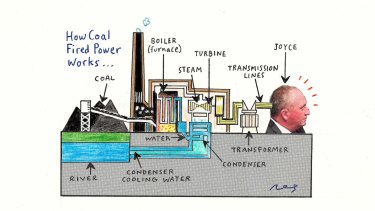
Illustration: Reg Lynch.
Long has the member for New England exhausted the mainstream media with his need for attention, and yet it’s strangely difficult to recall any formal policy positions he has fought for.
Not content with drenching the traditional airwaves with himself, this week Joyce was conscripted by his former chief of staff, the recently departed resources minister, Matt Canavan, to break the internet with their own podcast, Weatherboard and Iron.
The trend of politicians podcasting is a worrying one – Christopher Pyne, the former defence minister-turned lobbyist, recently launched one. Julia Gillard has one too.

Read the opinion piece from The Age by Jacqueline Maley - “Barnaby digs for coal on the moral high ground. How did we get here?

13 February, 2020

Indian Ocean Dipole linked to global warming in new research by Australian scientists

One of the big drivers of drought in Australia, the Indian Ocean Dipole, is trending towards a more drought-causing positive state due to climate change, according to new research.
Cracked earth in drought conditions.
Extreme positive Indian Ocean Dipole events have
 been strongly linked to drought in Australia.
Professor Nerilie Abram from the ANU Research School of Earth Sciences said the changes were occurring in the Indian Ocean Dipole's (IOD) behaviour. 
"That is going to increase the risk that we will have these very dry and hot years and those are the years where we precondition our landscape to burn," she said.
The 2019 drought occurred at a time where the Indian Ocean Dipole was at a record positive level. 
Extreme positive IOD events have been strongly linked to drought in Australia.

06 February, 2020

Climate change claim questioned

I note the comments made by Federal Member for Nicholls Damian Drum (News, February 4) and would contest many of his facts and statements but none more than his contention that ‘‘Australia leads the world’’.
This claim couldn’t be further from the truth on the international stage where Australia has played a destructive role from Kyoto negotiations in 1997 to the most recent gathering of nations in Madrid last year, with its intention to use Kyoto ‘‘credits’’ to meet its Paris Agreement targets.
"Those credits are highly
contentious" - John Pettigrew.
These ‘‘credits’’ are highly contentious for two reasons: how they were achieved and the intention to use these credits to weaken Australia’s response to the Paris Agreement.
Australia’s Kyoto delegation was dominated by representatives of the fossil fuel industries and led by Coalition Environment Minister Senator Robert Hill.
Throughout these negotiations Australia demanded special treatment, despite being one of the most affluent of developed countries and the highest per capita emitter in the world.
Australia negotiated a target at Kyoto in 1997 which allowed an increase in Australia’s greenhouse emissions by eight per cent above 1990 levels, three per cent higher than other developed countries.
Not satisfied with this concession, the Australian delegation then demanded what is known as ‘‘the Australia clause’’, which allowed the inclusion of carbon emission credits from reduced land clearing.
This inclusion allowed Australia’s emissions from fossil fuels to potentially rise by 25 to 30 per cent above 1990 levels as land clearing (not occurring in other developed countries) had already reduced dramatically at the time.
The Howard Government then, after demanding these concessions and undermining global emission targets, refused to ratify the Kyoto Agreement.
Australia, in announcing its intention to use ‘‘surplus’’ Kyoto credits to achieve its modest Paris targets, has again put our country at odds with the rest of the world and is again holding back global action to reduce emissions.
The Coalition Government was elected with an emission reduction target of 26 to 28 per cent by 2030 on 2005 levels, a clear mandate.
However, the use of ‘‘Kyoto credits’’ was never mentioned before or during this election and cannot be seen in any way as being endorsed by the electorate.
In September last year, Prime Minister Morrison twice told Today our per capita emissions would fall by half between now and 2030: ‘‘We will reduce our carbon emissions per capita by half between now and 2030.
‘‘Our per capita emissions will fall by half over the next 10 years.’’
If, as Prime Minister Morrison insists, Australia will meet its Paris targets ‘‘in a canter’’, why would Australia continue to threaten the use of Kyoto credits?
Australia should drop any intention to use these dubious credits and join with nations of the world to ensure that realistic and ambitious carbon reduction targets are set and met.

Letter from John Pettigrew, Bunbartha, published in The Shepparton News - “Climate change claim questioned”


01 February, 2020

On Australia’s Kangaroo Island, a fight to stay alive

KANGAROO ISLAND, Australia — The bend in the eucalyptus branch seemed like a custom home-design feature given how perfectly it fit his tiny form. There in the crook of the tree was a koala, mildly burned and all alone.
A koala climbs a charred eucalyptus tree as members of Humane Society International try to catch it on Kangaroo Island, Australia. (Ricky Carioti/The Washington Post)
A koala climbs a charred eucalyptus tree as
members of Humane Society International
try to catch it on Kangaroo Island, Australia.
His patch of wood, shared once by hundreds of other koalas, kangaroos and the occasional wombat, had been scorched black in the recent wildfires. For the moment, he was safe there about 50 feet up. But there was no water or food; the eucalyptus leaves that koalas eat had vanished in the flames.
On the ground, there was only black earth and carcasses. Dozens of carcasses, babies and adults, teens and what a rescuer said looked like twins — all so burned even the carrion birds would not touch them.
The fires that roared through southeastern Australia for months razed hundreds of houses and killed more than 20 people, including several firefighters. A scar the size of Portugal now marks the land, a varying mix of tropical forest, eucalyptus and red-earth plains.

Read the story from The Washington Post by Scott Wilson - “On Australia’s Kangaroo Island, a fight to stay alive.”

28 January, 2020

Australia’s Devastating Wildfires Were Not Inevitable

Blue Mountains, Australia—“There is no one in this current federal government that has any semblance of a sense of crisis,” Mark Greenhill tells me as we sit in his mayoral office in Katoomba, a small town some 100 kilometers west of Sydney. It is December 19. For over a month, three massive bushfires have plagued this small mountain community, a UNESCO World Heritage site, ravaging its ecosystem and laying waste to residents’ homes. I could smell the smoke in Sydney that morning; the haze descended on the city at least a dozen times in the past month, casting a sepia-toned pall and tripping office fire alarms. But it was nothing compared with Katoomba, where my eyes began to burn the moment I stepped off the train.

The country was once actually poised to lead on climate politics, and now, it burns.

As Greenhill speaks, his eyes dart to the window behind me. “Oh, fuck,” he says. I turn to look. A thick gray plume is billowing up from the trees just north of us. He jumps up and rushes to the window. “That is a cloud of fire,” he says. “That’s climate change right there.” A moment passes as the two of us stand in silence. “So, so,” he continues, picking up his train of thought, “there’s no sense of that national crisis. And that’s what we’re missing.” He points back to the fire cloud—“I’m just going to find out what that is”—and begins texting furiously. 
The technical term for what we saw that day is “pyrocumulonimbus,” or “pyroCb” for short. PyroCbs are weather events generated by wildfires. They can produce dry lightning storms, high winds, even full-blown tornadoes. (An aerial photo of the Hiroshima bombing, long thought to capture the distinctive nuclear mushroom cloud, was only recently reidentified as an image of the pyroCb from the ensuing firestorm that swept through the city.) In recent weeks, “pyroCb” has become a household term in Australia—a literal manifestation of the fires but also a symbol, nudging us to see what is happening to the country in the terms of armed conflict. As the fires tear through town after town with ruthless efficiency, pyroCbs lend them the look of an airborne attack: climate blitzkrieg. When Prime Minister Scott Morrison called in the navy to evacuate thousands of people stranded on beaches and mobilized the Australian Defence Force to help fight the fires, the symbolism became reality. Australia went to war with itself.

Read the story from The Nation by Daniel Judt - “Australia’s Devastating Wildfires Were Not Inevitable.”

The Australia fires portend a future of climate apartheid

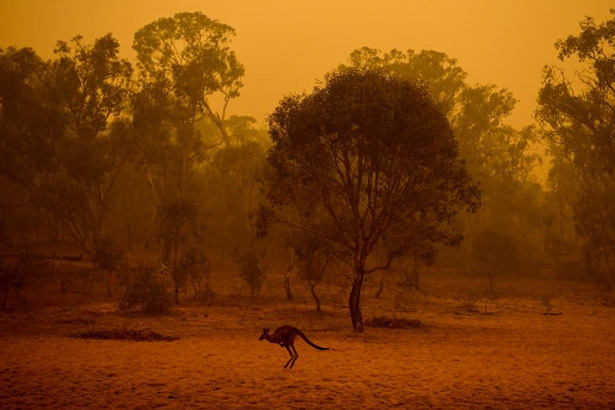
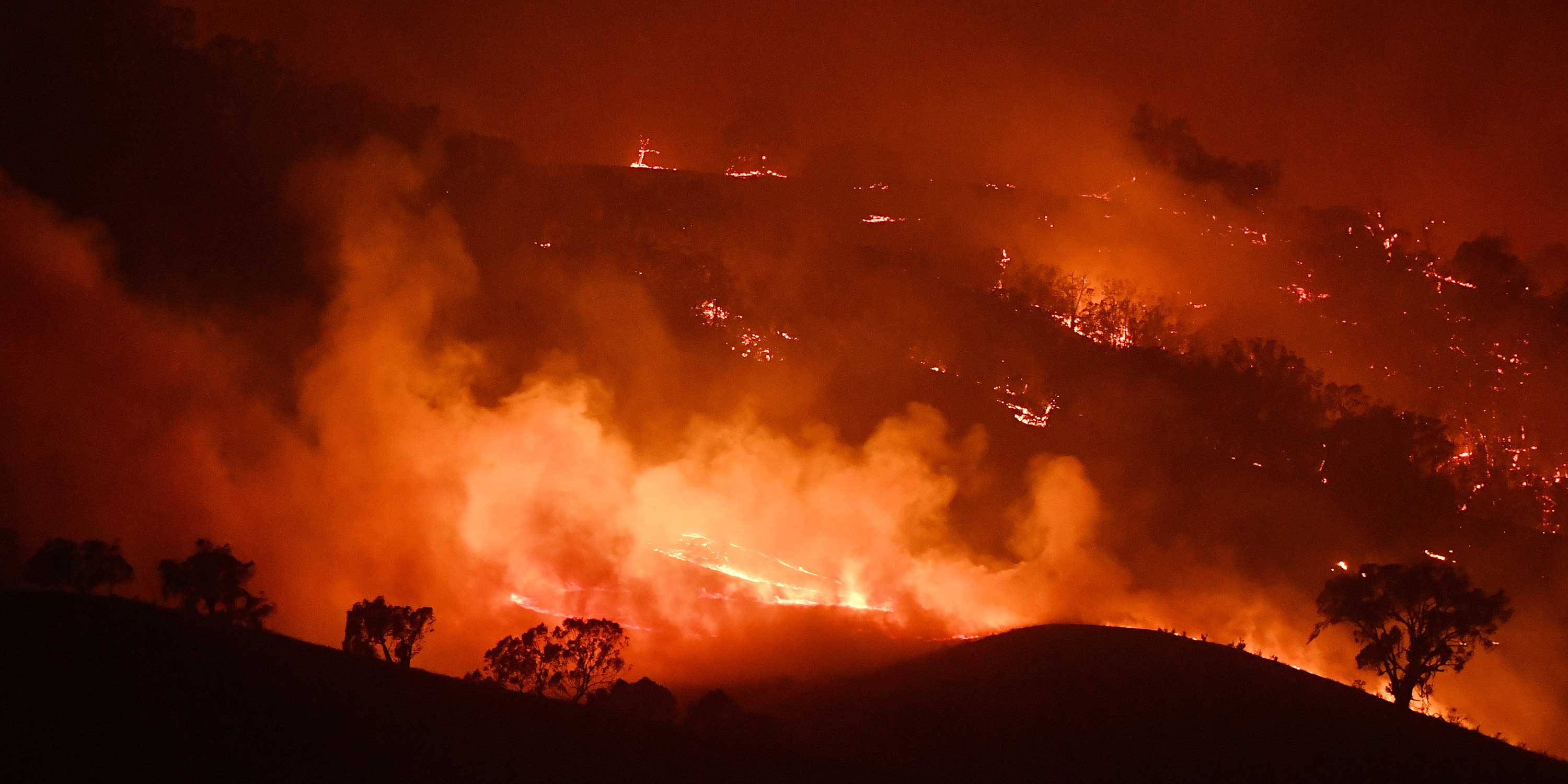
It will be a long hot summer in Australia. Fires of almost biblical proportions have swept across the country, devastating land, property and wildlife. More than 30 people have been killed, a billion animals have died, and more than 3,000 homes have been burned down. The cost of the bushfires has been estimated at $2bn and could climb even further.
Rural Fire Service (RFS) volunteers and NSW Fire and Rescue officers fight a bushfire encroaching on properties near Termeil, Australia on December, 3, 2019 [AAP image via Reuters/Dean Lewins]
Rural Fire Service (RFS) volunteers and NSW Fire and Rescue
 officers fight a bushfire encroaching on properties near Termeil,
 Australia on December, 3, 2019
Although heavy rain and lower temperatures this month have helped put out some fires, the threat of the blaze coming back is still imminent
Meanwhile, Australian Prime Minister Scott Morrison's response to this environmental catastrophe has been to refuse to expand measures to combat climate change. In December, as the death toll was climbing and Australian fire brigades struggled to control the fires, the prime minister left the country for a holiday in Hawaii.
His attitude and actions illustrate quite well just how the wealthy and their political allies plan to rule our burning planet.

Read the story from Al Jazeera by David A. Love - “The Australia fires portend a future of climate apartheid.”

The tide is coming: why our beaches are vanishing

Australia is crumbling into the sea. Experts estimate there are hundreds of beaches and coastal communities around the country at risk from coastal erosion. Within decades, as sea levels rise, that number could be in the thousands.
Last year, the Western Australian state government identified 55 “hotspots” where coastal erosion is expected to cause serious issues within 25 years. Towns up and down the coast are seeing roads washed away, and buildings and homes under threat.
In July last year, WA Emergency Services Minister Fran Logan told the ABC that dumping sand on the coast to try and hold the sea back was not a viable long-term solution. Entire coastal communities would simply need to retreat.
It’s the same all over the country. Sections of Victoria’s iconic Great Ocean Road risk being washed away within five years. At Inverloch, south-east of Melbourne, erosion has melted away a remarkable 50 metres of the coast in seven years — including 20 metres since the beginning of 2019. Truckloads of imported sand and a “wet” sand fence have been dumped as protection. The remedy has failed.

Read the story from Crikey by Charlie Lewis and Kishor Napier-Raman - “The tide is coming: why our beaches are vanishing.”

26 January, 2020

How Does a Nation Adapt to Its Own Murder?

BRUNY ISLAND, Australia — The name of the future is Australia.
These words come from it, and they may be your tomorrow: P2 masks, evacuation orders, climate refugees, ocher skies, warning sirens, ember storms, blood suns, fear, air purifiers and communities reduced to third-world camps.
Billions of dead animals and birds bloating and rotting. Hundreds of Indigenous cultural and spiritual sites damaged or destroyed by bush fires, so many black Notre Dames — the physical expression of Indigenous Australians’ spiritual connection to the land severed, a final violence after centuries of dispossession.
Everywhere there is a brittle grief, and it may be as much for what is coming as for what is gone.
The dairy farmer Farran Terlich, whose properties in the South Coast were razed in a firestorm that killed two of his friends, described the blaze as “a raging ocean.” “These communities are destroyed across the board,” he said, “and most people are running dead.”
Dead, too, is a way of life.
Read the story from The NewYork Times by Richard Flanagan - “How Does a Nation Adapt to Its Own Murder?

If you love Australia, climate change should scare the hell out of you

I love Australia.
Bushfire
Australia is a nation on the extremities, where climate change will
 affect and strip away what we love much sooner than will
 occur in Europe and North America.’
It’s not a thing you hear too often from progressives. Mostly this is because we don’t go in for the pathetic jingo-nationalist, quasi-militaristic “love it or leave it”-style patriotism that John Howard attempted to link with a love of country.
But I do love Australia. I get an absurd amount of irrational pride when I hear of Australians doing well.
When I read stories that Indigenous rock art might be among the oldest in the world I get excited and think, yeah suck it, caves of Cantabria!
I can still remember where I was when John Aloisi scored the winning penalty against Uruguay (jumping up in my home in Cairns and cutting my hand on the overhead fan), and like all sensible Australians I let out a deep groan whenever I hear someone start yet again an “Aussie, Aussie, Aussie” chant at the tennis.

Read the story from The Guardian by Greg Jericho - “If you love Australia, climate change should scare the hell out of you.” 

18 January, 2020

To Help Australia, Look to Aboriginal Fire Management

Since September 2019, Australia has been ravaged by bushfires. You know the statistics: about 18 million acres burned, around 2,000 homes destroyed, and nearly 1 billion animals affected. The fires have also affected Aboriginal communities and lands.
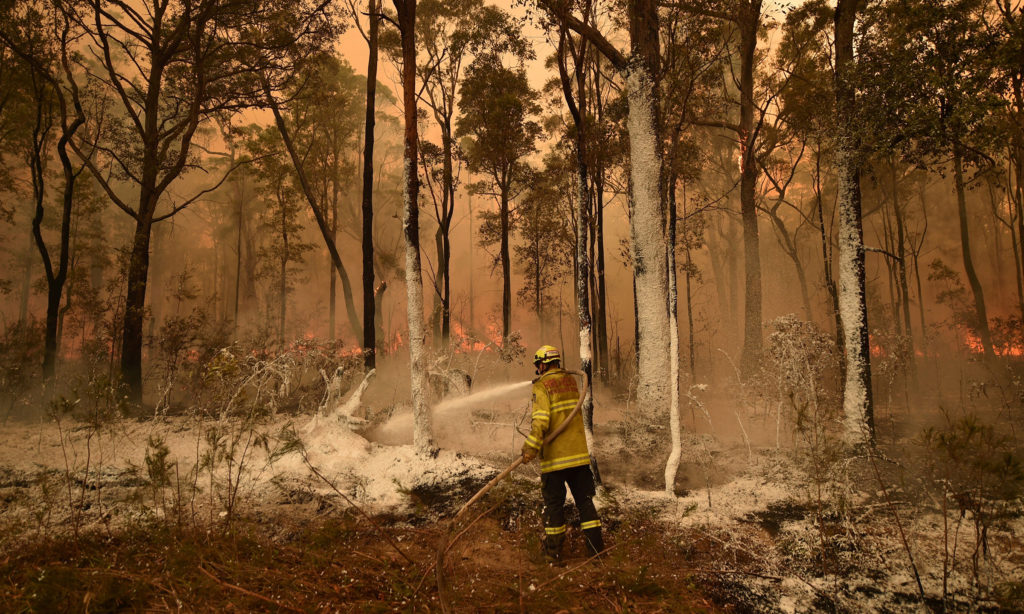
A firefighter sprays foam retardant on a back burn ahead of
a fire front in the New South Wales town of Jerrawangala on Jan. 1, 2020. 
On January 3, the small Aboriginal community of Mogo, New South Wales, was destroyed, including the homes of five members of the local Aboriginal Land Council and the Land Council building. In Victoria, the Aboriginal community of Lake Tyer has been on high alert, as the East Gippsland bushfires burn just 20 kilometers away. Indigenous Protected Areas—reserved areas of land managed by local Indigenous people—have been devastated as well. Russell Irving, project coordinator at the Minyumai Indigenous Protected Area in New South Wales, noted in a November statement that, “We and many of our small-scale farmer neighbours are at threat of becoming members of the rapidly growing number of climate refugees in our own country.”
Historically, bushfires in Australia were a lot less common than they are today. Climate change is partially to blame. Temperatures have risen dramatically in Australia over the last century, causing more extreme droughts and unpredictable fire seasons. But the ongoing impacts of colonialism—including poor land management—is also part of the puzzle. For tens of thousands of years, Aboriginal Australians managed their environment through controlled burns. These fires continue to shape Australia’s landscape. In the Central Arnhem region in northern Australia, for example, a study found kangaroos were more abundant in areas that had been burned by Aboriginal people, because the grass in burned areas was more nitrogen-rich than grass in non-burned areas.

Read the story from Yes! magazine by Abaki Beck - “To Help Australia, Look to Aboriginal Fire Management.”