Showing posts with label wildlife. Show all posts

30 March, 2020

‘Probably the worst year in a century': the environmental toll of 2019

Record heat and drought across Australia delivered the worst environmental conditions across the country since at least 2000, with river flows, tree cover and wildlife being hit on an “unprecedented scale”, according to a new report.
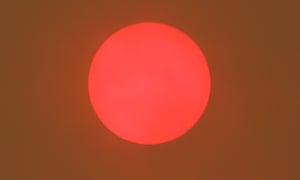
The sun glows red during the ACT bushfires
The sun glows red during the ACT bushfires, one of
the events that contributed to a disastrous 2019
 for the environment in Australia.
The index of environmental conditions in Australia scored 2019 at 0.8 out of 10 – the worst result across all the years analysed from 2000.
The year delivered unprecedented bushfires, record heat, very low soil moisture, low vegetation growth and 40 additions to the threatened species list.
The report’s lead author, Prof Albert van Dijk of the Australian National University’s Fenner school of environment and society, told Guardian Australia 2019 was “probably the worst in a century or more” for the environment.

Read the story from The Guardian by Graham Readfearn - “‘Probably the worst year in a century': the environmental toll of 2019.”

28 January, 2020

The Australia fires portend a future of climate apartheid

It will be a long hot summer in Australia. Fires of almost biblical proportions have swept across the country, devastating land, property and wildlife. More than 30 people have been killed, a billion animals have died, and more than 3,000 homes have been burned down. The cost of the bushfires has been estimated at $2bn and could climb even further.
Rural Fire Service (RFS) volunteers and NSW Fire and Rescue officers fight a bushfire encroaching on properties near Termeil, Australia on December, 3, 2019 [AAP image via Reuters/Dean Lewins]
Rural Fire Service (RFS) volunteers and NSW Fire and Rescue
 officers fight a bushfire encroaching on properties near Termeil,
 Australia on December, 3, 2019
Although heavy rain and lower temperatures this month have helped put out some fires, the threat of the blaze coming back is still imminent
Meanwhile, Australian Prime Minister Scott Morrison's response to this environmental catastrophe has been to refuse to expand measures to combat climate change. In December, as the death toll was climbing and Australian fire brigades struggled to control the fires, the prime minister left the country for a holiday in Hawaii.
His attitude and actions illustrate quite well just how the wealthy and their political allies plan to rule our burning planet.

Read the story from Al Jazeera by David A. Love - “The Australia fires portend a future of climate apartheid.”

24 June, 2018

Wild dogs make a return to help restore the ecological balance

There are just 14 of them, far fewer than those that roamed Mozambique's Gorongosa National Park before the nearly two-decade civil war that started in the 1970s. As up to a million people lost their lives to violence and famine, much of the park's wildlife also was wiped out - including the wild dogs, an endangered species vulnerable to snares and disease.
In this undated photo supplied by Gorogosa Media,
a pack of wild dogs make their way down a road in Mozambique.
Now they have been re-introduced to Gorongosa, carnivores unleashed on plant eaters as part of an intricate conservation project that aims to restore a diverse ecosystem at the southern end of Africa's Great Rift Valley.


02 June, 2018

Victoria’s plan to control 'feral horses' puts it at odds with NSW

Victoria has challenged NSW over its plan to extend protection to wild horses in the Kosciuszko National Park, introducing a rival strategy to control animals it says are "causing significant damage to threatened plants and other wildlife”.
Brumbies in the Kiandra high country, in the Kosciuszko National Park.
The Andrews government's Feral Horse Strategic Action Plan, released on Saturday, contradicts the Berejiklian Coalition government's bill, now before the NSW Parliament, to protect what it dubs "heritage horses”.

"Horses are not a natural part of the Australian environment," the Victorian plan states. "Their hard hooves can cause serious damage to alpine, subalpine, montane and floodplain environments.”


Read Peter Hannam’s story from The Age - “Victoria’s plan to control 'feral horses' puts it at odds with NSW.”

30 March, 2018

The plastics crisis is more urgent than you know. Recycling bottles won’t fix it

West Wales, last weekend. The old foam mattress lying waterlogged on an otherwise clean beach might have been at sea for months before it was washed up on the tide. A large bit of it had broken off, and the rest was crumbling. It was a clear threat to wildlife, so we heaved what was left of it above the wave line and promised to come back to dispose of it properly when it was dry.
 Illustration by Eva Bee
But how do you safely dispose of an old mattress made of billions of tiny plastic particles leaking formaldehyde and other potentially dangerous chemicals? Do you burn it? Bury it? Do you expect the company who made it to come to collect it? Answers to environment secretary Michael Gove, who today pledged to stem the tide of plastic debris by announcing a consultation on a plastic-bottle return scheme for England, which aims to get people to recycle more.


Read John Vidal’s comment from The Guardian - “The plastics crisis is more urgent than you know. Recycling bottles won’t fix it.”

29 March, 2017

Australia’s animals and plants are changing to keep up with the climate

Climate change is one of the greatest threats facing Australia’s wildlife, plants and ecosystems, a point driven home by two consecutive years of mass coral bleaching on the Great Barrier Reef.

Flora and fauna can adapt to climate change,
but some are more successful than others.
Yet among this growing destruction there is a degree of resilience to climate change, as Australian animals and plants evolve and adapt.

Some of this resilience is genetic, at the DNA level. Natural selection favours forms of genes that help organisms withstand hotter and drier conditions more effectively.

Over time, the environmental selection for certain forms of genes over others leads to genetic changes. These genetic changes can be complex, involving many genes interacting together, but they are sufficient to make organisms highly tolerant to extreme conditions.


Read the piece by a professor from the School of BioSciences and Bio21 Institute at the University of Melbourne, Ary Hoffmann, on The Conversation - “Australia’s animals and plants are changing to keep up with the climate.”

21 January, 2016

Let's not forget the purpose of public land: Marissa Knodel


Marissa Knodel - she
writes about the urgency
to protect public land.
Established in 1908 by President Theodore Roosevelt, the Malheur National Wildlife Refuge in eastern Oregon encompasses nearly 188,000 acres of resting, breeding and nesting habitat for hundreds of migratory birds and other species. Its purpose is to protect these bird species and provide a pristine area for birding, fishing, hunting and hiking. Lately, however, it’s been making headlines for far different reasons.

Starting January 2, a self-proclaimed militia broke into the abandoned headquarters at the Malheur Refuge, following a demonstration in support of Dwight and Steven Hammond, arrested for arson after setting fires that spread to public land in 2001 and 2006. Boiled down to the essentials, the leaders of the occupationAmmon and Ryan Bundydescribe this dispute as a battle between the federal government and the American people over land and resources, land that the American government took from the Paiute people, and which they still consider sacred. Yet their father, rancher Cliven Bundy, has robbed taxpayers of more than one million dollars for the right to graze cattle on public lands. The Bundys claim their armed occupation is about taking a hard stance against the federal government for the people, and that they are prepared to remain for years until the federal government relinquishes control of the wildlife refuge.

Read Marisa Knodel’s Friends of the Earth story - “Public lands for the people and by the people, not the Bundys.”

14 September, 2015

Godzilla’ El Niño to produce mega-droughts


W

alking on cornflakes. That’s what it sounds like to hike through a rainforest in the grip of a strong drought. Each step crackles with dry snapping twigs and leaves. It’s frustrating for field biologists like us – we can forget about glimpsing anything but the most oblivious of wildlife.

Rainforests aren’t supposed to be bone-dry like this, and normally they’re not. But at our Daintree Drought Experiment in far north Queensland, we and our colleagues have suspended more than 3,000 plastic panels above the forest floor to create an artificial mega-drought. The experiment began only three months ago but already the rainforest beneath is wilted and hurting.

Read The Conversation story - “‘Godzilla’ El Niño: time to prepare for mega-droughts”.