Showing posts with label coral bleaching. Show all posts

23 March, 2020

Great Barrier Reef watchers anxiously await evidence of coral bleaching from aerial surveys

The full impact of coral bleaching across the Great Barrier Reef will become clearer this week as aerial surveys of hundreds of reefs are completed in the bottom two thirds of the world’s biggest reef system.
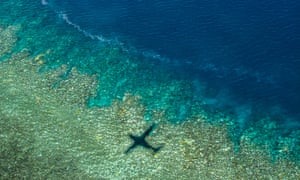
Great Barrier Reef aerial survey
Aerial surveys this week are expected to reveal the extent of
coral bleaching on the Great Barrier Reef over the summer.
An aerial survey carried out last week over almost 500 individual reefs between the Torres Strait and Cairns revealed some severe bleaching of corals closer to shore, but almost none on outer reefs.
From Monday the spotter plane will head south over reefs where satellite observations and temperature readings have shown corals are likely to have undergone higher levels of heat stress than those in the north.
Scientists fear those corals could be found to have been badly bleached, as they are less used to higher temperatures and had escaped major impacts in 2016 and 2017.

Read the story from The Guardian by Graham Readfearn - “Great Barrier Reef watchers anxiously await evidence of coral bleaching from aerial surveys.”

20 February, 2020

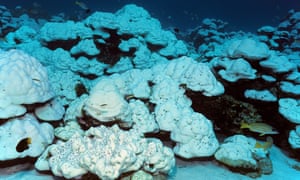
Great Barrier Reef on brink of third major coral bleaching in five years, scientists warn

The Great Barrier Reef could be heading for a third major coral bleaching outbreak in the space of five years if high ocean temperatures in the region do not drop in the next two weeks, scientists and conservationists have warned.
The Great Barrier Reef
The Great Barrier Reef could be facing
 another major coral bleaching outbreak.
Heat stress is already building across the world’s biggest reef system, with reports of patchy bleaching already occurring. But a major widespread event is not currently taking place.
“We are down to the wire,” said Prof Terry Hughes, director of the ARC Centre of Excellence for Coral Reef Studies at James Cook University.
The Great Barrier Reef Marine Park Authority is closely monitoring conditions. Areas of heat stress are spreading, particularly across the central and southern areas that are popular with tourists.

Read the story from The Guardian by Graham Readfearn - “Great Barrier Reef on brink of third major coral bleaching in five years, scientists warn.”

31 August, 2019

Great Barrier Reef outlook downgraded to 'very poor' as threats mount

The Great Barrier Reef is at "a critical point" with the marine park's outlook downgraded on Friday from "poor" to "very poor" due to coral bleaching and deforestation.
The Great Barrier Reef has had its outlook downgraded in a further sign that scientists fear for the future of the world's largest reef system as climate change and other threats mount.
The Great Barrier Reef has had its outlook downgraded in a further
 sign that scientists fear for the future of the world's largest reef
 system as climate change and other threats mount.
Climate change resulting in rising sea temperatures was blamed in the federal government's five-year Great Barrier Reef Outlook Report 2019 highlighting the most significant threats to the reef.
"The current rate of global warming will not allow the maintenance of a healthy reef for future generations," the report said. "Everything possible should be done to create recovery windows."
The Great Barrier Reef Marine Park Authority's chiefs said management efforts would reduce some pressures and the sheer size of the reef means it remains "an extraordinary experience for visitors".

Read the story from The Age by Peter Hannam - “Great Barrier Reef outlook downgraded to 'very poor' as threats mount.”

30 April, 2019

Climate change damage to Queensland's world heritage rainforest 'as bad as Great Barrier Reef’

The wet tropics world heritage area in north Queensland has been damaged by climate change in a manner “equivalent” to coral bleaching on the Great Barrier Reef, the area’s management authority has said.
 Mount Alexandra lookout with a view of the Daintree River
mouth in north Queensland. Local authorities say the area’s
tropical rainforest is in ‘accelerating decline’ due to climate change.
In an extraordinary statement issued on Monday, the authority’s board said the tropical rainforest was in “accelerating decline” and that some of the area’s unique species were at imminent risk of extinction.

Last summer was the hottest on record.

“Extreme heat is the wet tropics world heritage area’s coral-bleaching event equivalent, with some mountain-adapted species, like the lemuroid ringtail possum, unable to survive even a day of temperatures above 29C,” the statement said.


01 April, 2018

Sun shield’ could be used to protect Great Barrier Reef from warming, say scientists

A protective film 50,000 times thinner than a human hair could be used to protect coral reefs from rising temperatures.
Areas of the Great Barrier Reef could be protected
 from rises in temperatures using a 'sun shield' 
By applying a layer of protection to the surface of the water researchers think parts of the Great Barrier Reef could be effectively cooled, preventing deadly coral bleaching events.

This ‘sun shield’ is made from the same substance that makes up the coral skeletons themselves – calcium carbonate.

Read the Independent story by its science correspondent, Josh Gabbatiss - “‘Sun shield’ could be used to protect Great Barrier Reef from warming, say scientists.”


(Personally, the idea of any form of geo-engineering is offensive as it is little more than an extension and sustenance of ideas that permit the maintenance of business as usual, a philosophy that has brought us to a point that life as we understand and enjoy it may well collapse, bringing to an end the near-goldilocks-like conditions of the past 10,000 years which have allowed humanity to thrive. However, an Irish friend has suggested that the Beneath the Wisteria blog would be decidedly more balanced if the geo-engineering idea was allowed more exposure - he provided a the link to this story - Robert McLean)

05 January, 2018

‘Rather startling': Study finds rapid increase in frequency of coral bleaching

The frequency of severe coral bleaching events has increased fivefold in four decades because of climate change, a pace already exceeding the time needed for some species to recover, a new global study has found.
Coral reefs are bleaching at shorter intervals around the world. 
Of 100 reefs examined worldwide, just six have escaped severe bleaching since 1980.


Read the story by Peter Hannam on today’s Melbourne Age - “‘Rather startling': Study finds rapid increase in frequency of coral bleaching.”

16 May, 2017

‘Alarming': Keeping warming to 1.5 degrees to shield Australia from big extremes

Australia will endure more heatwaves, droughts and coral bleaching at 1.5 degrees of warming but the extremes will be considerably less than if global temperatures increase by 2 degrees, new research shows.
In some of the first research on the impacts for Australia of the 1.5 degree to 2 degree range agreed at the Paris climate summit in 2015, Melbourne University scientists have found the chances of a repeat of events such as the "angry summer" of 2012-13 are significantly reduced at the lower end of the warming scale.

That summer, which remains the country's hottest, was already about 10 times more likely than without the 1 degree of warming already experienced since pre-industrial times, said Dr Andrew King, a Melbourne University climate scientist and lead author of the paper published in Nature Climate Change.

At warming of 1.5 degrees, the odds of such a summer with its heat extremes and bush fire-conducive weather increases from about 44 per cent now to 57 per cent. The chance rises to 77 per cent in a 2-degree warmer world, the researchers found.


Read Peter Hannam’s story in today’s Melbourne Age - “‘Alarming': Keeping warming to 1.5 degrees to shield Australia from big extremes.”

25 April, 2017

Great Barrier Reef: Making clouds brighter could help to curb coral bleaching, scientists say

Marine scientists have upped the ante in their fight to save the Great Barrier Reef from the devastating effects of coral bleaching.

Cloud altering technology is an environmentally
 benign option for preserving the reef, scientists say.
A team of Australian researchers at the Sydney Institute of Marine Science is working on plans to alter the clouds above the reef in a bid to save the delicate coral communities below.

Marine cloud brightening is the process of making larger and more reflective clouds over the ocean to cool the water underneath.

It may seem far-fetched, but Daniel Harrison, a postdoctoral research associate with the Ocean Technology Group at the University of Sydney, believes it could work.


(The idea the we use what is described as “cloud brightening” is really just geo-engineering given a more emotionally friendly description and, I wonder, if it works on this limited scale, what happens next? 

A two or three degree increase in temperatures is already locked into Earth’s climate system and the intellectual powers of humanity, and our present resources, should be directed toward adaptation ideas that will enable us to live through the coming century, rather than a piecemeal solution, as honourable as it is, to save one aspect of what it is that make life as we know it so rewarding - Robert McLean)

29 March, 2017

Australia’s animals and plants are changing to keep up with the climate

Climate change is one of the greatest threats facing Australia’s wildlife, plants and ecosystems, a point driven home by two consecutive years of mass coral bleaching on the Great Barrier Reef.

Flora and fauna can adapt to climate change,
but some are more successful than others.
Yet among this growing destruction there is a degree of resilience to climate change, as Australian animals and plants evolve and adapt.

Some of this resilience is genetic, at the DNA level. Natural selection favours forms of genes that help organisms withstand hotter and drier conditions more effectively.

Over time, the environmental selection for certain forms of genes over others leads to genetic changes. These genetic changes can be complex, involving many genes interacting together, but they are sufficient to make organisms highly tolerant to extreme conditions.


Read the piece by a professor from the School of BioSciences and Bio21 Institute at the University of Melbourne, Ary Hoffmann, on The Conversation - “Australia’s animals and plants are changing to keep up with the climate.”

Cyclone Debbie: Storm likely to add to Great Barrier Reef's woes, scientist says

Cyclone Debbie appears to have added another blow to the Great Barrier Reef, hammering a region that had escaped the worst of the coral bleaching over the past 15 months, a senior researcher says.
Cyclone Debbie as it crossed the north
Queensland coast on Tuesday. 

The slow-moving category four tropical storm, which crossed the north Queensland coast on Tuesday afternoon, is likely to have left a trail of extensive damage to reefs in its path, much like Cyclone Yasi in 2011, said David Wachenfeld, director of reef recovery at the Great Barrier Reef Marine Park Authority.

"The primary concern will be the immediate physical damage in that central part of the storm with high wind speeds," Dr Wachenfeld said. "It's had lots of time for the wave energy to be built up by the winds and for that wave energy to hit the tops of the reefs.”

Cyclones can be a mixed blessing for corals. While reefs near the storm's centre can be badly damaged, the tempest can also bring much-needed mixing of relatively hot, stagnant waters.


Read Peter Hannam’s story in today’s Melbourne Age - “Cyclone Debbie: Storm likely to add to Great Barrier Reef's woes, scientist says.”

19 March, 2017

Great Barrier Reef tourism headed for tough times as coral bleaching worsens

A year ago, Tourism Tropical North Queensland issued a call for members to "bombard social media with the tsunami of joy" to counter global news headlines suggesting the Great Barrier Reef was in trouble from coral bleaching.

A tsunami of a different sort will likely be needed this year as the bleaching has not only returned but is now hitting the key tourist zone from Port Douglas to Cairns and south to Townsville and beyond.

Heat stress on corals continues to mount with sea temperatures still abnormally high. There's also no cyclone or large tropical low on the forecast horizon to stir in cooler waters and provide cloud cover.

"Bleaching is a real bitch from a marketing perspective," said Col McKenzie, executive director of another industry group, the Association of Marine Park Tourism Operators. "I expect [numbers] will be hit.”


Read Peter Hannam’s story in today’s Melbourne Age - “Great Barrier Reef tourism headed for tough times as coral bleaching worsens.”

16 March, 2017

Are we there yet?': Fears that 'significant' coral mortality still to come

The world is 33 months into its biggest recorded coral bleaching event with little sign of it ending, raising the prospect that coral mortality on the Great Barrier Reef will increase "significantly" from the quarter already lost in the past year, scientists say.
Eyes are on us: Coral bleaching has
 returned to the Great Barrier Reef -
and other reefs - in 2017. 

"Is this the global bleaching event that doesn't go away?", said Mark Eakin, coordinator of the Coral Reef Watch run by the US National Atmospheric and Oceanic Administration. "The patterns that we are seeing in the [forecast] models are looking very similar to what we saw in the last two years.”


Read Peter Hannam’s story in today’s Melbourne Age - “‘Are we there yet?': Fears that 'significant' coral mortality still to come.”

10 March, 2017

Great Barrier Reef just the tip of the climate change iceberg

Australia and other nations must be held to account for obligations they have made to protect World Heritage sites such as the Great Barrier Reef, legal groups say.
Bleaching near Port Douglas last month as sea
temperatures exceed coral thresholds.

US-based Earthjustice and Environmental Justice Australia on Thursday unveiled legal analysis in Paris that they said demonstrates Australia was failing to fulfil responsibilities to protect and conserve the reef.

They also called on the World Heritage Committee to finally give priority to climate change following widespread coral bleaching in 2016 that resulted in the death of about one-fifth of the Great Barrier Reef's corals alone.

The demand comes as the US National Oceanic and Atmospheric Administration's Coral Reef Watch pointed to many reefs facing the threat of renewed bleaching in 2017, including the Great Barrier Reef


Read Peter Hannam’s story in the Melbourne Age - “Great Barrier Reef just the tip of the climate change iceberg.”

25 August, 2016

Record-breaking heat giving the world a 'new norm'

Subtle changes are bringing major
and significant weather outcomes.
As the world endures a third straight year of record-breaking heat, a new study has given fresh insight into what global warming is likely to mean for Australians if it is not curbed.

Using new methodology, Germany-based researchers Climate Analytics found the difference between 1.5 and 2 degrees of warming – the two goals included in the Paris climate deal – would be much greater in terms of extreme events and disasters than previously believed.

Already, at about 1 degree warmer than pre-industrial times, parts of the world are experiencing more frequent and intense extreme events – heatwaves, unusual dry spells, dumping rainfall, massive coral bleaching.

The report says the upper end of current climate extremes would be "the new normal" at 1.5 degrees warming - which could be just 10 to 20 years away under the current trajectory.

Read Adam Morton’s story in the Melbourne Age - “Climate change: Warning of extreme events and a move into uncharted territory.”

24 June, 2016

'Fantastic move' for reef to buy Cape York cattle station

 A flood plume from taking sediment from a north
Queensland river onto the Great Barrier Reef.
 Sediment smothers coral and
reduces its ability to recover from bleaching events.
Environment groups are applauding a “fantastic move” by the Queensland government to protect the Great Barrier Reef by buying a Cape York cattle station responsible for a disproportionate amount of pollution that flows on to the reef.

The Queensland government has spent $7m buying the 560 sq km Springvale Station, situated south of Cooktown, the ABC reported on Wednesday.

Cattle stations cause erosion and long gullies that pour sediment into rivers that drain into the water around the Great Barrier Reef.

The Queensland environment minister, Steven Miles, said badly degraded grazing land on this one property was responsible for 40% of the sediment that flows from gully erosion into the Normanby River.

“Runoff from land carries sediment from the Normanby basin to the outer reef where it blocks light, smothers marine organisms and reduces coral and seagrass growth,” he said.

The Normanby River flows into the ocean near Lizard Island, where the Guardian revealed shocking images of coral bleaching and mortality this year.

09 June, 2016

Arctic drilling collapse good news for World Oceans Day

It’s often hard to find good news when it comes to the world’s oceans. Overfishing, coral bleaching, dead zones, acidification, pollution, oil spills, melting sea ice, sea level rise, the odd Cold War-era Russian rocket crashing into Baffin Bay with some leftover toxic fuel in the tank: There are as many marine bad news stories as there used to be fish in the overfished sea.

So on World Oceans Day a bit of positive news is a breath of fresh air — or gill-full of clean water.

Repsol, a Spanish oil company which owned a significant portion of the drilling leases for Alaska’s Chukchi Sea, abandoned 55 of them last week and plans to drop the remaining 38 next year.

“Repsol is in the process of relinquishing its Chukchi Sea acreage position offshore Alaska,” Repsol spokeswoman Jan Sieving said in a statement.

04 June, 2016

Media blamed for reef distortions, not activists

Dr Russell
Reichelt.
The chairman of the Great Barrier Reef Marine Park Authority, Russell Reichelt, has played down a report that said he accused activist scientists and lobby groups of distorting maps and data to misrepresent the extent of coral bleaching on the reef.

The authority withdrew from a joint announcement from the national coral bleaching taskforce about the extent of coral bleaching earlier in the week because Reichtel believed maps accompanying the research did not depict the full picture.

The taskforce said mass bleaching had killed 35% of corals on the northern and central Great Barrier Reef.

29 March, 2016

Bleaching will change the reef forever - Prof Hughes

Professor Terry Hughes - "This will
change the reef forever."
An aerial survey of the northern Great Barrier Reef has shown that 95 per cent of the reefs are now severely bleached — far worse than previously thought.

Professor Terry Hughes, a coral reef expert based at James Cook University in Townsville who led the survey team, said the situation is now critical.

"This will change the Great Barrier Reef forever," Professor Hughes told 7.30.

"We're seeing huge levels of bleaching in the northern thousand-kilometre stretch of the Great Barrier Reef."

Of the 520 reefs he surveyed, only four showed no evidence of bleaching.

From Cairns to the Torres Strait, the once colourful ribbons of reef are a ghostly white.

21 March, 2016

Great Barrier Reef threat at 'highest level'

Environment Minister,
Greg Hunt.
Federal Environment Minister Greg Hunt says the coral bleaching threat level on the Great Barrier Reef Marine Park will be increased to its highest level.

Mr Hunt took a flight over Lizard Island in Queensland's far north to view the bleaching event, after researchers working on the island reported the worst level of bleaching in 15 years.

But Mr Hunt said it was not as bad as first thought.

"It is not as severe at this stage as 1998 or 2002, which were both El Nino-related events, it is however, in the northern parts a cause for concern,"' Mr Hunt said.

"The reef is 2,300 kilometres long and the bottom three-quarters is in strong condition, but as we head north, it becomes increasingly prone to bleaching.

"Essentially what you could see was patches of coral bleaching as you approached Lizard Island."

The University of Queensland's Global Change Institute surveyed 40 sites in the far northern section of the reef and again in 2014, following Tropical Cyclone Ita.

The Federal Government will now fund another survey of the same sites in September this year.


(I’m confused! The CSIRO, unquestionably a government organization, has significantly changed its ability to undertake and complete climate change research and yet now the government’s Environment Minister, Greg Hunt, has announced to research the bleaching of the Great Barrier Reef.

The bleaching that has attracted the government funding can be directly attributed to climate change, something that immeasurably worsened by Federal Government policies, such as allowing the giant Adani coal mine to proceed – Robert McLean.)