Showing posts with label worried. Show all posts

20 February, 2020

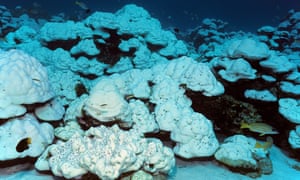
Great Barrier Reef on brink of third major coral bleaching in five years, scientists warn

The Great Barrier Reef could be heading for a third major coral bleaching outbreak in the space of five years if high ocean temperatures in the region do not drop in the next two weeks, scientists and conservationists have warned.
The Great Barrier Reef
The Great Barrier Reef could be facing
 another major coral bleaching outbreak.
Heat stress is already building across the world’s biggest reef system, with reports of patchy bleaching already occurring. But a major widespread event is not currently taking place.
“We are down to the wire,” said Prof Terry Hughes, director of the ARC Centre of Excellence for Coral Reef Studies at James Cook University.
The Great Barrier Reef Marine Park Authority is closely monitoring conditions. Areas of heat stress are spreading, particularly across the central and southern areas that are popular with tourists.

Read the story from The Guardian by Graham Readfearn - “Great Barrier Reef on brink of third major coral bleaching in five years, scientists warn.”

03 September, 2018

Payne heads to Pacific meeting with a nod to neighbours' climate fears

New Foreign Minister Marise Payne has acknowledged she will carry the baggage of “an extremely difficult week” over Australia’s approach to climate change when she faces Pacific island leaders worried about the threat to their countries posed by rising sea levels.
New Foreign Minister Marise Payne.
Senator Payne will head to Nauru on Monday for her first overseas meeting, the Pacific Islands Forum, at which she expects to finalise a major regional security agreement but is also likely to face questions from leaders in the neighbourhood about Australia’s commitment to climate action after the chaotic leadership change 10 days ago.

Canberra is looking to deepen its ties with Pacific nations amid concern about China’s strategic ambitions in what Australia has traditionally considered its backyard, with government ministers repeatedly saying Australia wants to be the “partner of choice” to smaller neighbours.

With some Pacific leaders voicing their concern about Australia’s commitment to climate action, Senator Payne acknowledged this was a key issue for low-lying island countries but stressed Australia’s history of practical action ought to assuage their worries.


Read the story from The Age by David Wroe - “Payne heads to Pacific meeting with a nod to neighbours' climate fears.”

01 April, 2018

Climate chaos to continue in 2018, UN chief warns; Will the world rise to challenge?

“Scientists are now worried that unless accelerated action is taken by 2020, the Paris goal may become unattainable,” the UN chief told reporters at the world body’s New York Headquarters.
A woman walks in the street of Roseau, capital of Dominica,
which has struggled to overcome the severe impact of two
category 5 hurricanes which tore through the region in
September 2017.
The Paris Agreement on climate change, adopted by world leaders in December 2015, aims to keep global temperature rise to well below 2 degrees Celsius and pursues efforts to limit the temperature increase even further, to 1.5 degrees.

“I am beginning to wonder how many more alarm bells must go off before the world rises to the challenge,” Mr. Guterres said, noting that 2017 had been filled with climate chaos and 2018 has already brought more of the same.

“Climate change is still moving much faster than we are,” he warned, calling the phenomenon the greatest threat facing humankind.


16 August, 2017

Left in the dark

A Mooroopna business leader is worried about the future of competitive industries in regional Victoria after he experienced a large spike in his power bills.

Gouge Linen owner Rob Priestly said after going onto a new electricity contract for his business he realised the delivered cost of power on his bills had risen by between 70 to 80 per cent from two years ago.
Victorian Nationals leader Peter Walsh
says he hears everyday from businesses
complaining about spikes in power 
prices.
Although the price rise does not threaten the sustainability of his business, which employs 150 people in Mooroopna, he expressed concern about similar rises could hit other large producers.

‘‘Everybody in our industry is in the same boat,’’ Mr Priestly.

‘‘I’m more worried about the impact on the broader community and on food manufacturing.’’

He said unlike his business, which did not face international competition, food manufacturers had to compete against foreign competitors which did not have large costs for power.

He would like to see the Victorian Government introduce policies to ease costs to make it easier for bigger businesses to compete in the global marketplace. It was a call echoed by Victorian Nationals leader Peter Walsh who had heard stories of big businesses hit with large power bill increases almost every day.

‘‘The prices have really spiked in the last six months,’’ Mr Walsh said.

‘‘Once there was speculation about the closure of Hazelwood there was a spike and once it closed it went higher again.’’

He listed dairy facilities, Kagome, SPC and farmers who use large cooling facilities and even hospitals would be the types of businesses hit with larger power bills.

‘‘Victoria has gone from a net exporter to a net importer of power,’’ he said.

He took aim at the State Government for much of the increases, and said we needed more than an increase in renewable energy to stay competitive.

‘‘There needs to be a serious investigation as to how Victoria brings in the next generation of baseload power generation,’’ he said.

Although he believed renewable energy had a place in the state, he was adamant coal fired power stations were still very important.

But he warned under current conditions, including a commitment for a state-based renewable energy target, energy companies would be reluctant to invest in baseload power generation.

‘‘Our manufacturing sector has developed with cheap power, our policy setting have to change,’’ he said.


This story  - “Left in the dark” - written by Barclay White was published in today’s Shepparton News.

28 June, 2017

The world’s tropical zone is expanding, and Australia should be worried

The Tropics are defined as the area of Earth where the Sun is directly overhead at least once a year — the zone between the Tropics of Cancer and Capricorn.

‘Tropics’ may conjure images of sun-kissed islands,
but the expanding tropical zone could bring
drought and cyclones further south.
However, tropical climates occur within a larger area about 30 degrees either side of the Equator. Earth’s dry subtropical zones lie adjacent to this broad region. It is here that we find the great warm deserts of the world.

Earth’s tropical atmosphere is growing in all directions, leading one commentator to cleverly call this Earth’s “bulging waistline”.


Read the thoughts of the Adjunct Professor of Environmental Geography from, CQUniversity Australia,  Steve Turton, on The Conversation - “The world’s tropical zone is expanding, and Australia should be worried."