Showing posts with label droughts. Show all posts

05 October, 2019

Flash Drought in the South Brings Record Heat Without Rain

It was a hot summer in the American South, and droughts have affected tens of millions of people there after one of the driest and hottest Septembers on record.
Because this dry spell began quickly — instead of creeping in gradually, as droughts usually do — it’s being referred to as a “flash drought.” 
In other words, “some of these areas have basically seen the faucet turn off,” said Brian Fuchs, a climatologist at the National Drought Mitigation Center at the University of Nebraska-Lincoln.
“Then you couple that with well-above-normal, record-setting heat for this time of year,” he added. “Lots of places saw not only the driest September on record, but they also had their warmest temperatures on record.”

Read the story from The New York Times by Jacey Fortin - “Flash Drought in the South Brings Record Heat Without Rain.”

24 August, 2019

We’d Better Retreat from the Coasts While We Still Can, Scientists Urge Amid Climate Crisis

As many as 1 billion people are expected to be forced out of their homes by the droughts, floods, fires and famines associated with runaway climate change over the next 30 years — and they all have to go somewhere. This massive global exodus can go one of two ways: either it will be a chaotic mess that punishes the world's poor, or it can be a path to a fairer, more sustainable world.

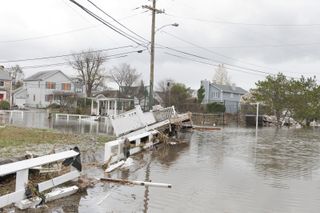
flooded streets after hurricane sandy
Flooded streets after Hurricane Sandy show the
damage that can occur in vulnerable coastal areas.
 We should plan for the inevitable and strategically
retreat from such vulnerable coastal communities
 now, scientists argue in a new paper.
In a new policy paper, published today (Aug. 22) in the journal Science, a trio of environmental scientists argue that the only way to avoid the first scenario  is to start planning now for the inevitable "retreat" from coastal cities. 

"Faced with global warming, rising sea levels, and the climate-related extremes they intensify, the question is no longer whether some communities will retreat — moving people and assets out of harm’s way — but why, where, when, and how they will retreat," the authors of the paper wrote.


Read the story from LiveScience by Brandon Specktor - “We’d Better Retreat from the Coasts While We Still Can, Scientists Urge Amid Climate Crisis.”

15 May, 2019

Can we prepare for climate impacts without creating financial chaos?

There is a perverse and hidden danger from climate change that few people, even those who unquestionably accept the science, know how to deal with. Someday, likely sooner than we think, the destruction that warmer global temperatures are inflicting — through record floods, wildfires, droughts and hurricanes — could physically overwhelm our ability to maintain many communities in their existing form.
Communities face a tricky dilemma as climate changes:
How to prepare for impacts without scaring away
homeowners and investors and setting off a damaging
economic spiral.
But by talking openly about this, and taking the necessary steps to address it, communities open the door to another danger. If markets suddenly value the risk of climate change properly, it could lead to a mass withdrawal of investment that kills real estate values, dries up tax revenue and leads to a wider financial crisis.

That is the reality confronting Ted Becker, the mayor of Lewes, Delaware, a town of about 3,000 people in which some buildings sit just steps from the Atlantic oceanfront. “When you live here every day, and you see things change, it’s hard to accept that climate change isn’t happening,” he says.


Read the story form Ensia by Geoff Debicki - “Can we prepare for climate impacts without creating financial chaos?

10 March, 2019

‘Whole thing is unravelling': climate change reshaping Australia's forests

Australia’s forests are being reshaped by climate change as droughts, heatwaves, rising temperatures and bushfires drive ecosystems towards collapse, ecologists have told Guardian Australia. Trees are dying, canopies are getting thinner and the rate that plants produce seeds is falling. Ecologists have long predicted that climate change would have major consequences for Australia’s forests. Now they believe those impacts are unfolding.
Researchers have found that big eucalypts grow slower
as temperatures rise thanks to climate change. 
“The whole thing is unravelling,” says Prof David Bowman, who studies the impacts of climate change and fire on trees at the University of Tasmania. “Most people have no idea that it’s even happening. The system is trying to tell you that if you don’t pay attention then the whole thing will implode. We have to get a grip on climate change.”

Read the story from The Guardian by Graham Readfearn - “‘Whole thing is unravelling': climate change reshaping Australia's forests.”


(Listen to the “Climate Conversations” featuring Professor David Bowman).

09 February, 2019

The green new deal shows just how grand climate politics can be

If it’s hard to imagine the sweeping changes proposed in the “Green New Deal” actually happening, don’t blame the Green New Deal. It’s just that it has been so long since any politician suggested something so grand. The wildfires, hurricanes, droughts, and sea level rise that climate scientists have long promised are here, but we could get accustomed to that. We could forget that the world of five years ago or a decade ago was any different. And we got used to elected representatives saying predictable things about it too—doubt and denial, or expressions of concern that climate change is too complicated and too expensive to deal with. We grow accustomed to their farce.

US representative Alexandria Ocasio-Cortez
 (D-New York), along with Senator Ed Markey
(D-Massachusetts), introduced the ambitious
 "Green New Deal" resolution on Thursday.
So it’s jarring when something breaks the pattern. A resolution from the US House of Representatives that proposes national, urgent action on climate change and more—well, we’re not used to that. A vast set of policies to fight climate change, prepare for its effects, address income inequality, and save working-class jobs, fronted by a brand-new congressperson with a national profile—Alexandria Ocasio-Cortez, New York’s AOC? That’s new. The so-called Green New Deal reads like a wholesale reset to the Democratic Party platform, weaving the existential threat of a warming planet into old-school liberal themes. Defend the working class. Clean up pollution. Give people health care and housing.


Read the Wired story by Adam Rogers - “The green new deal shows just how grand climate politics can be.”

02 February, 2019

Climate change a burning issue (again) in voters' minds

This piece of backroom intelligence shouldn’t come as a surprise, given the summer we are all still enduring. Record high temperatures, the hottest January on record; storms; floods in some places, droughts in others; mass fish kills in ailing rivers.
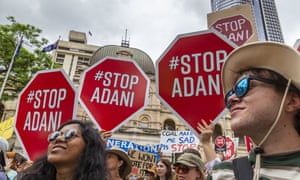
Adani protest
 ‘Climate change is not only a hot-button issue on its
own terms. Some of the research suggests it has
also become a proxy for political dysfunction.’ 
Climate change is back as a vote-changing issue – top of mind for many Australian voters. Private polling conducted for the environment movement and for the major parties suggests community concern about climate change is currently sitting at levels not seen since the federal election cycle in 2007.
If you can remember the events of 2007, you’ll recall that John Howard was forced into a significant about-face on the issue. Within sight of the election that swept Kevin Rudd into power, Howard signed the Liberal party up to emissions trading, a “world’s best-practice” cap and trade scheme, and declared Australia must prepare for a “low-carbon future”.


Read the story from The Guardian by Katharine Murphy - “Climate change a burning issue (again) in voters' minds.”

18 January, 2019

The IPCC’s Climate Change report, and the common mindsets we need to shift

Earlier this week, the Intergovernmental Panel on Climate Change (IPCC) published a critical report on the urgency of addressing the indisputable climate breakdown we’re experiencing, and the global human and environmental consequences of the projected temperature rise. The floods, droughts and poverty that result from extreme heat are already occurring, widespread and indiscriminately. And with the IPCC’s warning that we have just twelve years to limit the climate change catastrophe, the message is loud and clear: we must act now.

Carra Santos.
The major role is that of the politicians and policy-makers. Those in charge of the environment, agriculture, health, industry, infrastructure, international trade and more, have an absolute responsibility to connect the dots and collaborate to achieve sustainability and balance. This is primarily across the reduction of global CO2 emissions, the increase in use of renewable energy to decrease reliance on fossil fuels, and responsibility of land use and management for sustainable agriculture and energy.


Read the Food Culture Forum story by Carra Santos - “The IPCC’s Climate Change report, and the common mindsets we need to shift.”

10 December, 2018

It’s not rocket science: Climate change was behind this summer’s extreme weather

Summer 2018 saw an unprecedented spate of extreme floods, droughts, heat waves and wildfires break out across North America, Europe and Asia. The scenes played out on our television screens and in our social media feeds. This is, as I stated at the time, the face of climate change.
Thick smoke covers a beach near the village of Sarti in Halkidiki,
 northern Greece, as a wildifire rages in the area on Oct. 25.
It’s not rocket science. A warmer ocean evaporates more moisture into the atmosphere — so you get worse flooding from coastal storms (think Hurricanes Harvey and Florence). Warmer soils evaporate more moisture into the atmosphere — so you get worse droughts (think California or Syria). Global warming shifts the extreme upper tail of the “bell curve” toward higher temperatures, so you get more frequent and intense heat waves (think summer 2018 just about anywhere in the Northern Hemisphere). Combine heat and drought, and you get worse wildfires (again, think California).

Read the OpEd from The Washington Post by Michael Mann - “It’s not rocket science: Climate change was behind this summer’s extreme weather.”

06 August, 2018

Chart of the day: is this the most severe drought in history?

Australia is no stranger to droughts, so how does the current big dry across southern Australia compare historically?
In 2018, autumn rainfall was the lowest since the 1902 Federation drought.
The chart below shows autumn rainfall compared to the long-term average, going back to 1900.

In 2018, autumn rainfall was 57 mm below average, the driest autumn since the 1902 Federation drought.

But the 2017-18 year overall was not one of the driest on record — there were 19 other years that were drier.


Read the ABC News story by Catharine Hanrahan from the digital storytelling team - “Chart of the day: is this the most severe drought in history?

29 July, 2018

This Summer’s Heat Waves Could Be the Strongest Climate Signal Yet

Earth's global warming fever spiked to deadly new highs across the Northern Hemisphere this summer, and we're feeling the results—extreme heat is now blamed for hundreds of deaths, droughts threaten food supplies, wildfires have raced through neighborhoods in the western United States, Greece and as far north as the Arctic Circle.
Extreme heat killed more than 80 people in Japan
in July, just a few weeks after flooding from downpours
 was blamed for more than 200 deaths there.
At sea, record and near-record warm oceans have sent soggy masses of air surging landward, fueling extreme rainfall and flooding in Japan and the eastern U.S. In Europe, the Baltic Sea is so warm that potentially toxic blue-green algae is spreading across its surface.

There shouldn't be any doubt that some of the deadliest of this summer's disasters—including flooding in Japan and wildfires in Greece—are fueled by weather extremes linked to global warming, said Corinne Le Quéré, director of the Tyndall Centre for Climate Change Research at the University of East Anglia.

"We know very well that global warming is making heat waves longer, hotter and more frequent," she said.

"The evidence from having extreme events around the world is really compelling. It's very indicative that the global warming background is causing or at least contributing to these events," she said.


Read Bob Berwyn’s story from Inside Climate News - “This Summer’s Heat Waves Could Be the Strongest Climate Signal Yet.”

23 July, 2018

Recent Australian droughts may be the worst in 800 years

Australia is a continent defined by extremes, and recent decades have seen some extraordinary climate events. But droughts, floods, heatwaves, and fires have battered Australia for millennia. Are recent extreme events really worse than those in the past?
Places such as Berri were affected by Millennium
Drought, caused by low cool-season rain.
New materials and techniques are now being
used to observe drought causes and water
patterns in Australia’s history to help the future.
In a recent paper, we reconstructed 800 years of seasonal rainfall patterns across the Australian continent. Our new records show that parts of Northern Australia are wetter than ever before, and that major droughts of the late 20th and early 21st centuries in southern Australia are likely without precedent over the past 400 years.

This new knowledge gives us a clearer understanding of how droughts and flooding rains may be changing in the context of a rapidly warming world.


Read the story from The Conversation - “Recent Australian droughts may be the worst in 800 years.”

09 April, 2018

Arctic melting could worsen future California droughts

Melting ice in the Arctic might seem a world away from California’s farms and aquifers. But droughts in the state could get worse as the Arctic melts.
Extent of Arctic sea ice in September 2016 versus the
1981-2010 average minimum extent (gold line). 
Summers in the Arctic Ocean are expected to be ice-free within a few decades. When that happens, the precipitation California receives could decrease as much as 15 percent.

Cvijanovic: “We see quite clearly sea ice shaping how much rainfall California receives.”


Read the Yale Climate Connections story by Diana Madson - “Arctic melting could worsen future California droughts.”

09 September, 2017

Are We F--ked? Decoding the resistance to climate change

The evidence is everywhere: forests retreating, glaciers melting, sea levels rising. 

The "money shot" - golfer blissfully play on
as America's forests burn.
Droughts, floods, wildfires and storms have increased five-fold over the past 50 years. 

And we're only just beginning to feel the strain of climate change. It's estimated that rising sea levels will threaten 30 million people in Bangladesh alone. 

Miami could disappear within a generation. Despite all of these dire events and projections, the attacks continue — on climate scientists.


Read Paul Kennedy’s comment on CBC Radio - “Are We F--ked? Decoding the resistance to climate change.”

18 May, 2017

Why 2°C of global warming is much worse for Australia than 1.5°C

Australia is a land of extremes. We’ve experienced all manner of climate extremes over the past few years, from heatwaves (both on land and over the Great Barrier Reef), to droughts and flooding rains.
Fires in Blue Mountains Australia, October 22, 2013. 
We can already link some of these recent extreme events to climate change. But for others, the link is less clear.

So far we have had about 1°C of global warming above the average pre-industrial climate. So how will extreme weather events change with more warming in the future? Will they become more frequent? Will they become more severe?

We have investigated these questions in our new research, published today in Nature Climate Change.


16 May, 2017

‘Alarming': Keeping warming to 1.5 degrees to shield Australia from big extremes

Australia will endure more heatwaves, droughts and coral bleaching at 1.5 degrees of warming but the extremes will be considerably less than if global temperatures increase by 2 degrees, new research shows.
In some of the first research on the impacts for Australia of the 1.5 degree to 2 degree range agreed at the Paris climate summit in 2015, Melbourne University scientists have found the chances of a repeat of events such as the "angry summer" of 2012-13 are significantly reduced at the lower end of the warming scale.

That summer, which remains the country's hottest, was already about 10 times more likely than without the 1 degree of warming already experienced since pre-industrial times, said Dr Andrew King, a Melbourne University climate scientist and lead author of the paper published in Nature Climate Change.

At warming of 1.5 degrees, the odds of such a summer with its heat extremes and bush fire-conducive weather increases from about 44 per cent now to 57 per cent. The chance rises to 77 per cent in a 2-degree warmer world, the researchers found.


Read Peter Hannam’s story in today’s Melbourne Age - “‘Alarming': Keeping warming to 1.5 degrees to shield Australia from big extremes.”

26 April, 2017

Global Warming Behind Record-Breaking Climate Events Worldwide: Here's The Evidence

Are extreme weather conditions such as droughts, heat waves, intense storms triggered by human-caused climate change?
Extreme weather conditions and
climate change equate.
This is a question that Noah Diffenbaugh, a professor of Earth system science at Stanford's School of Earth, Energy & Environmental Sciences, and his research team always get.

But the answer to this seemingly simple question is never simple. In fact, scientists, in the past, generally avoid linking specific climate or weather events to global warming because of several different factors that cause them. But that was before.


15 April, 2017

How to Turn Neighborhoods Into Hubs of Resilience

Think of it as a silver lining to the gathering dark clouds. We live in an era of extraordinary disruption, from the serial crises of a changing climate to the wrenching shifts of a globalized economy. But in that disruption lies the potential for positive transformation.
PUSH Buffalo is working to transform a 25-block
area of the city into the beginning of a new
community-driven sustainable economy. 
Addressing climate change requires adapting to the impacts that are already here—heat waves, droughts, superstorms and more—while preventing and mitigating future impacts. Taking these challenges seriously calls for radical changes in the way we live. It calls us to zero out our carbon emissions, and to rethink the systems that shape our lives, including the economy, food and power. It calls us to fundamentally transition from a world of domination and extraction to a world of regeneration, resilience, and interdependence.

It’s a tall order, no doubt, but that transition is already underway. In our work with movement builders on the front lines of the transition, we’ve identified two key guideposts—connectedness and equity—that point us toward the world we want.


Read the Yes! Magazine story - “How to Turn Neighborhoods Into Hubs of Resilience.”

08 April, 2016

Pipeline to help save drought-affected farming communities

The illustration used in today's Age with Richard
Willingham's story about piping water to drought
affected areas in Victoria's north-central districts.
Drought-affected communities in Victoria's north-central districts will be hooked up to the state's water grid under an $80 million plan to lay 1300 kilometres of new pipes.

The project will connect the isolated Wimmera Mallee pipeline system to the rest of the state in what Water Minister Lisa Neville said was "game-changing."

Premier Daniel Andrews, on a two-day tour of drought ravaged regions, announced on a farm outside Wedderburn on Thursday that the south-west Loddon Shire would be connected to the grid through West Waranga Channel, near Bendigo and the Wimmera Mallee pipeline.

Read Richard Willingham’s story in today’s Melbourne Age - “1300 kilometres of new water pipes to connect Victoria's drought hit communities.”

05 October, 2015

Fossil fuel companies benefit by $10m a minute every day


F

ossil fuel companies are benefitting from global subsidies of $5.3tn (£3.4tn) a year, equivalent to $10m a minute every day, according to a startling new estimate by the International Monetary Fund.

The IMF calls the revelation “shocking” and says the figure is an “extremely robust” estimate of the true cost of fossil fuels. The $5.3tn subsidy estimated for 2015 is greater than the total health spending of all the world’s governments.

The vast sum is largely due to polluters not paying the costs imposed on governments by the burning of coal, oil and gas. These include the harm caused to local populations by air pollution as well as to people across the globe affected by the floods, droughts and storms being driven by climate change.

Read the Guardian story - “Fossil fuels subsidised by $10m a minute, says IMF”.

(“Fantasy” probably best describes any idea that fossil fuel companies will surrender without a fight to the mass application of renewable energy. The fossil fuel industry is clearly the beneficiary of public largesse, something it will not give up without a struggle. Any suggestion that those companies, which presently profit handsomely from myths they portray as fact, will behave altruistically and in a philanthropical manner to relinquish the riches they have tapped is, bluntly a fantasy – Robert McLean).

15 July, 2015

Many enthused about dams, but it is a false belief


M
any in Australia see man-made dams as the solution to the nation’s water scarcity problems.

The simplistic view wants us to trap and store the massive downpours that are becoming more common because of global warming and then use that water as we go about enduring the inevitable droughts.

Such views take no account of the damage such dams cause to the local environment. the flora and fauna, and not to mention people who live in the area, the significant and devastating overall changes they make to the river systems on which they are inevitably built and, of course, the accompanying silting or the dams that can, and does lead to their ultimate ineffectiveness and failure.

Responding to Climate Change (RTCC) reports that the Belo Monte hydroelectric plant in Brazil is flouting agreements to protect indigenous communities as its builder seeks approval to start generating power, environmental lawyers have warned.

The US$11 billion dam on an Amazonian tributary – set to be the third-largest producer of hydropower globally – has met just 30% of the social and environmental conditions set by government, said AIDA Americas.