Showing posts with label next 30 years. Show all posts

24 August, 2019

We’d Better Retreat from the Coasts While We Still Can, Scientists Urge Amid Climate Crisis

As many as 1 billion people are expected to be forced out of their homes by the droughts, floods, fires and famines associated with runaway climate change over the next 30 years — and they all have to go somewhere. This massive global exodus can go one of two ways: either it will be a chaotic mess that punishes the world's poor, or it can be a path to a fairer, more sustainable world.
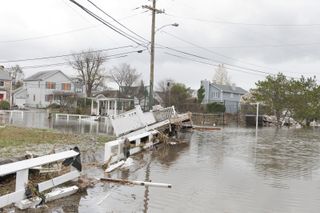
flooded streets after hurricane sandy
Flooded streets after Hurricane Sandy show the
damage that can occur in vulnerable coastal areas.
 We should plan for the inevitable and strategically
retreat from such vulnerable coastal communities
 now, scientists argue in a new paper.
In a new policy paper, published today (Aug. 22) in the journal Science, a trio of environmental scientists argue that the only way to avoid the first scenario  is to start planning now for the inevitable "retreat" from coastal cities. 

"Faced with global warming, rising sea levels, and the climate-related extremes they intensify, the question is no longer whether some communities will retreat — moving people and assets out of harm’s way — but why, where, when, and how they will retreat," the authors of the paper wrote.


Read the story from LiveScience by Brandon Specktor - “We’d Better Retreat from the Coasts While We Still Can, Scientists Urge Amid Climate Crisis.”

22 June, 2019

Temperature rises will make Brisbane a 'difficult place to live' within 30 years, report finds

An alarming report has found temperature increases from climate change and urban growth will make Brisbane "a difficult place to live" within the next 30 years, and more people will be at risk of dying from extreme heat.
The study found the number of hot days and nights would double.
The long-term climate modelling also found the number of hot days and nights will double in Australia's third largest city by 2050, and people will need to avoid outdoor activities throughout most of summer.

The peer-reviewed study, which was published recently in the International Journal of Climatology, investigated the impact of urban growth and climate change on heat stress during summer in Brisbane, from the present day to 2050.


09 March, 2019

Climate change to expose half of world's population to disease-spreading mosquitoes by 2050, study finds

Over the next 30 years, mosquito-borne diseases such as dengue, yellow fever and the Zika virus are on course to spread – posing a risk to half the world’s population, new research has revealed.
Climate change and modern travel are facilitating
 the spread of diseases around the world.
Two of the main disease-spreading mosquitoes – Aedes aegypti and Aedes albopictus – are forecast to significantly expand their range due to warming temperatures.

The models predict that by 2050, 49 per cent of the world’s population will live in places where these species are established if greenhouse gas emissions continue at current rates, and if they are not curbed, even greater areas will be at risk.