Showing posts with label floods. Show all posts

06 April, 2020

Coronavirus and degrowth

This is proving a remarkable year for all the worst reasons. First, we experienced Black Summer, the most severe season of fires in Australia’s history. (The 173 fatalities of the Black Saturday Australian bushfires on 7 February 2009 retains the record for most deaths).
Degrowth

Then Australia experienced floods: on one hand, a mercy after the drought and snuffing out the fires, but; on the other hand, it brought its own human and social destruction, pollution and despair. This happened at the same time as the record-breaking three months of severe winter flooding in the United Kingdom.
Meanwhile, the Antarctic endured an ‘unprecedented heat wave’. Brewing, simultaneously, was the public health and economic crisis of Covid-19, or coronavirus.
Read the story from Ecologist by Anitra Nelson and Vincent Leigey - “Coronavirus and degrowth."

29 January, 2020

Brazil downpours displace tens of thousands

Rio de Janeiro: More than 30,000 people have been displaced by heavy rains in south-east Brazil that also killed 54 people and left 18 missing.

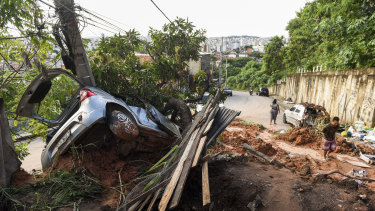
A vehicle lies half-buried in the mud after a landslide caused by heavy rains in Belo Horizonte, Brazil.
A vehicle lies half-buried in the mud after a landslide
 caused by heavy rains in Belo Horizonte, Brazil. 
The storms in recent days caused floods and landslides, submerging entire neighbourhoods and sending homes tumbling down hillsides in the states of Minas Gerais, Espirito Santo and Rio de Janeiro. Rains subsided by Monday, but were expected to resume later this week in some areas.
Flooded roads created violent rapids, sweeping up victims, cars and other debris.
Those evacuated were being housed in makeshift shelters in churches, schools and fire stations. Local authorities have asked for donations of clothes, sheets and mattresses for the victims.
Read the story from The Age by Anna Jean Kaiser - “Brazil downpours displace tens of thousands.”


(The climate crisis produces distinctly different weather, from droughts and downpours such as this one - Robert McLean)

24 August, 2019

We’d Better Retreat from the Coasts While We Still Can, Scientists Urge Amid Climate Crisis

As many as 1 billion people are expected to be forced out of their homes by the droughts, floods, fires and famines associated with runaway climate change over the next 30 years — and they all have to go somewhere. This massive global exodus can go one of two ways: either it will be a chaotic mess that punishes the world's poor, or it can be a path to a fairer, more sustainable world.

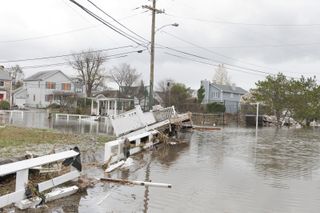
flooded streets after hurricane sandy
Flooded streets after Hurricane Sandy show the
damage that can occur in vulnerable coastal areas.
 We should plan for the inevitable and strategically
retreat from such vulnerable coastal communities
 now, scientists argue in a new paper.
In a new policy paper, published today (Aug. 22) in the journal Science, a trio of environmental scientists argue that the only way to avoid the first scenario  is to start planning now for the inevitable "retreat" from coastal cities. 

"Faced with global warming, rising sea levels, and the climate-related extremes they intensify, the question is no longer whether some communities will retreat — moving people and assets out of harm’s way — but why, where, when, and how they will retreat," the authors of the paper wrote.


Read the story from LiveScience by Brandon Specktor - “We’d Better Retreat from the Coasts While We Still Can, Scientists Urge Amid Climate Crisis.”

28 July, 2019

Extreme weather has damaged nearly half Australia's marine ecosystems since 2011

 Extreme climate events such as heatwaves, floods and drought damaged 45% of the marine ecosystems along Australia’s coast in a seven-year period, CSIRO research shows.
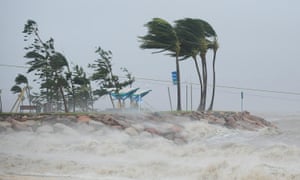
Cyclone Yasi
Strong winds from cyclone Yasi hit Townsville in 2011.
Storms, heatwaves and coral bleaching have devastated
Australian coasts in the past decade.
More than 8,000km of Australia’s coast was affected by extreme climate events from 2011 to 2017, and in some cases they caused irreversible changes to marine habitats.

The study collated all the published research by leading scientists, who have examined the effects of marine heatwaves, heavy rainfall from tropical storms, cyclones and droughts on coral, kelp, mangrove and seagrass communities.

Read the story from The Guardian by Lisa Cox - “Extreme weather has damaged nearly half Australia's marine ecosystems since 2011.” 

02 February, 2019

Climate change a burning issue (again) in voters' minds

This piece of backroom intelligence shouldn’t come as a surprise, given the summer we are all still enduring. Record high temperatures, the hottest January on record; storms; floods in some places, droughts in others; mass fish kills in ailing rivers.
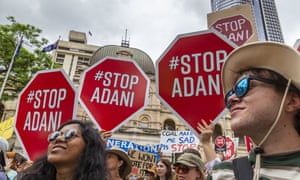
Adani protest
 ‘Climate change is not only a hot-button issue on its
own terms. Some of the research suggests it has
also become a proxy for political dysfunction.’ 
Climate change is back as a vote-changing issue – top of mind for many Australian voters. Private polling conducted for the environment movement and for the major parties suggests community concern about climate change is currently sitting at levels not seen since the federal election cycle in 2007.
If you can remember the events of 2007, you’ll recall that John Howard was forced into a significant about-face on the issue. Within sight of the election that swept Kevin Rudd into power, Howard signed the Liberal party up to emissions trading, a “world’s best-practice” cap and trade scheme, and declared Australia must prepare for a “low-carbon future”.


Read the story from The Guardian by Katharine Murphy - “Climate change a burning issue (again) in voters' minds.”

18 January, 2019

The IPCC’s Climate Change report, and the common mindsets we need to shift

Earlier this week, the Intergovernmental Panel on Climate Change (IPCC) published a critical report on the urgency of addressing the indisputable climate breakdown we’re experiencing, and the global human and environmental consequences of the projected temperature rise. The floods, droughts and poverty that result from extreme heat are already occurring, widespread and indiscriminately. And with the IPCC’s warning that we have just twelve years to limit the climate change catastrophe, the message is loud and clear: we must act now.

Carra Santos.
The major role is that of the politicians and policy-makers. Those in charge of the environment, agriculture, health, industry, infrastructure, international trade and more, have an absolute responsibility to connect the dots and collaborate to achieve sustainability and balance. This is primarily across the reduction of global CO2 emissions, the increase in use of renewable energy to decrease reliance on fossil fuels, and responsibility of land use and management for sustainable agriculture and energy.


Read the Food Culture Forum story by Carra Santos - “The IPCC’s Climate Change report, and the common mindsets we need to shift.”

23 July, 2018

Recent Australian droughts may be the worst in 800 years

Australia is a continent defined by extremes, and recent decades have seen some extraordinary climate events. But droughts, floods, heatwaves, and fires have battered Australia for millennia. Are recent extreme events really worse than those in the past?
Places such as Berri were affected by Millennium
Drought, caused by low cool-season rain.
New materials and techniques are now being
used to observe drought causes and water
patterns in Australia’s history to help the future.
In a recent paper, we reconstructed 800 years of seasonal rainfall patterns across the Australian continent. Our new records show that parts of Northern Australia are wetter than ever before, and that major droughts of the late 20th and early 21st centuries in southern Australia are likely without precedent over the past 400 years.

This new knowledge gives us a clearer understanding of how droughts and flooding rains may be changing in the context of a rapidly warming world.


Read the story from The Conversation - “Recent Australian droughts may be the worst in 800 years.”

12 May, 2018

How is climate change affecting Mexico?

As Mexico City’s chief resiliency officer, Arnoldo Kramer, said to The New York Times, “Climate change has become the biggest long-term threat to this city’s future. And that’s because it is linked to water, health, air pollution, traffic disruption from floods, housing vulnerability to landslides — which means we can’t begin to address any of the city’s real problems without facing the climate issue.”
Climate change is threatening to push a
crowded capital toward a breaking point.
And we’d argue the same is true for the rest of the nation – and the world. Climate change touches every aspect of our lives.

Here are three leading ways climate change is already hitting Mexico and its people. Plus, as a bonus, two ways you can take action today to help solve the climate crisis.


Read the Climate Reality Project story - “How is climate change affecting Mexico?

24 February, 2018

India’s air pollution crisis risks becoming humanitarian catastrophe

Before heading off on a foreign assignment, journalists take a course about working in hostile environments — learning about things like trauma first aid, weapons effects, and how to survive earthquakes, floods and civil unrest.
ABC's Siobhan Heanue wears the face mask
she had to buy in order to breathe properly.
It's all pretty useful training. And heading off to live and work in India, I was more than aware of the everyday dangers I'd be facing.

For instance, India has one of the world's highest road tolls and Delhi is one of the worst places in the world for sexual violence against women.


Read the ABC News story by Siobhan Heanue - "India’s air pollution crisis risks becoming humanitarian catastrophe.”

12 February, 2018

Heatwaves send temperatures soaring in many parts of Australia, but what are they?

Heatwaves are Australia's deadliest natural disaster. They have killed more people than bushfires, cyclones and floods put together.
Because Earth is a sphere, there is proportionally more energy near the equator.
The Bureau of Meteorology defines them as "three days or more of high maximum and minimum temperatures that is unusual for that location”.

During the extreme heatwave that hit south east Australia in 2009, 374 people died in Victoria and evidence exists for up to 500 heatwave-related deaths all together.

Events like 2009 are rare — the last comparable event in south east Australia occurred in 1939.
But it doesn't have to be a once in a generation event to put people at risk.

So what are heatwaves exactly, and why do they happen?


13 October, 2017

Vietnam floods: Death toll rises to 54 as swathes of land washed away

Floods and landslides have killed at least 54 people in Vietnam and left another 39 missing since a tropical depression battered the country earlier this week, officials say.

Two soldiers walk a pig through flood water

Vietnam is prone to destructive storms and flooding due to its long coastline, killing hundreds of people in Vietnam each year.

The heavy rain in the central and northern regions has disrupted travel in some areas, limiting the rescue attempts for the missing.

The storm that hit central Vietnam on Tuesday also injured 31 people and submerged more than 30,000 houses, damaged infrastructure, crops and livestock, the Vietnam Disaster Management Authority said in a statement.

Vietnam is prone to destructive storms and flooding due to its long coastline, killing hundreds of people in Vietnam each year.

20 September, 2017

Neil deGrasse Tyson says it might be 'too late' to recover from climate change.

Scientist and astrophysicist Neil deGrasse Tyson said Sunday that, in the wake of devastating floods and damage caused by Hurricanes Harvey and Irma, climate change had become so severe that the country "might not be able to recover.”

Neil deGrasse Tyson.
In an interview on CNN's "GPS," Tyson got emotional when Fareed Zakaria asked what he made of Homeland Security Adviser Tom Bossert's refusal to say whether climate change had been a factor in Hurricanes Harvey or Irma's strength -- despite scientific evidence pointing to the fact that it had made the storms more destructive.

"Fifty inches of rain in Houston!" Tyson exclaimed, adding, "This is a shot across our bow, a hurricane the width of Florida going up the center of Florida!"


18 September, 2017

Enough tiptoeing around. Let’s make this clear: coal kills people

Coal kills people. This isn’t even slightly scientifically controversial.

‘How can journalists and editors report on the politics
of coal on one page and bushfires around Sydney in
September on another without making the connection?’
From the mines to the trains to the climate disruption; from black lung to asthma, heat stress to hunger, fires to floods: coal is killing people in Australia and around the world right now.

Yet we are once again having what passes for political debate about extending the life of coal-fired power stations and, extraordinarily, building new ones. The conversation is completely disconnected from the fact that two-thirds of Bangladesh was reported to be underwater, record-breaking hurricanes were battering the US, and wildfires were roaring in both the northern and southern hemispheres at the same time.

Read Tom Hollo’s comment in The Guardian - “Enough tiptoeing around. Let’s make this clear: coal kills people.”

09 September, 2017

Are We F--ked? Decoding the resistance to climate change

The evidence is everywhere: forests retreating, glaciers melting, sea levels rising. 

The "money shot" - golfer blissfully play on
as America's forests burn.
Droughts, floods, wildfires and storms have increased five-fold over the past 50 years. 

And we're only just beginning to feel the strain of climate change. It's estimated that rising sea levels will threaten 30 million people in Bangladesh alone. 

Miami could disappear within a generation. Despite all of these dire events and projections, the attacks continue — on climate scientists.


Read Paul Kennedy’s comment on CBC Radio - “Are We F--ked? Decoding the resistance to climate change.”

11 June, 2017

Flood warnings for northern NSW as long weekend turns into a washout

Elle Hunt.
Parts of northern New South Wales are being warned to expect further heavy rainfall and the possibility of floods over the public holiday weekend, with the outlook for the rest of the country clouded by the possibility of showers.

The Bureau of Meteorology issued a severe weather warning for the northern rivers and parts of the mid north coast districts mid-morning on Sunday, with a low-pressure trough along the NSW north coast causing heavy rainfall and thunderstorms.

Up to 200mm of rain and flash flooding was forecast from Port Macquarie up to Lismore through to early next week, following two days of heavy and persistent rainfall. Forecasters said Lismore, Grafton, Coffs Harbour, Port Macquarie, Sawtell and Dorrigo could be affected.


Read Elle Hunt’s story on The Guardian - “Flood warnings for northern NSW as long weekend turns into a washout.”

28 May, 2017

Sri Lankan landslides, flooding kills 122, as nation appeals for international help

The number of people known to have been killed in floods and landslides in Sri Lanka has risen to 122, with the country appealing for international assistance.

Sri Lanka has asked its neighbours and the UN
for help in its search and rescue effort.
The state-run disaster management centre said a further 97 people were still missing after the worst torrential rains since 2003.

The Foreign Ministry said an appeal had been made to the United Nations and neighbouring countries to provide assistance "especially in the areas of search and rescue operations”.

India is sending three Navy ships with supplies and other aid, the first of which arrived in Colombo on Saturday.

Officials said deaths were reported from the western coastal district of Kalutara, the central southern district of Ratnapura and the southern district of Matara.


15 April, 2017

Extreme weather: why the impact will be felt more widely

Extreme is the new normal when it comes to weather, with devastation caused by floods, fires and cyclones filling our news feeds all too frequently.
Health services need to build surge capacity
 to prepare for extreme weather events in the future. 
Thanks to the relatively recent development of event attribution in climate science, researchers can now confidently attribute the increase in extreme weather events to human-forced climate change.

For Australians, climate change means more heatwaves, more droughts, more intense cyclones (although less of them) and more flooding. The impact of such weather is already a reality for many who have lost homes and, tragically, loved ones, in events like the recent Queensland and northern New South Wales floods.

But the impact of extreme weather will be felt more widely. How will it affect our health? Are our buildings changing to adapt? Will our insurance policies change?

We asked seven University of Melbourne experts about our preparedness.


Read the story by Catriona May on the University of Melbourne’s Pursuit website - “Extreme weather: why the impact will be felt more widely.”

05 April, 2017

Severe storms, floods and your health fact sheet

Doctors for the Environment Australia has developed this fact sheet to detail the adverse effects of floods and storms on our health and simple measures for avoidance and treatment.

Such extreme weather events are becoming more frequent with climate change and are demanding and costly to health services and communities.


Read the Doctors for the Environment story - “Severe storms, floods and your health fact sheet.”

28 August, 2016

Charts illustrate health threats from climate change

The dog days of summer were particularly dogged this year.

July clocked in as the hottest month on record, marking the midpoint of what is likely to be the hottest year on record. With sweltering temperatures came a litany of crummy climate newsfloods in Louisiana, Zika in Miami, searing heat waves across the Northeastwith dire implications for human health.

Last year’s Lancet Commission on Health and Climate Change warned that the carbon crisis could undo the last half-century of progress in public health. And yet, for many, it remains unclear how climate change could land them in the hospital. Just one in four Americans can identify the ways that rising temperatures threaten their health.

To clarify that link, Climate Nexus and the American Public Health Association developed a series of infographics that illustrate the connection between climate change and all manner of life-threatening illness. [Disclosure: Climate Nexus and Nexus Media are both sponsored projects of Rockefeller Philanthropy Advisors.]

Let’s begin with air quality. Climate change is producing shorter winters and longer summers, extending allergy season. Warmer weather is also worsening pollution by fueling the formation of ozone. Heat and drought are setting the stage for wildfires, like the blaze recently seen in California, which produce smoke, threatening respiratory health.

26 June, 2016

All extreme weather linked to climate change - Kevin Trenberth

Kevin Trenberth - a 'game changer'.
In the wake of major hurricanes, floods and heat waves, scientists are quick to say that no single weather event can be attributed to climate change until careful analysis draws that conclusion. Now, a new study argues that thinking is backwards, that all extreme weather has a link to climate change.

The default position has been holding science back in connecting weather and climate, concludes the authors of a peer-reviewed paper published Monday in Nature Climate Change.

This "could be a game changer in how these studies are done in [the] future," lead author Kevin Trenberth said in an email.

Trenberth is a senior scientist at the National Center for Atmospheric Research (NCAR), and one of three researchers behind the study.

The paper presents a new research technique that grew out of an idea Trenberth first proposed at a conference in 2010. It also provides scientists examples of how to apply the method, and challenges the conclusions of a 2014 paper that found no climate influence in the massive floods that swept Boulder, Colo., in 2013.

Read the Inside Climate News story - “Most Extreme Weather Has Climate Change Link, Study Says.”