Showing posts with label extreme. Show all posts

19 February, 2018

Climate change will accelerate extreme weather events in the coming years

Humanity is now facing an ever-increasing threat of unpredictable and extreme weather, climate scientists warn.
This Jan. 4 Geocolor image from the National
Oceanic and Atmospheric Administration
(NOAA) GOES-16 satellite captured the record
"bomb cyclone" nor’easter that battered the
 East Coast of the United States in January 2018.
While global warming is creating more powerful storms and record-breaking, drought-driven wildfires, it would be a mistake to view these events as the “new normal,” they say. The planet has not reached a new climate stability, so the years ahead could be quite a lot worse.

“‘New normal’ implies that we reach some new sort of equilibrium and that's where things stay, whereas what we're looking at is an ever-shifting baseline,” says Penn State professor and atmospheric scientist Michael Mann.


12 January, 2018

A ‘perfect storm’: extreme winter weather, bitter cold, and climate change

World-renowned climate scientist Dr. Michael Mann explains why the bitter cold and snowy conditions gripping the US are “an example of precisely the sort of extreme winter weather we expect because of climate change.”
iew image on Twitter

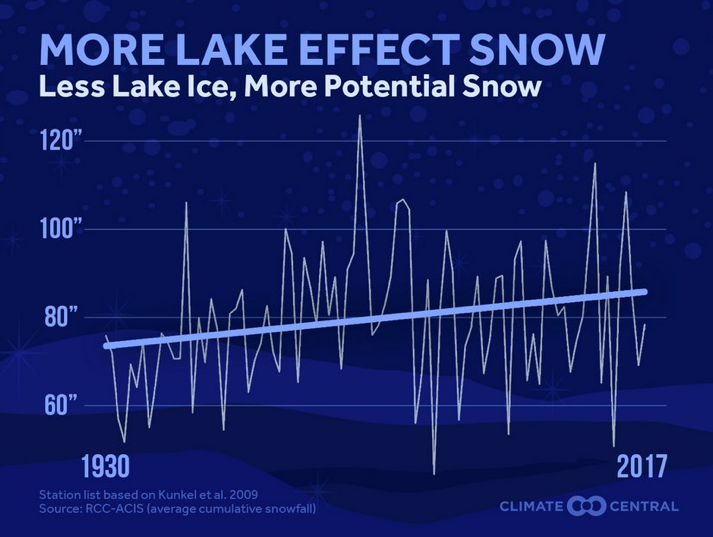
The US East Coast is experiencing an “old-fashioned” winter, with plenty of cold weather and some heavy snowfall in certain places. Listening to climate contrarians like President Donald Trump, you might think this constitutes the death knell for concern over human-caused climate change.
Yet, what we were witnessing play out is in fact very much consistent with our expectations of the response of weather dynamics to human-caused climate change.


04 January, 2018

Warning over extreme heat, wind predicted across Victoria on Saturday

Extreme temperatures predicted for Saturday have prompted a health warning from Victoria's chief medical officer.
With extreme heat and a northerly wind predicted, there are concerns
 fires could be started by spontaneously combusting hay bales
The Country Fire Authority is also on alert, with strong winds predicted and concerns over a spate of spontaneously combusting hay bales across the state.

The Bureau of Meteorology forecasts Melbourne will reach a top of 41, Geelong, Bendigo and Shepparton will hit 42, Ouyen and Swan Hill 43, and Mildura will be 44.

The Chief Health Officer has issued a health alert for the North Central weather district, while four other districts are near the threshold for an alert.


Read the story by Amber Schultz in today’s Melbourne Age -  “Warning over extreme heat, wind predicted across Victoria on Saturday.”

01 September, 2017

Hurricane Harvey: Connecting the dots between climate change and more extreme events

The science of attributing extreme weather to climate change is complicated and developing every day. 

Here’s a guide of what we know about the links between climate change and Harvey to help unpack the elements that contributed to this historic and unfolding storm. 


17 April, 2017

A powerful new tool reveals how climate change could transform your hometown

The climate is changing. Most people know that it's changing, and a sizeable majority even say they worry about those changes.

In almost every county in the United States,
 a majority of adults say they agree that the
climate is changing.
But at the same time, just 40% of Americans think it's going to harm them personally. And just 33% of Americans say they talk about climate change "even occasionally."

One of the reasons for this discrepancy may be that discussion of climate science tends to happen at the 30,000-foot level — examining global shifts in average temperatures and weather — or focuses on extreme environments, like the Arctic, where the impacts of climate change are most extreme.

But climate change is going to impact every corner of the Earth in some way or another.


Check out this report from Business Insider - “A powerful new tool reveals how climate change could transform your hometown.”

15 April, 2017

Extreme weather: why the impact will be felt more widely

Extreme is the new normal when it comes to weather, with devastation caused by floods, fires and cyclones filling our news feeds all too frequently.
Health services need to build surge capacity
 to prepare for extreme weather events in the future. 
Thanks to the relatively recent development of event attribution in climate science, researchers can now confidently attribute the increase in extreme weather events to human-forced climate change.

For Australians, climate change means more heatwaves, more droughts, more intense cyclones (although less of them) and more flooding. The impact of such weather is already a reality for many who have lost homes and, tragically, loved ones, in events like the recent Queensland and northern New South Wales floods.

But the impact of extreme weather will be felt more widely. How will it affect our health? Are our buildings changing to adapt? Will our insurance policies change?

We asked seven University of Melbourne experts about our preparedness.


Read the story by Catriona May on the University of Melbourne’s Pursuit website - “Extreme weather: why the impact will be felt more widely.”

05 January, 2017

Record-breaking extreme weather in Australia in 2016 devastates ecosystems

 Australia’s extreme weather in 2016 was driven
 by humankind’s burning of fossil fuels as
well as a strong El Niño. 
Australia’s weather was extreme in 2016, driven by humankind’s burning of fossil fuels as well as a strong El Niño, according to the Bureau of Meteorology’s annual climate statement.

That extreme weather led to devastated ecosystems both on land and in the sea, with unprecedented bushfires in regions that don’t usually burn, the worst coral bleaching on record, and has been attributed as the cause of damage to vast tracts of crucial kelp forests, oyster farms and salmon stocks across southern Australia.

The statement, released on Thursday, said the country as a whole had its fourth-warmest year on record, but locally, Sydney and Darwin broke records for both their hottest maximum temperatures and hottest minimum temperatures.

Hobart had its warmest night on record in 2016 and both Hobart and Brisbane had records for their hottest annual mean temperature fall as well. The hot and dry start to the year sparked bushfires in Victoria, Tasmania and Western Australia.

Read Michael Slezak’s story in The Guardian - “Record-breaking extreme weather in Australia in 2016 devastates ecosystems.”

01 November, 2016

Unnatural disasters: how we can spot climate’s role in specific extreme events

Brussels residents gain some respite from
the 2003 heatwave, the event that launched
the science of climate attribution.
These days, after an extreme weather event like a cyclone, bushfire, or major storm, it’s common to find people asking: was it climate change?

We also often hear people saying it is impossible to attribute any single weather event to climate change, as former prime minister Tony Abbott and the then environment minister Greg Hunt said after the bushfires in New South Wales in 2013.

While this may have been true in the 1990s, the science of attributing individual extreme events to global warming has advanced significantly since then. It is now possible to link aspects of extreme events to climate change.

However, as I describe in an article co-written by Susan Hassol, Simon Torok and Patrick Luganda and published today in the World Meteorological Organization’s Bulletin, how we communicate these findings has not kept pace with the rapidly evolving science. As a result, there is widespread confusion about the links between climate change and extreme weather.

Read the thoughts of a Research fellow at the Australian National University, Sophie Lewis, on The Conversation - “Unnatural disasters: how we can spot climate’s role in specific extreme events.”

14 February, 2014

New Scientist warns: 'It's even worse than we thought'


Beyond the determined efforts of a few innovative individuals, there is little positive news about climate change mitigation.

In a report headed: “Climate change: It’s even worse than we thought” New Scientist looks at arctic warming, extreme weather, sea levels, food production planetary feedbacks, human emissions and heat stress.

The news in each case is not good and it appears human survival depends entirely upon us changing our behaviours, significantly.

25 March, 2013

Short human time-frames and climate change are an ill-fit


The relatively short human time-frame is grossly inadequate to make much sense of complications associated with climate change.


Atmospheric waves
 and climate change.
An example of that appears near the end of a story headed: “Weather Extremes: Atmospheric Waves and Climate Change” published online by theenergycollective.

Discussing disturbing weather events around the world and the implication of atmospheric waves the story concludes: “……. the 32-year period studied in the project provides a good indication of the mechanism involved, yet is too short for definitive conclusions.”

Should 32 years be “too short for definitive conclusions”, it will most certainly take an athletic thinker to understand, react to and modify their behaviour to mitigate the causes of climate change.