Showing posts with label facing. Show all posts

13 November, 2019

Climate change makes bushfires worse. Denying the truth doesn't change the facts.

It’s not just climate protesters who powerful voices are trying to silence in Australia, it’s anyone who wants to talk about the bigger-picture causes to the problems Australia is facing.
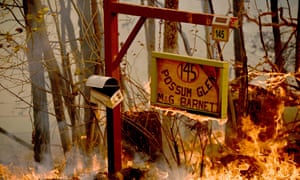
A bushfire burns outside a property near Taree
‘If we can’t talk about the underlying reasons why
bushfires are becoming more frequent, we can’t possibly
 talk about how to manage either the fires Australia is
experiencing today or the far worse ones we will experience
 in the decades to come.’
In modern Australia it has become “inappropriate” to talk about why our rivers are running out of water, why our aged care centres are running out of food and nappies, and why our fire brigades are running out of firetrucks. But it’s impossible to solve problems when you can’t talk about the underlying causes.
When people crash their car going around a tight bend we can sympathise with their families while discussing whether speed, fatigue, alcohol or poor road design were to blame. It’s not impossible to be sensitive to victims and serious about the cause at the same time.

Read the opinion piece from The Guardian by Richard Denniss - “Climate change makes bushfires worse. Denying the truth doesn't change the facts.” 

08 April, 2019

The young minds solving climate change

Global warming, and its effect on climate, is one the most pressing issues facing the world today. It is a metaproblem that exacerbates most other challenges that keep us up at night – from sea level rise or the loss of natural resources to increased conflict, poverty, and gender inequality.
A new generation is becoming energised over the need
to halt climate change. So how do we help them protect their future?
Despite much already having been written on the urgency with which we must reduce greenhouse gas emissions, pull carbon out of the air, and redesign our social-environmental systems towards new ways of doing business, most decision makers, from individual consumers to world leaders, have been excruciatingly slow to take action.

What seems to be lacking is an understanding and consensus of real, workable technologies and practices to solve the crisis of growing concentrations of greenhouse gases in Earth’s atmosphere.


Read the story from the BBC by Chad Frischmann - “The young minds solving climate change.”

03 October, 2018

Super fund alleged to have breached duties over climate change risk

Industry super fund REST is facing a new federal court legal battle over claims it breached its trustee duties by failing to properly factor climate change-related risks into its investment decisions.
As a young person, climate change is a pretty big deal, says Mark McVeigh.
Mark McVeigh, a 23-year-old ecology graduate and council worker from Brisbane, has racheted up his legal campaign against the super fund over its approach to climate change, accusing REST of breaching superannuation law by failing to act in his best interests.

REST is the default industry super fund for many retail workers.


Read the story from The Age by Ruth Williams - “Super fund alleged to have breached duties over climate change risk.”

24 September, 2018

What do Gen X and Gen Y worry about most? Climate change

Two generations of Australians believe one of the most important issues facing the country right now is climate change.
For many members of Gen X and Gen Y in Australia,
climate change is the most pressing issue facing the country.
The latest Life Patterns report by the University of Melbourne shows that many members of both Gen X and Gen Y see climate change as Australia’s most significant and urgent issue.


Read the Pursuit story from the University of Melbourne - “What do Gen X and Gen Y worry about most? Climate change.”

28 August, 2018

Scott Morrison faces test on Paris climate deal

Prime Minister Scott Morrison is facing his first foreign policy test ahead of a regional visit next week, as Pacific leaders urge him to deepen Australia’s cuts to greenhouse gas emissions and cement Australia’s commitment to the Paris agreement on climate change.
Prime Minister Scott Morrison is greeted at Quilpie airport by David Littleproud.
The moves heighten pressure on the new Prime Minister to confirm his stance on the global climate deal as two new cabinet ministers take on the Energy and Environment portfolios amid talk of a policy reset.

Fiji Prime Minister Josaia "Frank" Bainimarama wrote to Mr Morrison on Monday to congratulate him on his elevation while also seeking a commitment to tackle carbon emissions.

“We cannot settle for business as usual and we certainly cannot tolerate any backward steps,” Mr Bainimarama said of the urgent need to address climate change.

“I appreciate Australia’s commitment in this fight so far and I believe that this commitment must grow even stronger moving forward.


Read the story from The Age by David Crowe and Fergus Hunter - “Scott Morrison faces test on Paris climate deal.”

19 February, 2018

Climate change will accelerate extreme weather events in the coming years

Humanity is now facing an ever-increasing threat of unpredictable and extreme weather, climate scientists warn.
This Jan. 4 Geocolor image from the National
Oceanic and Atmospheric Administration
(NOAA) GOES-16 satellite captured the record
"bomb cyclone" nor’easter that battered the
 East Coast of the United States in January 2018.
While global warming is creating more powerful storms and record-breaking, drought-driven wildfires, it would be a mistake to view these events as the “new normal,” they say. The planet has not reached a new climate stability, so the years ahead could be quite a lot worse.

“‘New normal’ implies that we reach some new sort of equilibrium and that's where things stay, whereas what we're looking at is an ever-shifting baseline,” says Penn State professor and atmospheric scientist Michael Mann.


22 January, 2018

In Cape Town, 'Day Zero' is coming very soon - the day the water runs out

Johannesburg: Cape Town, South Africa's second-largest city, is facing its worst drought in a century, with its water supply expected to run dry April 21.
Residents of Cape Town wait in line to collect drinking
water from a mountain spring collection point.
They're calling it "Day Zero." In this city of 4 million, people will have to line up in the streets at just 200 water stations. The police and army will enforce a limit of 25 litres per person and adopt measures to control crowds. Some experts believe evacuations will be necessary.


Read Robyn Dixon’s story in today’s Melbourne Age - “In Cape Town, 'Day Zero' is coming very soon - the day the water runs out.”

03 January, 2018

Australian towns going off the grid

Australia is facing an energy crisis.
Some turned to solar panels and battery storage technology to solve their bill woes.
As prices rose to new highs last year and the ever-constant threat of blackouts hung over the east coast, many Australians looked for energy alternatives.

Some turned to solar panels and battery storage technology to solve their bill woes, gain greater control of their own power and make a real change in terms of their impact on the climate.

While they are taking steps at the individual level, others are looking to take full advantage of the push for more renewable energy and shift away from centralised power systems on a larger scale.


Read Cole Latimer’s story in today’s Melbourne Age - “Australian towns going off the grid.”