Showing posts with label century. Show all posts

07 December, 2019

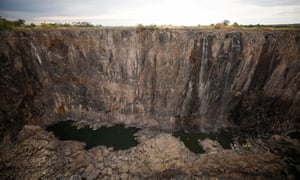
Victoria Falls dries to a trickle after worst drought in a century

For decades Victoria Falls, where southern Africa’s Zambezi river cascades down 100 metres into a gash in the earth, have drawn millions of holidaymakers to Zimbabwe and Zambia for their stunning views.
Dry cliffs at Victoria Falls in Zimbabwe
The dry cliffs of Victoria Falls in Zimbabwe
this week, during the area’s worst drought
in a century, fuelling concerns about climate change.
But the worst drought in a century has slowed the waterfalls to a trickle, fuelling fears that climate change could kill one of the region’s biggest tourist attractions.
While they typically slow down during the dry season, officials said this year had brought an unprecedented decline in water levels.

04 May, 2018

Nonviolence must include resisting the violence of climate change

“In the twenty-first century, nonviolence must include resisting the violence of climate change. People should resist the temptation to use fossil fuel energy or consume industrial foods that they do not need. Citizens should march and protest when governments fail to pass laws limiting overproduction and overconsumption. All human beings should find ways to help those who have been driven from their homes and livelihoods by the changing atmosphere. To resist violence is to seek climate justice” 


19 March, 2018

Sydney to ditch cars by 2056: report.

Planners envisage that by the middle of this century most Sydneysiders will be able to reach their place of work within 30 minutes using public transport or ‘‘active’’ options, such as walking or riding.

Sights such as this will be substantually lessened by
mid-this century if Sydney's plans come to fruition.
The NSW Government has released its Future Transport Strategy 2056 report, which suggests investment will increasingly be focused on ‘‘three cities’’ built around Western Sydney Airport, Greater Parramatta and the existing CBD.

‘‘Customers will be able to travel to one of these cities or to their nearest centre within 30 minutes of where they live by public or active transport,’’ the report states.

‘‘This will give people better access to access jobs, eduction and essential services.’’

The report suggests getting people out of their cars and using sustainable transport will reduce congestion and emissions and improve air quality and wellbeing.

‘‘Well-planned centres and cities will enable a shift from private cars to public transport and active transport modes, such as walking and cycling,’’ the strategy says.

‘‘In Sydney, the key to this will be the delivery of three 30-minute cities, supported by reliable ‘turn up and go’ mass transit services.’’

Active transport for short trips will be encouraged by providing safe and accessible footpaths with seating and shade.

There’ll also be better pedestrian crossings, lower traffic speeds, separated cycling paths and secure bicycle storage.

The report notes that by 2056 NSW will have more than 12 million residents.

Sydney will be a global city similar in size to London or New York.

Premier Gladys Berejiklian released the transport strategy yesterday alongside the State Infrastructure Strategy and the Greater Sydney Region Plan.

‘‘Now for the first time we have a co-ordinated vision for our state for the next 10, 20, 30 and 40 years,’’ Ms Berejiklian said.

‘‘It’s a plan that makes sure communities can expect to have jobs in their local area, shorter travel times and a better environment, which ensures lots of open and green spaces.’’

Transport Minister Andrew Constance said: ‘‘We want to improve public transport and roads so, that by 2056, 70 per cent of people live within 30 minutes of where they work or study.’’


Story from today’s Shepparton News - “Sydney to ditch cars by 2056: report.”

24 February, 2018

Ireland Demonstrates Climate Leadership with €22 billion Investment Plan

The Government of Ireland has announced it will invest €22 billion to transition the country to a low carbon and climate resilient society, aiming at almost zero emissions by middle of the century.
Ireland demonstrates leadership with regard climate change.
According to the country’s National Development Plan published this month, the funds are to be primarily deployed to reduce carbon emissions from transport, agriculture and the energy sector, along with flood defenses.
“While Ireland clearly faces a very significant task in reducing its greenhouse gas emissions, the current profile of which reflects the particular structure of our economy, action can be taken now to position Ireland to harness significant benefits from realising a low-carbon economy,” the report says.


Read the United Nations Climate Change story - “Ireland Demonstrates Climate Leadership with €22 billion Investment Plan.”

22 January, 2018

In Cape Town, 'Day Zero' is coming very soon - the day the water runs out

Johannesburg: Cape Town, South Africa's second-largest city, is facing its worst drought in a century, with its water supply expected to run dry April 21.
Residents of Cape Town wait in line to collect drinking
water from a mountain spring collection point.
They're calling it "Day Zero." In this city of 4 million, people will have to line up in the streets at just 200 water stations. The police and army will enforce a limit of 25 litres per person and adopt measures to control crowds. Some experts believe evacuations will be necessary.


Read Robyn Dixon’s story in today’s Melbourne Age - “In Cape Town, 'Day Zero' is coming very soon - the day the water runs out.”

17 October, 2017

Tropical thunderstorms are set to grow stronger as the world warms

Thunderstorms are set to become more intense throughout the tropics and subtropics this century as a result of climate change, according to new research.

A supercell thunderstorm in the US state of Oklahoma. 
Thunderstorms are among nature’s most spectacular phenomena, producing lightning, heavy rainfall, and sometimes awe-inspiring cloud formations. But they also have a range of important impacts on humans and ecosystems.

For instance, lightning produced by thunderstorms is an important trigger for bushfires globally, while the hailstorm that hit Sydney in April 1999 remains Australia’s costliest ever natural disaster.


Read the piece on The Conversation by a Lecturer from the School of Earth, Atmosphere and Environment at Monash University, Martin Singh - “Tropical thunderstorms are set to grow stronger as the world warms.”

26 May, 2017

Barack Obama on food and climate change: ‘We can still act and it won’t be too late

During the course of my presidency, I made climate change a top priority, because I believe that, for all the challenges that we face, this is the one that will define the contours of this century more dramatically perhaps than the others. No nation, whether it’s large or small, rich or poor, will be immune from the impacts of climate change. We are already experiencing it in America, where some cities are seeing floods on sunny days, where wildfire seasons are longer and more dangerous, where in our arctic state, Alaska, we’re seeing rapidly eroding shorelines, and glaciers receding at a pace unseen in modern times.
Barack Obama - The former president
addresses the greatest challenges facing
 the world, and what we can do about them
Over my eight years in office, we dramatically increased our generation of clean energy, we acted to curtail our use of dirty energy, and we invested in energy efficiency across the board. At the 2015 climate change summit in Paris, we helped lead the world to the first significant global agreement for a low-carbon future.


07 April, 2017

Peru’s Floods Follow Climate Change's Deadly Extreme Weather Trend

Peru's worst floods in nearly a century have killed more than 70 people, left 70,000 homeless in nearly every province and damaged 130,000 structures, including ancient archaeological sites. The downpours inundated the country in the first half of March, then moved north over Colombia, causing a mudslide that killed hundreds.
Flooding in Peru has left tens of thousands of people
homeless, following the global trend of extreme weather
 made more likely by climate change. 
The intense rain and flooding in Peru took emergency workers and scientists by surprise, because such extreme downpours typically are associated with a large-scale El Niño phenomenon. But the latest El Niño ended nearly a year ago.

The flooding instead has been linked to an exceptional and sudden emergence of extra-warm ocean waters just off Peru's coast, what scientists call a coastal El Niño. Since mid-March, NOAA satellites have showed this patch of the eastern Pacific as the most anomalously warm ocean region in the world. 

It won't be clear whether human-caused global warming was a direct factor in the flooding unless scientists do an attribution study. That would determine how much the buildup of heat-trapping greenhouse gases increased the odds of it happening. But the unusual heat blast and flooding are consistent with global warming, according to scientists.


24 April, 2015

Recent hesitation in global temperatures not what it appears


T

he recent hesitation in climbing global temperatures is not what it appears.

A story in today’s Melbourne Age - “Warming hiatus will not stop long-term global climate change” – warns that people should not invest hope is this “hiatus”.

It says, “A recent hiatus in global temperature rises will not temper the ultimate impact of climate change by the end of the century, research by Australian climate scientists has found.”

Researchers say, “They found whether a hiatus was present or not in the model made negligible difference to how much average global temperatures are projected to increase by in 2100 if emissions continue to grow at current rates

08 April, 2015

Central New South Wales can be disheartening and sometimes even alarming


D

riving through central New South Wales can be a little disheartening, and even alarming at certain times of the year.

A new website discussed on The Conversation suggests that by the end of the century even Melbournians could be living in central NSW conditions.

It says, “Even if we significantly reduce our greenhouse gas emissions as under an intermediate scenario, Melbourne’s annual average climate could look more like that of Adelaide’s, and Adelaide’s climate could be more like that of Griffith in New South Wales.”

Further, it adds, “The change in climate is much greater by 2090 and under a high emissions scenario. In this case Melbourne’s climate could then be more like that of Dubbo, Griffith’s more like that of Bourke (600 km away), Sydney’s more like Brisbane, and Coffs Harbour’s could be like Mackay.”

The story - “A new website shows how global warming could change your town” – says, "By 2090, Australian average temperature is projected to increase by 0.6 to 1.7C for low emissions, 1.4-2.7C for intermediate emissions, and 2.8 to 5.1C for high emissions.”

09 December, 2014

Foot-draggers for leaders, spinters for followers


The Climate Institute found June this year that Australia’s political leaders risked being stuck in the past as public attitudes on climate change and its solutions were on the rebound.

Little has changed, maybe even worsened.

Australians are general progressive and liberal thinkers, but our leaders are mostly mired in the past, unable to free themselves, and their thinking, the paradigms of the 20th Century.

The Climate Institute report is headed: “Australians are no climate dinosaurs as support for action evolves: poll”.

05 August, 2013

Climate change is on the march, double time


Climate change is inherently loaded with challenges, some to which we can adapt and others that are either impossible or border on that.

The latest warning from America’s Stanford University suggests the unfolding changes are happening so quickly that adaptation for much of life on earth is in fact impossible.

Scientific American says in a story headed: “Today’s climate change proves much faster than changes in the past 65 million years”, that earth’s eco systems will find it hard to adjust.

Quoting a Stanford University study, the Scientific American story said that if global temperatures rise 1.5 degrees Celsius over the next century, that increase will be 10 times faster than anything seen before.