Showing posts with label expected. Show all posts

31 December, 2019

Under-threat towns' fate depends on which way the wind blows.

The idyllic coastal hamlet of Mallacoota was on Monday night preparing for one of the longest nights in the town’s history, with a forecast midnight wind change expected to bring a massive firefront to its door.
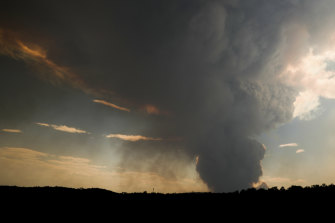
Smoke plumes from a bushfire seen northwest of Bruthen in East Gippsland
Smoke plumes from a bushfire seen northwest of Bruthen in East Gippsland.
As Victoria sweltered through a day of baking heat and parching northerly winds, fires raged across a 200-kilometre stretch of East Gippsland, with nine separate emergency warnings in force, popular holiday towns cut off by road closures and residents urged to stay put and find shelter within their communities.
By 5am Tuesday, there were eight separate emergency warnings in place, covering scores of towns, with 190,000 hectares burnt out. A huge fire was bearing down to the west of Mallocoota and another raged near Orbost. The Vic Emergency warnings map showed the far east of the state almost entirely under threat.

18 November, 2019

Total fire bans declared across SA ahead of catastrophic conditions on Wednesday

A total fire ban has been declared for South Australia on Tuesday ahead of catastrophic conditions expected on Wednesday.
Fire in the background with a man standing looking on
Fire reached close to Port Lincoln last week
in SA's first major bushfire for the season.
It is one of the first times the Country Fire Service (CFS) has declared a pre-emptive fire ban 24 hours before a hot and windy day, the agency's head said.
"It's pretty unusual that we take a precautionary fire ban and I hope that people will realise we've done so in response to the severity of the conditions which are forecasted for Wednesday," CFS chief officer Mark Jones said.

21 September, 2019

Thousands of Tech Workers Join Global Climate Change Strike

Thousands of workers from Amazon, Twitter, Google, Microsoft, Facebook, Square, and other tech companies are expected to walk out today as part of a worldwide climate change strike led by 16-year-old activist Greta Thunberg. After Amazon workers announced they were joining the demonstration last week, employees from other Silicon Valley firms began joining in. The same group of Amazon employees have been pushing the company to reduce its carbon footprint for nearly a year. Now, over 1,700 of them and counting have said they will join Friday’s walkout, which is expected to draw millions of participants in cities around the world.

Greta Thunberg amidst climate protestors
Swedish teenager, Greta Thunburg, marches with tech workers in the U.S.
The tech workers participating in the strike are part of a wider wave of employee activism that has spread across Silicon Valley over the past year. Many of those demonstrations concerned workplace issues at individual companies, such as sexual harassment or controversial government contracts. Friday's walkout represents a broader coalition across different corporations, focused on an issue facing the entire planet. Many of these employees make up one of the more privileged and highly visible labor forces in the world, working for innovative and resource-rich companies. If their efforts on climate change keep gaining momentum, they may have a significant impact, especially as the Trump administration continues to roll back environmental initiatives.


Read the story from Wired by Eduardo Munoz Alvarez/AP -  “Thousands of Tech Workers Join Global Climate Change Strike.”

15 June, 2019

Researchers probe the link between climate change and global conflict

Climate change is expected to exacerbate armed conflict, even as military efforts themselves serve as a driving source of global warming. This is the conclusion of multiple reports published this week probing the relationship between climate change and global conflict.
Drought in India.
The dynamic between climate change and global stability has been a source of contention for years, with experts largely agreeing that a link between the two does exist, even if on a minute level. But a series of reports released this week indicate that the connection between rising temperatures and conflict is becoming increasingly clear.
According to one of the studies, global warming that rises beyond the dangerous 2 degrees Celsius threshold is likely to substantially escalate clashes and conflicts within countries. These findings echo another report this week that warns climate change will harm global peace and stability within the next decade.

Read the Think Progress story by E.A. Crunden - “Researchers probe the link between climate change and global conflict.”

22 April, 2019

Earth Day 2019: Apple’s recycling robots and efforts to end single-use plastic

More than one billion people are expected to take part in Earth Day activities on April 22, with companies including Apple and Etihad also jumping on board.
Earth Day 2019 comes amid calls for government action on climate change. 
First held in 1970, Earth Day is credited as helping to launch the modern environmental movement through its mission to “diversify, educate and activate” people across the globe about environmental issues.

The 2019 event follows the release of a landmark report by the United Nations Intergovernmental Panel on Climate Change (IPCC) in October, showing time is running out to prevent catastrophic climate change.


Read the story from The New Daily by Isabelle Lane - “Earth Day 2019: Apple’s recycling robots and efforts to end single-use plastic.”

10 March, 2019

Is Tony Abbott's time up?

When economist Nick Scott retired, he expected his days to take on a peaceful rhythm. He would read. Go fishing. Spend time with his grandchildren. He did not envisage staging political protests while wearing an inflatable dinosaur suit but, well, life is full of surprises. "It's been liberating," he says of joining a grassroots movement to remove former prime minister Tony Abbott from Federal Parliament. "I thought, 'It's time to actually do something rather than just shouting at the television.' “
Some traditionally right-leaning voters are joining locals
in Sydney’s Warringah in turning against their long-time
federal Liberal MP.

Scott, 64, has lived for 30 years in the northern Sydney electorate of Warringah, held by Abbott for the Liberal Party for a quarter of a century. Though now a backbencher, Abbott, 61, is still the driving force behind the Coalition government's hard-right faction. Whether he retains his seat at the looming federal election could depend on the effectiveness of a campaign against him by a collection of small community groups that, as Scott puts it, "have simply popped up like mushrooms in the night". Some of them have thrown their support behind Zali Steggall, the world-champion skier turned barrister who is running against Abbott as an independent. But the groups are bound less by allegiance to any one candidate than an aversion to the sitting member. In Warringah, they are known unofficially as the ABBA (Any Bastard But Abbott) alliance.

Read the story from The Age by Jane Cadzow - “Is Tony Abbott's time up?”


(Listen to Zali Steggall on “Climate Conversations”)

25 February, 2019

The emissions reduction fund was deeply flawed – and no rebranding will change this

The Coalition government has today released its climate policy for the upcoming election.
‘We need to do so much more than accounting
tricks and the direct purchase of spurious abatement’.
Not much could have been expected from the government given that the prime minister has only been in the role six months, and not much was delivered.

There is not a lot of detail around the total package, the $3.5bn cash splash. What we have is enough to make clear that this is not the climate policy solution that the government thinks it is.


Read the story from The Guardian by Tim Baxter - “The emissions reduction fund was deeply flawed – and no rebranding will change this.”

20 February, 2019

Beaches closed as looming cyclone brings danger to Queensland

Severe Tropical Cyclone Oma is expected to bring more dangerous surf conditions and abnormally high tides as it moves closer to the southern Queensland coast, the weather bureau warns.
Didgeridoo player Russell Corowa is dwarfed by
 waves at Snapper Rocks on the Gold Coast on Tuesday.
The category two weather system was about 1100 kilometres north-east of Brisbane on Wednesday morning, and moving slowly towards Australia.

Beaches on the Gold Coast have already been closed this week, with people urged not to enter the water. A strong tide created by the impending cyclone has brought waves of up to three metres and led to some coastal streets being inundated.

On Tuesday, the king tide north of Mackay caused some erosion at Midge Point, and the Pioneer River to flow into the nearby carpark.


04 January, 2019

New lithium hydroxide factory in Western Australia wins federal approva

Earthworks for a new lithium hydroxide factory in Western Australia are expected to begin this month after the $1bn project received federal environmental approval.
The Kemerton plant is the second significant lithium
 hydroxide operation approved in Western Australia
since 2016. Pictured is the Bald Hill mine in WA. 
The plant owned by the world’s largest lithium producer, the US chemical company Albemarle, was approved by the WA government in October and is estimated to create up to 500 jobs in construction, with another 100 to 500 operational jobs once it is operational.

Australia’s trade minister, Simon Birmingham, said the plant would provide a much-needed local jobs boost and supply a growing global demand for lithium, which is used in renewable energy storage.


Read the story from The Guardian by Calla Walquist - “New lithium hydroxide factory in Western Australia wins federal approval.”

State braces for 'unpredictable' fires and authorities issue air quality warning as extreme heat descends on city

Victoria is set to swelter through the hottest day of the summer so far with extreme heat and strong, gusty winds expected to stir up dust prompting a health warning from authorities.
Melbourne is set to sweat through its hottest day in three years.
Emergency services are also bracing for "uncontrollable, unpredictable and fast-moving" fires.

The state's Environment Protection Authority has warned Melbourne and Geelong residents that the conditions are likely to raise dust and reduce air quality.

EPA Air Quality Scientist Gavin Fisher said in areas in such as Brooklyn and South Geelong, the air quality would be poor and could increase the risk of health problems for those with  heart and respiratory conditions.


01 January, 2019

A balmy start, but Melbourne is bracing for 42 degrees

Temperatures are expected to climb above 40 degrees on Friday as the state heads into the summer peak.
Melbourne could reach 42 degrees on Friday.
Following a balmy start to 2019, Melbourne is forecast to see the mercury rise on Thursday to 28 degrees before climbing to an expected 42 degrees on Friday.

Senior forecaster Rod Dickson said north-westerly winds were dragging heat from inland, causing a day of extreme heat.

"The maximum temperature depends on the time of the cool southerly change," Mr Dickson said.


Read the story from The Age  by Sumeyya Ilanbey and Olivia Jenkins -  “A balmy start, but Melbourne is bracing for 42 degrees.”

18 November, 2018

Labor poised to sign off on long-awaited energy plan

Labor is close to finalising its much-anticipated plan to cut carbon emissions from Australia's polluting electricity sector, which is expected to include a framework modelled on the now-defunct National Energy Guarantee.
Labor has previously criticised the government for stepping
 away from the National Energy Guarantee to cut emissions
 from electricity.
Fairfax Media understands that shadow cabinet is on Monday expected to consider the plan, which would outline how a future Labor government would implement its climate change targets for the electricity sector, including a 45 per cent cut in emissions.

The Coalition government dumped the National Energy Guarantee soon after Scott Morrison replaced Malcolm Turnbull as Prime Minister in September. That policy would have reduced emissions from the electricity sector and improved reliability and affordability.

Labor criticised the move, but its attack on the government over energy policy has been weakened by the fact that it has revealed few concrete plans of its own.


Read the story from The Age by Nicole Hasham - “Labor poised to sign off on long-awaited energy plan.”

19 October, 2018

Severe weather warning issued as dust storms and strong winds hit South Australia

Damaging wind gusts of up to 100 kilometres per hour are forecast ahead of a vigorous cold front, which is expected to reach Adelaide this afternoon.

Lincoln Highway between Arno Bay and Cowell during a dust storm.
The Lincoln Highway between Arno Bay and Cowell.


Dust storms are blowing across parts of South Australia as more severe weather crosses the state, prompting warning messages from emergency services.

The Bureau of Meteorology issued a severe weather warning for 10 of the state's districts, including Adelaide, the Mount Lofty Ranges and Eyre and Yorke Peninsulas.

18 October, 2018

California and climate change: Here's what to expect

California’s fourth, and most recent, climate assessment report reflects years of increasingly frequent and threatening natural disasters that have plagued the nation’s most populous state. In coming decades, they’re expected to become even more severe.
Active flame front of the 2007 Zaca Fire.
The state in its 2007 forecast had envisioned a tough 10 years ahead. That was the year the Witch Fire in San Diego County, which raged from October 21 to November 6, consumed nearly 200,000 acres, destroying 1,650 structures and killing one person. I remember that one distinctly: My wife and I had just returned from our honeymoon in Hawaii, and we evacuated our suburban neighborhood as thick brown clouds of smoke darkened the skies above.

The Zaca Fire in Santa Barbara County, which burned from that previous July 4 to September 4, was actually the biggest wildfire of 2007 at more than 240,000 acres. It consumed mostly rural land and destroyed just one building. At the time, it was the second largest fire in California history, behind San Diego County’s Cedar Fire in 2003, on which I reported as science writer with The San Diego Union-Tribune.


Read the story from Yale Climate Conections by Bruce Lieberman - “California and climate change: Here's what to expect.”

03 October, 2018

This Is Not A Blip

IN MARCH, THE COLORADO RIVER RESEARCH GROUP published a report urging water watchers to stop using the word “drought” to describe environmental changes in the southwestern United States. “Drought,” the group wrote, implies that “the condition is temporary—a deviation from a norm that is expected to eventually return.” But what is happening in the Colorado River Basin is not temporary. There will be no return. The old norm is dead. A better word to describe emerging conditions, the researchers suggested, would be “aridification”: the period of transition to a permanent condition of increasing water scarcity.

A few weeks later, David Lipton, the second-in-command at the International Monetary Fund, gave a speech in Sofia on the future of multilateralism. The occasion was the annual gathering of Eurofi, the pretend think tank set up by Europe’s main banks as a lever to keep Brussels market-friendly and free of anything that might faintly resemble profit infringement. Lipton, a cartoon technocrat with a brush of hair so tough and a gaze so unblinking he sometimes appears to have been taxidermied while still alive, began by lamenting that “until recently, the theme of multilateralism probably would have prompted me to focus on governance reforrems at the IMF.” But, he added, “times have changed. We live in an era of doubts and questions about the global order. We are in a trust recession.” The consequences of this slump in global trust, Lipton continued, are everywhere obvious: the rise of right-wing populism and protectionism; anger about income inequality; the growing popularity of “single-issue movements, online groups and communities that form on social media.” But Lipton also had good news: regulations introduced after the financial crisis led, ironically, to a renaissance in public trust in banks. Trust, in others words, “can be rebuilt.” For Lipton, the moral was clear: “We can restore trust in institutions and larger purposes if we set out to regain the sense that something concrete can be achieved by working together.”


Read the story by Aaron Timms from The Baffler - “This Is Not A Blip.”

17 September, 2018

Nature’s furies batter Asia and the United States

Hong Kong: Death tolls are expected to rise as the two storms that have lashed the Philippines and China and North Carolina continue to wreak havoc.
A police officer carries a girl in rain during a No 10
 Hurricane Signal raised for Typhoon Mangkhut in
Hong Kong on Sunday.
Typhoon Mangkhut battered Hong Kong and threatened the southern coast of China on Sunday, after cutting a destructive path through the Philippines and killing dozens of people there.


Read the story from The Age - “Nature’s furies batter Asia and the United States.”

30 July, 2018

VicForests says experiment 'very likely' to kill threatened glider, continues research

A government-owned logging company is conducting a controversial experiment expected to kill native animals that are already heading toward extinction, the ABC can reveal.
Ed Hill from the GECO Environment Centre at a
 logging site in an area of East Gippsland that is
 home to the threatened Greater Glider.
VicForests is owned by the Victorian Government and logs native forests for profit under exemptions to federal environment law.

It is now logging parts of East Gippsland forest at different intensities to measure survival rates of the threatened greater gliders that call it home.

VicForests argued the research would assist the conservation of the species, but acknowledged it was likely to kill some of them.


01 May, 2018

Matt Canavan threatens challenge to tree-clearing laws

The Turnbull government is threatening to use the Racial ­Discrimination Act in an attempt to overturn a revived tree-clearing crackdown in Queensland, which is expected to be passed into law this week.
Federal Minister for Resources and Northern Australia
 Matthew Canavan hope to use the High Court to overturn
Queensland's tree-clearing crackdown.
Federal Minister for Resources and Northern Australia Matthew Canavan confirmed that advice was being sought to possibly intervene in the High Court over the state laws.

Senator Canavan said the federal government was responding to calls from indigenous leaders who believed the proposed legislation would stifle economic ­development opportunities on Cape York.

The revival of the legislation, which contains more restrictions than flagged at the November election, follows the defeat of similar laws under the previous minority Palaszczuk government when it was opposed by former indigenous MP Billy Gordon.


Read Michael McKenna’s story from The Australian - “Matt Canavan threatens challenge to tree-clearing laws.”

Queensland farmers rally against laws to curb land clearing

The Queensland government is expected to pass new land-clearing laws on Tuesday amid fierce protests by farmers on the steps of the state parliament.
 One Nation senator Pauline Hanson, right, joins protesters
 against Queensland’s new land-clearing laws. 
The laws are an attempt to rein in soaring clearing rates and restore environmental protections that were scrapped in 2013. The Climate Council estimates bushland more than seven times the size of Brisbane – about 1m hectares – was cleared between 2012 and 2016.

About 500 farmers from across the state, wearing green shirts and waving signs that proclaimed them the “true environmentalists”, demonstrated on the grounds that the changes will harm the state’s agricultural sector. They didn’t miss the opportunity to point out that city dwellers’ smashed avocado and soy lattes were, in many cases, products of Queensland farming.


Read Ben Smee’s story from The Guardian - “Queensland farmers rally against laws to curb land clearing.”

14 April, 2018

Wet, warm start to winter for Australia

The Bureau of Meteorology’s latest seasonal forecast is predicting the start of winter to be wet and warm for large swathes of Australia.

Wetter-than-average conditions are expected across the southeast between next month and July, with daytime temperatures forecast to be warmer than usual.

The bureau’s latest three monthly climate outlook comes after a series of sweltering days across NSW, Victoria and South Australia where April temperatures soared to record highs.

Senior climatologist Lynette Bettio said the forecast reflected warmer-than-average sea surface temperatures around New Zealand and in the Tasman sea.

‘‘This may cause lower pressures over eastern Australia with a swing towards above average rainfall in the far southeast,’’ she said on Thursday.

‘‘Northern Australia is also likely to receive above average rainfall, however we are coming into the dry season across the north so we don’t need large rainfall totals to exceed the median.

‘‘Days and nights are forecast to be warmer than average across the south and cooler than average across parts of northern Australia, especially in Queensland.’’ — AAP


AAP story from The Shepparton News - “Wet, warm start to winter for Australia."