Showing posts with label conditions. Show all posts

04 January, 2020

Devastation marches west across Alpine and Upper Murray

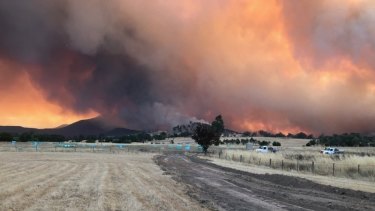
Property and stock losses have been “devastating” in Victoria’s already battered north-east and Upper Murray regions, residents said, as they prepared for conditions to worsen dramatically on Saturday.
Fires approach a cattle  farm in Cudgewa, near Corryong, earlier this week.
Fires approach a cattle farm in Cudgewa, near Corryong, earlier this week.
Temperatures are expected to reach up to 44 degrees, with dry conditions and gusty winds combining to create a horror recipe for firefighters and local residents as the fire front marches west.
There were early reports of properties razed in the Cudgewa and Corryong areas on Friday, as more people evacuated to Albury-Wodonga and beyond.

Read the story from The Age - “Devastation marches west across Alpine and Upper Murray.”

15 September, 2019

A crying shame: humanity sleepwalking to disaster

Almost every day I read or hear commentators on diverse fields of human activity blithely talking about trends and conditions that are likely to play out in the future. Some of them are happy to extend their prognostications decades into the future and adopt a business-as-usual approach.
Dr Ian Bayly at work in his private, post-retirement zooplankton laboratory.
Very few of them display any overt awareness that humanity is facing the prospect of a climate-induced societal collapse in the near term and that consequently much of their commentary is likely to be incapable of fulfilment.
I recently read Losing Earth: the Decade We Could Have Stopped Climate Change by Nathaniel Rich. Which decade was he referring to? The 1980s. To be a bit more conservative, and allow for some reasonable degree of time-lag, my view is that the 1990s is a fairer nomination for when effective climate change mitigation could have, and should have, commenced.
Here I have some personal experience: for six years before my retirement at the end of 1995, I taught climate change science to a second-year class at Monash University.

Read the story from The Age by Ian Bayly - “A crying shame: humanity sleepwalking to disaster.”

14 April, 2018

Wet, warm start to winter for Australia

The Bureau of Meteorology’s latest seasonal forecast is predicting the start of winter to be wet and warm for large swathes of Australia.

Wetter-than-average conditions are expected across the southeast between next month and July, with daytime temperatures forecast to be warmer than usual.

The bureau’s latest three monthly climate outlook comes after a series of sweltering days across NSW, Victoria and South Australia where April temperatures soared to record highs.

Senior climatologist Lynette Bettio said the forecast reflected warmer-than-average sea surface temperatures around New Zealand and in the Tasman sea.

‘‘This may cause lower pressures over eastern Australia with a swing towards above average rainfall in the far southeast,’’ she said on Thursday.

‘‘Northern Australia is also likely to receive above average rainfall, however we are coming into the dry season across the north so we don’t need large rainfall totals to exceed the median.

‘‘Days and nights are forecast to be warmer than average across the south and cooler than average across parts of northern Australia, especially in Queensland.’’ — AAP


AAP story from The Shepparton News - “Wet, warm start to winter for Australia."

13 March, 2018

Worst fire conditions in 12 months feared for this weekend

Extreme heat and high winds forecast for this weekend could see Victoria face its worst bushfire conditions in 12 months.

Authorities are bracing for wind gusts topping 100km/h ripping across the state's parched bushland over two days that could hit 35 degrees.

“We have had hot days, and we have had windy days so far this season,” Emergency Management Commissioner Craig Lapsley said. “We haven’t had hot and windy.

“It’s extremely dry. We have not experienced serious rain across the state for about 40 days. Gardens are dry, the bush is dry, grasses are dry.


Read Liam Mannix’s story from The Age - “Worst fire conditions in 12 months feared for this weekend.”

04 March, 2018

Ice skaters take to Amsterdam's canals during Europe's big freeze

The freezing conditions gripping Europe have produced one unexpected upside: parts of Amsterdam’s canals have frozen over, allowing locals to ice skate on the waterways.
Europe's "big freeze" has it benefits, for some.
For the first time in about six years, part of the Prinsengracht and Keizersgracht canals froze hard enough to support the weight of dozens of sightseers, locals and ice skaters.

Footage from the canals shows people on skates criss-crossing the ice while others stroll along enjoying the novelty of walking on what is normally flowing water.


03 February, 2018

The real cost of McMansions

As Melburnians sweltered through an intense spell of heat and humidity this week, a series of power outages made conditions especially testing for tens of thousands of people.
McMansions were always going to result in high power bills for residents.
Some saw political gains to made by blaming the blackouts on the closure of Victoria's decrepit Hazelwood power station by its French owners last March even though electricity supplies were not the issue.


Read Peter Hannam’s story in today’s Age - “The real cost of McMansions.”

19 January, 2018

Victoria to swelter for second straight day

Nine children were rescued from hot cars and more than 1000 homes left without power as Victorians sweltered through a dangerously hot day yesterday.

Emergency Management Commissioner Craig Lapsley.
Emergency Management Commissioner Craig Lapsley warned people to brace for even worse conditions today.

‘‘The fire risk is real and the fire risk only gets worse with the fact that there’s no respite across the state tonight,’’ Emergency Services Commissioner Craig Lapsley said yesterday.

Mr Lapsley said central and western Victoria were most at risk of bushfire, with blazes already burning near the SA border and Geelong.

Despite extreme heat warnings, chief health officer Charles Guest said there had been reports yesterday of nine children being left in parked cars.

‘‘We know that leaving children in parked cars can lead to death. I’m glad to say this hasn’t happened this summer so far,’’ he said.

More than 1000 properties in Beaufort, near Ballarat, were left sweltering without fans and air conditioners because of a power failure before operator Powercor restored electricity.

Dr Guest said people without access to air conditioning or at risk of heat exhaustion were advised to head to shopping centres or cinemas to cool down.

The Bureau of Meteorology is predicting temperatures to reach 42°C today with other parts of the state to see ranges in the low to mid-40s.

‘‘It’s going to be dry, hot and a change in the south, but the change won’t be helping things in the north,’’ bureau state manager Andrew Tupper said.

He said there would be a risk of dry lightning, which occurs when electrical storms hit without rain managing to make it to the ground.

Temperatures hit 39°C in Melbourne and above 40°C in regional towns yesterday.

Total fire bans remain across the Mallee, Wimmera and south-west districts in the state.


Story from the Shepparton News - “Victoria to swelter for second straight day.”

17 January, 2018

Why we need to 'climate proof' our sports stadiums

For many Australians summer is synonymous with cricket and tennis. But as Australian summers become more prone to extreme heat conditions, sustainable and climate-adaptable stadium design has become a leading consideration for both sporting codes and governments.
The SCG was measured at 57.6 degrees
Celsius on Sunday during the fifth Ashes Test.
The final Ashes Test played at the Sydney Cricket Ground recently showed that the cricketing community must adapt to heatwaves made worse by climate change.

And in recent years the Australian Open has produced many stories of both tennis players and spectators suffering in extreme heat. And more are expected over the two weeks of the current tournament.

As the New South Wales Government embarks on a hugely expensive rebuild of major stadiums across Sydney, now is a good time to ask whether major Australian sports venues are adequately "climate-proofed" for a warming future.


Read the story on ABC News from The Conversation by Macquarie University’s Paul J Govind - “Why we need to 'climate proof' our sports stadiums.”

04 January, 2018

Severe heat alert

Firefighters will be on high alert this weekend, after the Bureau of Meteorology issued a severe fire warning that could place much of Victoria at risk.

Maximum temperatures are forecast to exceed 40°C across much of the state on Saturday, with fresh winds also expected ahead of an approaching front.

CFA District 22 operations officer Travis Harris said the forecast weather conditions were the perfect brewing ground for fires.
Fire ready: Firefighters will be on high alert this weekend
with strong winds and low humidity forecast.
Mr Harris said conditions would be favourable today and tomorrow, but the fire danger on Saturday would mean crews would be on high alert.

The CFA will put control centres in place on Saturday, in addition to extra resources and people, in the event of an incident.

‘‘It’s all factored around the weather so the high temperatures, combined with the strong winds and low humidity will increase the dangers if a fire was to start,’’ Mr Harris said.

Northern parts of the state will be most impacted, with the northern country and north central to receive severe warnings, and warnings for the Wimmera and Mallee areas to be set to extreme.

Lighting any fires is illegal on high fire danger rating days, and even activities such as mowing grass and working machinery can spark a blaze.

Mr Harris said fires could occur anywhere at any time, but asked those on rural properties to be even more vigilant.

“We hope that everyone is on their best behaviour, so we can have bad fire weather, but if nothing happens that will be fantastic; if one starts, there’s an increased risk that a fire could take hold,’’ he said.

“We just ask people to be extra vigilant and to put off any tasks that are high risk.

‘‘At this stage, we have no expectation for what Saturday may bring, we’re still monitoring the forecast and keeping an eye on it.’’


Rhiannon Tuffield writes in the Shepparton News - “Severe heat alert.”

26 November, 2017

Global hot spot: Exceptional heat pushes up ocean temperatures off Australia

Australia is home to a global hot spot for sea-surface temperatures, with a record burst of prolonged heat in the country's south-east helping to make conditions several degrees warmer than average.
Daily weather charts generated by the US National Oceanic and Atmospheric Administration show the unusual warmth is almost unmatched around the world, compared with normal temperatures.

Only patches off Greenland and New York in the US are as abnormally warm compared with long-run averages. (See chart below.)

"It's clear sea-surface temperatures around south-eastern Australia, and Tasmania in particular, are well above average," Blair Trewin, senior climatologist for the Bureau of Meteorology, told Fairfax Media.


Read Peter Hannam’s story in today’s Melbourne Age - “Global hot spot: Exceptional heat pushes up ocean temperatures off Australia.”

05 October, 2017

NSW farmers urged to plan for dry season as lack of rain increases pressure on landholders

A sheep and cattle farmer from the New South Wales Hunter Valley says conditions in the region have not been as dry as they currently are in almost 40 years.

Large parts of NSW are in desperate need of rain.
The observation came as farmers were urged to plan for the warmer months in a bid to mitigate the effects of the harsh conditions.

Ian MacCallum has worked the land around Moonan Flat in the Upper Hunter for 60 years.

"For the cattle industry, it is particularly bad because our cows have just calved, and we've got young calves on the ground which are this coming year's income.


30 April, 2017

Yes, I am a climate alarmist. Global warming is a crime against humanity

Most of us have wondered about the human context of past crimes against humanity: why didn’t more people intervene? How could so many pretend not to know? To be sure, crimes against humanity are not always easy to identify while they unfold.
‘We are the bystanders who must choose to intervene or be defined by our failure.’ 
We need some time to reflect and to analyze, even when our reasoning suggests that large scale human suffering and death are likely imminent. The principled condemnation of large scale atrocity is, too often, a luxury of hindsight.

I’m a climate alarmist because there is no morally responsible way to downplay the dangers that negligent policies – expected to accelerate human-caused climate change – pose to humankind.
There can be no greater crime against humanity than the foreseeable, and methodical, destruction of conditions that make human life possible – hindsight isn’t necessary.


Read Laurence Torcello’s story on The Guardian - “Yes, I am a climate alarmist. Global warming is a crime against humanity.”

10 February, 2017

NSW weather: Fire warning as extreme heat and dangerous winds forecast for weekend.

The NSW Rural Fire Service says
 temperatures and winds will
 pick up on Saturday.
Firefighters are warning of dangerous conditions across many parts of New South Wales, with extreme heat forecast over the next few days.

Bureau of Meteorology (BOM) forecaster Olenka Duma said there would be widespread heatwave conditions with temperatures reaching the mid 40s over many inland areas and high 30s along the coast on the weekend.

"It is going to be very hot, particularly over the next couple of days," she said.

The NSW Rural Fire Service (RFS) said the state would experience the worst bushfire conditions in four years with severe and extreme fire dangers in widespread areas.

14 January, 2017

Call it the Southern California drought. Rain and snow end Northern California water woes

A week of powerful storms in Northern California
 has significantly eased the state’s water shortage.
What was once a statewide drought this week became a Southern California drought.

A week of powerful storms has significantly eased the state’s water shortage, pulling nearly all of Northern California out of drought conditions, according to the U.S. Drought Monitor.

The  report underscores what experts have been saying for several months. As a series of storms have hit Northern California this winter, the drought picture there is improving, but water supply remains a concern in Southern California and the Central Valley.

More than 40% of the state is no longer in a drought, according to the data released Thursday.

Perhaps most striking, a giant swath of the state was declared to have no signs of abnormal dryness at all. The percentage of the state that fell into that category nearly doubled from 18% last week to almost 35% after the storm.