Showing posts with label Australian. Show all posts

07 March, 2020

‘Energy superpower' hub hopes dim as Germany, Australia stop funding

The future work of dozens of researchers seeking to develop a low-carbon "energy superpower" vision hangs in the balance after support from both the German and Australian governments was halted.
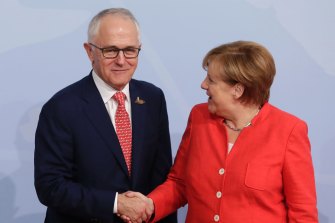
Australian prime minister Malcolm Turnbull and German Chancellor Angela Merkel agreed in 2017 at the G7 leaders' summit to back an energy transition hub that is now facing an uncertain future after both nations ended their support.
Australian prime minister Malcolm Turnbull and German
 Chancellor Angela Merkel agreed in 2017 at the G7 l
eaders' summit to back an energy transition hub that
is now facing an uncertain future after both nations ended their support.
The Energy Transition Hub, a five-year $20 million venture signed in 2017 to foster research by Australian and German universities, stops receiving funds from Germany this quarter, with the Morrison government's support ending in June.

Read the story from The Age by Peter Hannam - “‘Energy superpower' hub hopes dim as Germany, Australia stop funding.”

02 November, 2018

Billionaire tackles government 'dishonesty' on renewables

Australian software billionaire Mike Cannon-Brookes has accused Prime Minister Scott Morrison of being dishonest over the cause of rising power bills, as he called on supporters of clean energy to get behind his "Fair Dinkum Power" movement.
Atlassian's Mike Cannon-Brookes has used
Twitter to pick another battle over energy.
CREDIT:
"People are saying 'why is my bill so expensive?' and [Mr Morrison] is out there saying 'it's renewables' - that is not true, that is dishonest," Mr Cannon-Brookes told Fairfax Media on Thursday.

"Your power bill is expensive for a lot of reasons and the experts agree it is nothing to do with renewables.”

Earlier this week, the Atlassian co-founder started a movement on Twitter mocking the federal government's use of the term "fair dinkum power", which became a catch-all term for baseload, fossil fuel energy, after Mr Morrison started using the expression in response to concerns about the reliability of wind and solar power.


Read the story from The Age by John McDulling and Cole Latimer - “Billionaire tackles government 'dishonesty' on renewables.”

21 September, 2018

Discovery of mummified penguin chicks provides clues to catastrophic weather events in Antarctica: scientists

Australian and Chinese scientists have discovered hundreds of mummified penguin chicks on Long Peninsula in Antarctica.
The mummified bird carcasses were found
 lying in heavy sediments in east Antarctica.
The researchers said the find sheds light on the effects of two catastrophic weather events that decimated breeding colonies in the area, and could also unlock clues about the impact of climate change on Antarctic penguin populations.

A study published in the Journal of Geophysical Research —Biogeosciences analysed sediment at the site where researchers found the mummified baby birds.

Scientists said the discovery holds clues to two massive weather-related calamities that wiped out large numbers of birds, one about 200 years ago and one around 750 years ago.


27 July, 2018

Steel giant Bluescope turns to solar with major deal.

Australian steel giant BlueScope is turning to solar to help power its Port Kembla Steelworks, signing a 7-year power purchase agreement to take the bulk of the output from the 133MW (AC) Finley Solar Farm to be located 100km west of Albury.
Australian steel giant BlueScope is turning to
solar to help power its Port Kembla Steelworks.
The landmark deal with ESCO Pacific and Schneider Electric continues the rush of major corporate buyers towards solar technologies, with Finley expected to supply the equivalent of 20 per cent of BlueScope’s Australian electricity purchases, “significantly” reducing costs and providing price certainty.

It also follows a commitment by UK billionaire Sanjeev Gupta to power his steelworks in Whyalla with solar and storage, a commitment that will result in more than 1GW of large-scale solar and storage.


Read the story from RenewEconomy by Giles Parkinson - “Steel giant Bluescope turns to solar with major deal.

13 April, 2018

Victorian coal to keep lights on in Japan, says Turnbull

On one of Victoria’s hottest mid-April days on record, Australian and Japanese leaders gathered at the base of Loy Yang, the state’s biggest power plant, to launch a project to secure the long-term future of its vast brown coal reserves.
Malcolm Turnbull says brown coal might
one day keep the lights on in Japan.
If this $496 million pilot project to convert the Latrobe Valley’s brown coal into liquid hydrogen pays off, there is hope that a new export industry will be created that will fuel the valley’s coal-dependent economy for many decades to come.

Speaking at the launch of the project between Australia and Japan in the Latrobe Valley, Prime Minister Turnbull highlighted the government's agnostic position on energy, one of the main tenets of the National Energy Guarantee, which has been used to increase the role of coal in Australia's energy mix.


Read the story from The Age by Adam Carey and Cole Latimer - “Victorian coal to keep lights on in Japan, says Turnbull.”

14 March, 2018

Australian first trial shows wind can provide energy security

An Australian first trial is taking wind farms from passive producers that sell all their output in a slab to more active, and opportunistic, participants in the energy market.
The combination of renewables plus storage at
Hornsdale is changing Australia's energy market.
Neoen Australia’s South Australian Hornsdale 2 wind farm has carried out a trial which could see wind replace coal, gas and even pumped hydro in providing energy stability.


Read Cole Latimer’s story from The Age - “Australian first trial shows wind can provide energy security.”

Companies 'failing' to deal with climate change risk

Too many big Australian companies are failing to reveal plans for tackling climate change or to explain how climate change may impact their businesses, according to new research.

Ruth Williams - Australian companies failing
to reveal plans for tackling climate change.
The report, to be released Wednesday by climate NGO Market Forces, is based on public information from 73 big listed companies operating in sectors considered high-risk on climate change.

It found that 84 per cent of the companies had not released a plan to reduce their greenhouse gas emissions, 60 per cent did not have an emissions reduction target, and less than half had identified climate change as a material business risk.

Market Forces is now calling for the disclosure of climate change-related risks to be made mandatory for companies, saying too many were failing to adhere to voluntary standards.


Read the story by Ruth Williams from The Age - “Companies 'failing' to deal with climate change risk.”

07 March, 2018

Australian homes, business installed 6.5 solar panels per minute in 2017

We know that Australian homes and businesses were installing rooftop solar at a record-breaking clip in 2017, but the latest data from the Clean Energy Regulator makes that official – and how.


According to the CER’s latest update on the Small-Scale Renewable Energy Scheme, solar panels were installed on rooftops at a mind-bending rate of 6.5 per minute in 2017, adding a total of 1057MW new capacity for the year.

This equates to 3.5 million solar panels being fixed to Australian rooftops, or more than 9500 installed every day, the CER said.

All told, there was a 41 per cent increase in installed renewable energy capacity across all states and territories compared to 2016, the report says.


Read the One Step off the Grid story by Sophie Vorrath - “Australian homes, business installed 6.5 solar panels per minute in 2017.”

10 February, 2018

Health Check: how can extreme heat lead to death?

Our climate is becoming hotter. This is our reality. Extreme heat is already responsible for hundreds of deaths every year. It’s a big environmental killer, and deaths from heatwaves in Australian cities are expected to double in the next 40 years.
Our climate is going to get warmer, and we
need to protect ourselves from heat-related illness. 
Those most at risk are the elderly, people with chronic illness, those living in socioeconomic disadvantage, outdoor workers, and athletes who play their sport in brutally high temperatures. But extreme heat can affect anyone at any age.

So, what happens in our body during times of extreme heat? And how can it lead to fatal consequences?

Read the piece on The Conversation by the Emeritus Professor of Medicine from the University of Adelaide, David Shearman -  “Health Check: how can extreme heat lead to death?

05 February, 2018

Gas giant bills threat: price hikes of up to $430 predicted

Australian households could be paying as much as $430 more for electricity by the end of next year unless wholesale gas prices are brought under control, according to a new report that warns the Turnbull government's energy policies are falling short.
Australia is one of the world's largest gas exporters. 
Policy analysts at the McKell Institute have for the first time modelled the impact of wholesale gas prices on household power bills in New South Wales, Victoria and Queensland - finding consumers are already paying between $100 and $200 more than what the Australian Competition and Consumer Commission considers reasonable.


Read Adam Gartrell’s story in the Age - “Gas giant bills threat: price hikes of up to $430 predicted.”

30 January, 2018

Away from the public gaze, serious threats to the environment keep rising

Threats to the Australian environment get reported in bursts – a contested development decision or a particular conservation campaign can thrust an issue into the headlines and on to the nightly news bulletins for weeks before a deal is crunched and a “solution” heralded.

Our environment is always under threat, especially when we divert our gaze.
But the “solutions” are often illusory and the actual threats keep rising, away from the scrutiny of the political and news cycles.

As the last five-yearly and independent “state of the environment report” found: “The main pressures facing the Australian environment today are the same as in 2011: climate change, land use change, habitat fragmentation and degradation, and invasive species,” with interactions between them amplifying the threats.

It noted that in a few cases (such as air quality and poor agricultural practices) the pressures had eased, but in most (such as grazing, invasive species, habitat destruction, coalmining and urban growth) they had worsened.

After 30 years of environment reporting, on and off, it’s evident that the “deals” to end headline-grabbing environmental battles often aren’t enduring solutions at all, with the scrapping continuing away from the national public gaze.


Read the story by Lenore Taylor from The Guardian  - “Away from the public gaze, serious threats to the environment keep rising.”

24 January, 2018

Ex-Holden workers ready to build electric cars at a 'moment's notice’

Laid-off Australian car workers would be ready to start work "at a moment's notice" if the former Holden factory in Adelaide is retooled to build electric vehicles, the manufacturing union says.
Head of GFG Sanjeev Gupta visits the Arrium Steel plant in Whyalla, South Australia. 
The South Australian government has revealed that British billionaire Sanjeev Gupta's GFG Alliance, which last year saved the troubled Arrium steelworks from closure, now has its sights on buying assets from Holden's defunct Elizabeth plant to "develop the site as a manufacturing base for an electric vehicle".


Read Nick Toscano’s story in today’s Melbourne Age - “Ex-Holden workers ready to build electric cars at a 'moment's notice’.”

18 January, 2018

'Modify facilities or move Australian Open': health and safety expert

The Australian Open shouldn't be held in January unless changes are made to Melbourne Park to protect players and fans from the searing heat, a health and safety expert has warned.

Players at the Australian
tennis open are suffering,
as are many spectators.
Players and spectators sweltered through 39-degree conditions at Melbourne Park, with 42 degrees the forecast for Friday.

Some clever kids took refuge in the water fountains at Garden Square to beat the heat. Outside courts with shade had spectators sitting out of the sun while courts with no shade were empty.

The crowd of 38,072 was down about 10,000 people on the two previous day-time totals.

Most players looked uncomfortable, but Frenchman Gael Monfils battled the most. He lost to Novak Djokovic on Rod Laver Arena where the on-court temperature was 69 degrees. 

He won the first set but then crumbled, virtually giving up in some points, to lose in four sets.


Read The Sydney Morning Herald story by Gene Efron and Anthony Colangelo - “'Modify facilities or move Australian Open': health and safety expert.”

17 January, 2018

Why we need to 'climate proof' our sports stadiums

For many Australians summer is synonymous with cricket and tennis. But as Australian summers become more prone to extreme heat conditions, sustainable and climate-adaptable stadium design has become a leading consideration for both sporting codes and governments.
The SCG was measured at 57.6 degrees
Celsius on Sunday during the fifth Ashes Test.
The final Ashes Test played at the Sydney Cricket Ground recently showed that the cricketing community must adapt to heatwaves made worse by climate change.

And in recent years the Australian Open has produced many stories of both tennis players and spectators suffering in extreme heat. And more are expected over the two weeks of the current tournament.

As the New South Wales Government embarks on a hugely expensive rebuild of major stadiums across Sydney, now is a good time to ask whether major Australian sports venues are adequately "climate-proofed" for a warming future.


Read the story on ABC News from The Conversation by Macquarie University’s Paul J Govind - “Why we need to 'climate proof' our sports stadiums.”

05 January, 2018

How playing games on your phone or tablet could cut your power bill

Summer has arrived, and with it, soaring energy bills. Australian households are paying more for their power as generators struggle to meet consumer demand.

Money-saving screen time? 
We blast our air conditioners to stay cool, and put on that old fridge for the Christmas drinks, both of which are likely to blow out our electricity bill.

But while we wait for the situation to improve, there is something you can do to help save money in the meantime: play games.

There is growing evidence that “serious” mobile phone games (games designed for purposes other than entertainment) can help households become more energy-efficient.


26 December, 2017

Farmers on the front line of climate change

Not long after leaving school, I followed the well-trodden path of many farm girls and boys; packing my bags and joining a shearing team. Through 40-plus degree days of skirting fleeces and grinding blades (hot tip, this is not a good way to cool down) on the edge of the pastoral country during a Western Australian summer as a 17-year-old, I had no idea the suffocating heat was rapidly becoming a defining feature of our changing climate. Fast forward more than a decade and as I write this, in Crookwell, NSW it’s 38 degrees and a local sheep farmer has come in from an early morning start – forced to muster his lambs before the inescapable heat stresses livestock, and farmers. Shaking his head as the sweat drips down, he wonders how to adjust to temperatures 14 degrees above average.
Farmers, standing at the front line.
For most urban dwellers, summer means time by the pool and flocking to the nearest shopping centre when the heat becomes too much. For Australian farmers, summer means something very different. 


Read Verity Morgan-Schmidt’s story on The Border Mail - “Farmers on the front line of climate change.”

24 December, 2017

Flying home for Christmas? Carbon offsets are important, but they won’t fix plane pollution

But all this travel comes at a cost. According to the Global Sustainable Tourism Dashboard, all Australian domestic trips and one-way international journeys (the other half is attributed to the end point of travel) amount to 15 million tonnes of carbon dioxide for 2016. That is 2.7% of global aviation emissions, despite a population of only 0.3% of the global total.


Flying home for Christmas.
Australia is an important player in the global tourism business. In 2016, 8.7 million visitors arrived in Australia and 8.8 million Australians went overseas. A further 33.5 million overnight trips were made domestically.

The peak month of air travel in and out of Australia is December. Christmas is the time where people travel to see friends and family, or to go on holiday. More and more people are aware of the carbon implications of their travel and want to know whether, for example, they should purchase carbon offsets or not.


Read the piece on The Conversation by Susan Becken and Brendan Mackey - “Flying home for Christmas? Carbon offsets are important, but they won’t fix plane pollution.”

20 December, 2017

Heavy industry the winner under new carbon trading proposal

A government proposal to allow international carbon credit trading has buoyed the Australian manufacturing industry, but may have little impact on cutting energy sector emissions.
Manufacturers may invest in cheaper offsets, rather than lower emissions technology.
Manufacturers may invest in cheaper offsets,
rather than lower emissions technology. 
The manufacturing, smelting and energy sectors - some of the highest carbon-emitting industries in Australia - could look overseas to buy carbon credits to reduce their comparative emission levels without investing in higher-priced domestic carbon credits or lower-emissions technology under a proposal in the Turnbull government's latest climate change policy review. 


Read Cole Latimer's story in today’s Melbourne Age - “Heavy industry the winner under new carbon trading proposal.”

19 December, 2017

BHP set to leave World Coal Association, threatens Minerals Council withdrawal

Australian mining giant BHP is set to pull out of the World Coal Association and is threatening to leave the Minerals Council of Australia over differences on climate change policy.
BHP Billiton said the World Coal Association
had "narrower activities of benefit to BHP".
The company has published a 22-page report outlining key climate and energy policy differences between it and several of the lobby groups it is a member of.

The review has found material differences between BHP's position and the position of the Minerals Council of Australia (MCA), the US Chamber of Commerce and the World Coal Association (WCA).

BHP said it has reached a preliminary view to exit the WCA, with a final decision due by the end of March.


Read the ABC News by Michael Janda - story - “BHP set to leave World Coal Association, threatens Minerals Council withdrawal.”

18 December, 2017

OUR FUTURE: Climate change and summer sports.

For any Australian sporting enthusiast, summer means cricket at the MCG, watching the world’s best tennis players at the Australian Open or simply appreciating the outdoors as you play sport yourself. 
Humans are not designed with withstand increasingly extreme heat.
But no matter what you are doing, it’s always extremely hot. What will happen to our sporting calendar as the climate continues to warm? I fear cancellation of sport events could become commonplace.

Last year, the Australian Open had to abandon play on a number of matches as temperatures soared past 40 degrees during qualifying rounds. Ticket sales have steadily reduced by thousands over the past few years as spectators opt to avoid the heat.

In February, in a first for both NSW Cricket and Rugby League, all graded games were cancelled one weekend due to dangerously hot weather.

Our bodies aren’t designed to withstand increasingly extreme heat. Health experts are concerned for a new generation of respiratory illness if temperatures continue to rise. Dr Liz Hanna said we’ll end up in a “contest of who copes best in the heat more than who is best in their sport”.

Perhaps we could be headed for a future of indoor sport or the rescheduling summer classics to winter months. But it’d be un-Australian to let our sporting events be sidelined this summer, so we need to start making some changes. 


Read the special report in The Advocate - “OUR FUTURE: Climate change and summer sports.