Showing posts with label electric vehicles. Show all posts

21 November, 2019

Road user charges for electric vehicles 'on the radar' as fuel excise revenue falls

Road user charges for electric vehicles are being considered by the Victorian and NSW governments, paving the way for a major overhaul of the way motorists are taxed as early as next year.
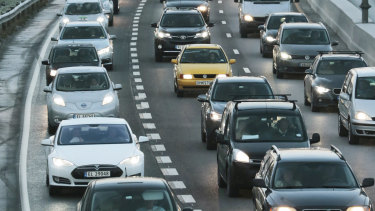
Road user charges for electric vehicles could be introduced as early as next year.
Road user charges for electric vehicles
could be introduced as early as next year. 
Victoria is likely to be the first mover, with senior government and industry sources confirming consultations had begun on a charge that is under consideration for May's Victorian state budget. NSW will watch developments closely before deciding on its own course of action, but Treasury has been discussing changes with the sector.

07 April, 2019

Electric vehicles an opportunity for local government

Local councils could save money and reduce greenhouse gas emissions by shifting their fleets to electric vehicles, a study by ClimateWorks Australia suggests.
Sydney Lord Mayor Clover Moore's council has embraced electric cars in their fleet.
Project officer Claire Connell said more than half of new vehicles sold in Australia in 2017 were purchased by the government and corporate fleets so it was a significant opportunity.


Read the story from The Age by Caitlin Fitzsimmons - “Electric vehicles an opportunity for local government.”

03 April, 2019

Motorists could pay to reach Labor target for electric cars

Federal and state governments would have to consider waiving stamp duty and car registration on electric vehicles as well as giving them the special use of transit lanes to reach Labor’s ambitious new target for electric car sales.
The Commonwealth faces a $2 billion annual budget
blow if it encourages a shift from petrol and diesel vehicles.
Motorists might also have to accept “preferential parking” for the plug-in vehicles under a detailed report to the federal government on how to ensure half the nation’s new cars are electric by 2030.


Read the story from The Age by David Crowe - “Motorists could pay to reach Labor target for electric cars.”

29 January, 2019

Dutch man's epic 89,000km drive proves electric cars are viable in Australia

A Dutch man who has driven 89,000km from Amsterdam to Adelaide in a small electric car says he is proving to Australians that electric vehicles are a viable alternative.
 
Wiebe Wakker at a wildlife crossing during his drive around
Australia in his electric car. The Dutch man has driven
89,000km from Amsterdam to Adelaide in his
converted 2009 Volkswagen Golf.
 
Since March 2016, adventurer Wiebe Wakker has driven across 33 countries from Europe to the Middle East to south-east Asia and finally to Australia in a 2009 Volkswagen Golf, converted to electric.

Over the past seven months he has continued the journey around Australia from Darwin down to Perth, across the Nullarbor to Newcastle, up to Queensland, and back down to Adelaide. After Adelaide, Wakker will finish once he reaches Melbourne and then Sydney.


Read the story from The Guardian by Naaman Zhou - “Dutch man's epic 89,000km drive proves electric cars are viable in Australia."

22 October, 2018

Electric vehicles get ultra-rapid charging network

Electric vehicles will soon have access to an ultra-rapid charging network along the major driving routes from Brisbane to Adelaide, including around Sydney and Melbourne, and separately in Western Australia.

Energy Minister, Angus Taylor.
The Australian Government, through the Australian Renewable Energy Agency (ARENA), will provide $6 million to Chargefox Pty Ltd to develop 21 ultra-rapid charging stations powered by renewable energy.

The $15 million network is expected to have no more than 200 kilometres between stations which is within the range of current electric vehicles.

The ultra-rapid charge will provide a range of up to 400 kilometres in just fifteen minutes, compared to a current charging time of several hours.

The stations will be open to the public and all-electric vehicle models currently sold in Australia.

Euroa in Victoria and Barnawartha North, outside Albury Wodonga on the New South Wales-Victorian border, will be the first sites for the charging stations.

The network will help open up interstate travel and regional communities to the potential of electric vehicles.

Electric vehicles have the potential to lower transport costs, enhance fuel security, and increasingly create more sustainable cities with less pollution and better health outcomes for our communities.


(This is a press release from the Minister for Energy, Angus Taylor)

26 September, 2018

High petrol prices fuelling interest in electric cars

Spiking petrol prices are forcing small firms like Kristian Milosevski's construction outfit Zipclad to rethink the way they do business, and even consider switching to electric vehicles.
High petrol prices are creating serious overheads
for businesses, says Kristian Milosevski from Zipclad.
"High prices are definitely starting to bite into our budgets, with companies like myself, we're always on the road so we're driving all over [the city], petrol is a big overhead," Mr Kristian Milosevski told Fairfax Media as he was filling up his car on Tuesday.

Petrol prices have risen sharply this month close to 10-year highs. The most expensive regular unleaded petrol in Sydney on Tuesday was $1.68 per litre and in Melbourne $1.70 a litre. Whereas petrol retailers like Caltex and BP were buying their petrol from suppliers for $1.40 a litre.


Read the story by Cole Latimer from The Age - “High petrol prices fuelling interest in electric cars.”

10 September, 2018

The Driven Podcast: Chief scientist Alan Finkel on battery EVs and fuel cell EVs

Australia’s chief scientist Alan Finkel has had a close connection to electric vehicles for more than a decade.

He was the chief technology officer for the Better Place, the ambitious company that imagined swapping battery packs in standard models, but whose ambition was run over by the fall in the battery costs.

Finkel owns two electric vehicles of his own – a Nissan Leaf and a Tesla – and loves them. “It’s so much more exciting” driving an EV, he says. “You feel so much more connected than in a petrol power vehicle.”


Read/listen to the RenewEconomy story/podcast - “The Driven Podcast: Chief scientist Alan Finkel on battery EVs and fuel cell EVs."

02 September, 2018

Introducing RenewEconomy’s new electric vehicle website: TheDriven.io

Today we are proud to introduce RenewEconomy’s new website focusing on electric vehicles, and the transition to zero carbon transport – TheDriven.io

Whether you are merely curious about EVs, just love to drive them, are an EV nerd, or want to keep up with the news and analysis about new models, government policy and developments in the charging space, we hope that this new website is for you.


TheDriven.io is a joint venture between RenewEconomy – Australia’s leading website on renewables, storage and climate policy – and private investors.

We are launching it now because we are on the verge on an extraordinary shift in our transport options and choices. Car companies are  ready to roll out new EV models in Australia, and policy makers are grappling with what they should do.

Read the story by Giles Parkinson from RenewEconomy - “Introducing RenewEconomy's new elctric vcehicle website: TheDriven.io."

(As exciting as this maybe for those responsible, “TheDriven.io" appears to be a further example of the broad acceptance that our future is inextricably linked to the electric car and that just as soon as our car fleet is fully electric we can relax and turn out attention to other things. 
That is simply not true. 

It is the private ownership of cars and the energy intense infrastructure surrounding it that must go if we are to eventually see a truly sustainable world, and we won’t as it seems unlikely that we, humans, have the intellectual bravery, or the will, to rid ourselves of the privately-owned vehicle and invest, in every sense, in creating and building a sophisticated public transport system - Robert McLean)

26 April, 2018

China stakes claim on electric car market with 100 new models at auto show

Chinese car brands are staking a leadership claim in the global race to dominate electric vehicles, unveiling and promoting more than 100 new models at the country's annual auto show.
The LSEV is touted as the first mass-producible
3D-printed electric car in the world.
More than two-thirds of the hybrid and fully electric plug-in cars on display in Beijing are from Chinese brands, despite international car giants trying hard to court the huge local market with the unveiling of several new electric SUVs.

New energy vehicles (NEVs) aren't just fashionable in China's big cities — they are also being actively pushed by China's government through subsidies for manufacturers and a planned cap-and-trade quota system that will force car companies to make at least 10 per cent of their output NEVs or face fines.


Read the Bill Birtles story from ABC News - “China stakes claim on electric car market with 100 new models at auto show.”

23 April, 2018

Sweden’s solution for charging electric cars is bold, but flawed

Sweden's electric road claims to solve the problem of charging cars.
The eRoadArlanda pilot scheme, which covers two kilometres of road outside Stockholm, is an attempt to solve one of the biggest challenges that the transport industry faces. Namely, how to move freight and people in a way that neither damages the climate through greenhouse gas emissions nor the quality of air through nitrogen oxide pollution.

The eRoadArlanda scheme is supposed to extend the range of electric vehicles beyond what was previously possible. Yet, as an engineer, I have concerns about the durability of this road. Even more significantly, the cost of the technology and the disruption that building it causes is likely to restrict any mass scale replication. If this solution cannot be widely replicated then it is really no solution at all.


Read the comment from The Age by Rick Greenough - “Sweden’s solution for charging electric cars is bold, but flawed.”

13 March, 2018

‘We'll be left behind': Greens want 2030 ban on fossil-fuel car sales

All sales of new petrol and diesel-powered cars would be banned by 2030 to spur the take-up of electric vehicles, according to a Greens policy aimed at winning over voters in this weekend's byelection in the Melbourne electorate of Batman.
The road ahead will be one for electric vehicles if the Greens policy gains traction.
Such a goal would bring Australia into line with nations such as India and the Netherlands - which have targets of phasing out sales of new cars powered by combustion engines by 2030 - and slice deeply into a net import fuel bill now running at about $16 billion a year, the Electric Vehicle Council said.


Read Peter Hannam’s story from The Age - “‘We'll be left behind': Greens want 2030 ban on fossil-fuel car sales.”

10 February, 2018

Chief scientist Alan Finkel hits back at electric car doubters

Affordable electric vehicles that can drive up to 600 kilometres on a single charge will help bring a motoring revolution to Australia, predicts Chief Scientist Alan Finkel, in an intervention that defies naysayers of the technology.
In praise of the transport revolution: Chief Scientist Alan Finkel with an electric car. 
In an interview with Fairfax Media, Dr Finkel said the onus was on the federal government to cut greenhouse gas emissions from the transport sector, but predicted electric cars “will be a significant element” of policies considered.

Read Nicole Hasham’s story in The Age - “Chief scientist Alan Finkel hits back at electric car doubters.”

(I repeat, personally owned privately operated cars, electric or otherwise, should not be considered a part of what is needed in an energy restrained future as a method of moving people about. We need, rather, a sophisticated public transit system, which we can build just as soon as we break our addiction to the profit motive and privatisation - Robert McLean) 

24 January, 2018

Ex-Holden workers ready to build electric cars at a 'moment's notice’

Laid-off Australian car workers would be ready to start work "at a moment's notice" if the former Holden factory in Adelaide is retooled to build electric vehicles, the manufacturing union says.
Head of GFG Sanjeev Gupta visits the Arrium Steel plant in Whyalla, South Australia. 
The South Australian government has revealed that British billionaire Sanjeev Gupta's GFG Alliance, which last year saved the troubled Arrium steelworks from closure, now has its sights on buying assets from Holden's defunct Elizabeth plant to "develop the site as a manufacturing base for an electric vehicle".


Read Nick Toscano’s story in today’s Melbourne Age - “Ex-Holden workers ready to build electric cars at a 'moment's notice’.”

19 January, 2018

Formula E could be the only viable motorsport series by 2040

Alejandro Agag, the founder and CEO of Formula E championship has predicted that, given the current climate policies, the electric vehicles racing series will be the motorsport of the future.
Formula E will be the motorsport of the future.
Mr. Agag said that advanced technological developments, the direction of climate policies in restricting carbon emissions and the increasing decline in conventional combustion engine vehicles manufacturing will soon take over the motorsports industry too.

"I think Formula E is going to get really, really big. I believe that in 20, 30, 40 years, we will be the only motorsport out there”, he said.


Read the Climate Action story - “Formula E could be the only viable motorsport series by 2040.”

08 June, 2017

New ‘Instantly Rechargeable’ Battery Deals a Fatal Blow to Fossil Fuels

Purdue researchers have developed technology for an “instantly rechargeable” battery that is affordable, environmentally friendly, and safe. Currently, electric vehicles need charging ports in convenient locations to be viable, but this battery technology would allow drivers of hybrid and electric vehicles to charge up much like drivers of conventional cars refill quickly and easily at gas stations.
A Purdue researcher working on the
 "instantly rechargeable" battery.
This breakthrough would not only speed the switch to electric vehicles by making them more convenient to drive, but also reduce the amount of new supportive infrastructure needed for electric cars dramatically. Purdue University professors John Cushman and Eric Nauman teamed up with doctoral student Mike Mueterthies to co-found Ifbattery LLC (IF-battery) for commercializing and developing the technology.


03 June, 2017

The Country Adopting Electric Vehicles Faster Than Anywhere Else

Since the 14th century, Akershus Fortress has protected Oslo from raids by bloodthirsty Swedes. Now a Cold War bomb shelter in its basement is being repurposed to help save the Norwegian capital from more insidious foes: pollution and global warming. Starting this month, electric car owners will be able to drive down a narrow ramp between rough-hewn rock walls dripping with condensation and plug in at one of 86 charging stations—for free.
The basement of Oslo’s Akershus Fortress has
been retrofitted with dozens of charging stations
for electric vehicles.
The facility will get plenty of use as Norwegians switch to electric vehicles faster than anyone else on the planet. More than a third of all new cars are either fully electric or plug-in hybrids, well over 10 times the proportion in the U.S. With about 100,000 electrics on the road, Norway (population 5 million) trails only the U.S., China, and Japan in absolute numbers. By 2025, the government has suggested, there may be no gasoline- or diesel-powered cars sold in the country. “It’s safe to say that Norway is the first mass market for EVs,” says Sture Portvik, the city official overseeing the Akershus garage.


Read Matthew Campbell’s story on BloombergBusinessweek - “The Country Adopting Electric Vehicles Faster Than Anywhere Else.”

23 May, 2017

Electric vehicles: Big energy join auto to drive Aus EV uptake

Although bounding ahead on distributed renewables and battery storage, Australia’s uptake of electric vehicles remains stalled, all but going in reverse thanks to a combination of narrow product choice, a lack of emissions standards for vehicles, and few if any incentives for consumers to plug in to the future.

Last year, a total of just 219 fully electric cars were reported as sold throughout Australia last year, compared to 12,000 hybrid vehicles, 363,000-plus diesel vehicles and more than 768,000 petrol fuelled cars.


Read Sophie Vorrath’s story on RenewEconomy - “Electric vehicles: Big energy join auto to drive Aus EV uptake.”

09 May, 2017

Death spiral for cars. By 2030, you probably won’t own one

By 2030, you probably won’t own a car, but you may get a free trip with your morning coffee. Transport-As-A-Service will use only electric vehicles and will upend two trillion-dollar industries. It’s the death spiral for cars.

A major new report predicts that by 2030, the overwhelming majority of consumers will no longer own a car – instead they will use on-demand electric autonomous vehicles.

By 2030, within 10 years of regulatory approval of autonomous electric vehicles (A-EVs), the report says, 95 per cent of all US passenger miles traveled will be served by on-demand, autonomous, electric vehicles that will be owned by fleets rather than individuals.

The provision of this service may come virtually free as part of another offering, or a corporate sponsorship. Imagine, for instance, paying a token sum for a ride into town after buying a latte for $4.50. Or getting a free ride because the local government has decided to make transport easier.


Read the Giles Parkinson story on RenewEconomy - “Death spiral for cars. By 2030, you probably won’t own one.”

14 April, 2017

The lowdown on hydrogen — part 1: transportation

‘The hydrogen economy had been written off as a failure by most industry watchers, writes independent energy expert and former software engineer Roger Arnold. Lately, however, hydrogen seems to be making a comeback. Not because of any special technology breakthroughs but because persistence and general advances have begun’

U.S. Department of Transportation Deputy
Secretary Thomas J. Barrett re-fuels a
hydrogen vehicle August 13, 2008 at the
Liberty Science Center in Jersey City,
New Jersey.
After more than two decades of hype about the imminent arrival of a transformative “hydrogen economy”, many veteran technology watchers — myself included — had concluded that hype was pretty much all it was. Hydrogen fuel cell vehicles in particular looked like a failed dream. Bright innovators like Canada’s Geoff Ballard had attacked the problem and burned through serious investment money trying to develop a product that could stand up to the rigors of the automotive market. All with little success. And beyond the cost and durability issues of fuel cells themselves, the hydrogen storage issue stubbornly resisted commercially practical solutions.

In recent years, hybrids and battery electric vehicles have appeared to hold the inside track for low carbon and zero carbon transportation. Tesla has reshaped perceptions of what is possible for battery electric vehicles. The cost of lithium-ion battery packs has been driven down, while capacity, performance, and reliability have increased dramatically. To be sure, government programs have continued to fund fuel cell R&D. If nothing else, fuel cells still hold broad appeal for military programs. But to those of us who felt we understood the issues, the barriers to broad use of hydrogen as an energy carrier looked pretty fundamental. We — or at least I — didn’t really expect to see them fall anytime soon.

Read the EnergyPost story by Roger Arnold - “The lowdown on hydrogen — part 1: transportation.”


(Privately owned vehicles for human movement has an unspoken ideal in all such stories when what we really should be discussing is how do we create an publicly owned public transit system that answers all our needs for human movement within our communities - a public transport system would be more environmentally friendly in that it would vastly lower our carbon emissions, and consume considerably less public space than that demanded,or least needed, by an exponentially growing fleet of privately-owned vehicles - Robert McLean)

04 June, 2016

Creating the 'Tesla of eco-villages' near Amsterdam

RegenVillages aims to create the "Tesla of
eco-villages," and its first
development is underway outside Amsterdam
Imagine a neighborhood that can grow its own food, produce its own energy, and turn its waste system into a closed-loop regenerative system. Now imagine a network of such villages all over the world. Pretty far-fetched, eh? Maybe, but that's what people thought just a few decades ago, when the first modern hybrids were being brought to market, and the idea of affordable and practical electric cars was starting to be pursued commercially.

But today, even just a quick look at the alternative transportation market, which includes everything from e-bikes to electric airplanes, reveals a quite different view, and while there are a number of kinks to work out (cutting costs, adding infrastructure), it's starting to look a lot less like science fiction and a lot more like we're living in the future right now. And although electric vehicles might seem a lot sexier to talk about than housing developments, addressing the sustainability of our living quarters, and the neighborhoods and communities that surround them, is something at least as eco-worthy as the latest electric mobility innovations.