Showing posts with label autonomous vehicles. Show all posts

04 November, 2019

How we feel about our cars means the road to a driverless future may not be smooth

There is a reasonable expectation that autonomous vehicles will dominate the future of transport. Utopian visions suggest these driverless vehicles will lead to dramatic changes to our cities and their transportation. 
Autonomous vehicles operating on a network would allow traffic to move safely and seamlessly through cities. They would use less space per vehicle. Traffic flow would be unhindered by traffic lights or other traditional driver signals. 
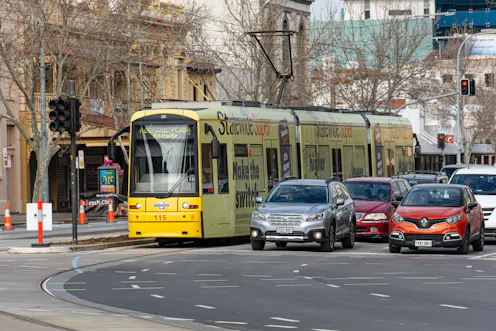
Image result for How we feel about our cars means the road to a driverless future may not be smooth
Car owners’ attachment to driving and the willingness
of others to switch from public transport could confound
 rosy predictions for autonomous vehicles.
More efficient transportation would use less fuel. Urban spaces could be repurposed as parking needs virtually disappear.
But this utopian vision depends on a range of factors. In particular, these predictions largely rely on how current car drivers respond to the advent of autonomous vehicles. 
Our research suggests people’s attitudes to driving and their cars could limit the predicted benefits to traffic flow and city efficiency, at least during the initial transition to driverless vehicles. 

Read the story from The Conversation by a Senior Lecturer from the University of Adelaide, Raul A. Barreto -  “How we feel about our cars means the road to a driverless future may not be smooth.”

18 May, 2017

Rethinking Transportation - RethinkX Project report

We are on the cusp of one of the fastest, deepest, most consequential disruptions of transportation in history. 

By 2030, within 10 years of regulatory approval of autonomous vehicles (AVs), 95% of U.S. passenger miles traveled will be served by on-demand autonomous electric vehicles owned by  eets, not individuals, in a new business model we call “transport-as-a-service” (TaaS). 
The TaaS disruption will have enormous implications across the transportation and oil industries, decimating entire portions of their value chains, causing oil demand and prices to plummet, and destroying trillions of dollars in investor value — but also creating trillions of dollars in new business opportunities, consumer surplus and GDP growth.

The disruption will be driven by economics. Using TaaS, the average American family will save more than $5,600 per year in transportation costs, equivalent to a wage raise of 10%. This will keep an additional $1 trillion
per year in Americans’ pockets by 2030, potentially generating the largest infusion of consumer spending in history.

We have reached this conclusion through exhaustive analysis of data, market, consumer and regulatory dynamics, using well-established cost curves and assuming only existing technology. This report presents overwhelming evidence that mainstream analysis is missing, yet again, the speed, scope and impact of technology disruption. Unlike those analyses, which produce linear and incremental forecasts, our modeling incorporates systems dynamics, including feedback loops, network effects and market forces, that better re ect the reality of fast-paced technology-adoption S-curves. 

These systems dynamics, unleashed as adoption of TaaS begins, will create a virtuous cycle of decreasing costs and increasing quality of service and convenience, which will in turn drive further adoption along an exponential S-curve. Conversely, individual vehicle ownership, especially of internal combustion engine (ICE) vehicles, will enter a vicious cycle of increasing costs, decreasing convenience and diminishing quality of service.


Read the RethinkX Project report - “Rethinking Transportation.” 

09 May, 2017

Death spiral for cars. By 2030, you probably won’t own one

By 2030, you probably won’t own a car, but you may get a free trip with your morning coffee. Transport-As-A-Service will use only electric vehicles and will upend two trillion-dollar industries. It’s the death spiral for cars.

A major new report predicts that by 2030, the overwhelming majority of consumers will no longer own a car – instead they will use on-demand electric autonomous vehicles.

By 2030, within 10 years of regulatory approval of autonomous electric vehicles (A-EVs), the report says, 95 per cent of all US passenger miles traveled will be served by on-demand, autonomous, electric vehicles that will be owned by fleets rather than individuals.

The provision of this service may come virtually free as part of another offering, or a corporate sponsorship. Imagine, for instance, paying a token sum for a ride into town after buying a latte for $4.50. Or getting a free ride because the local government has decided to make transport easier.


Read the Giles Parkinson story on RenewEconomy - “Death spiral for cars. By 2030, you probably won’t own one.”

10 July, 2016

Food delivery device invades our footpaths

The "suitcase" meets a pedestrian
 - it's programmed to give way.
Pedestrians often complain that there is no room on the sidewalks (and in New York City, people are taking to the streets because of it), and it’s because the cars stole all the space and everyone else is fighting over scraps. And while we worry about how pedestrians will deal with autonomous vehicles on the roads, now they will also have to worry about autonomous delivery vehicles on the sidewalks.

Vehicles like the new Starship, designed in Estonia, tested in London and soon coming to Washington DC. CEO Allan Martinson describes it in the Washington Post:

“It’s basically a mobile phone on wheels,” Martinson said. Its low speed and weight — 4 miles per hour and 40-pounds max — also short-circuit safety concerns, he added. “It’s basically a rolling suitcase. If you go home and try to kill yourself with a suitcase, you’d have to be very inventive.”