Showing posts with label cities. Show all posts

23 April, 2020

Earth Day Activists Wanted to Disrupt the Fossil Fuel Industry. The Pandemic Is Doing it For Them

Nineteen-seventy was a simpler time. (February was a simpler time too, but for a moment let’s think outside the pandemic bubble.) 
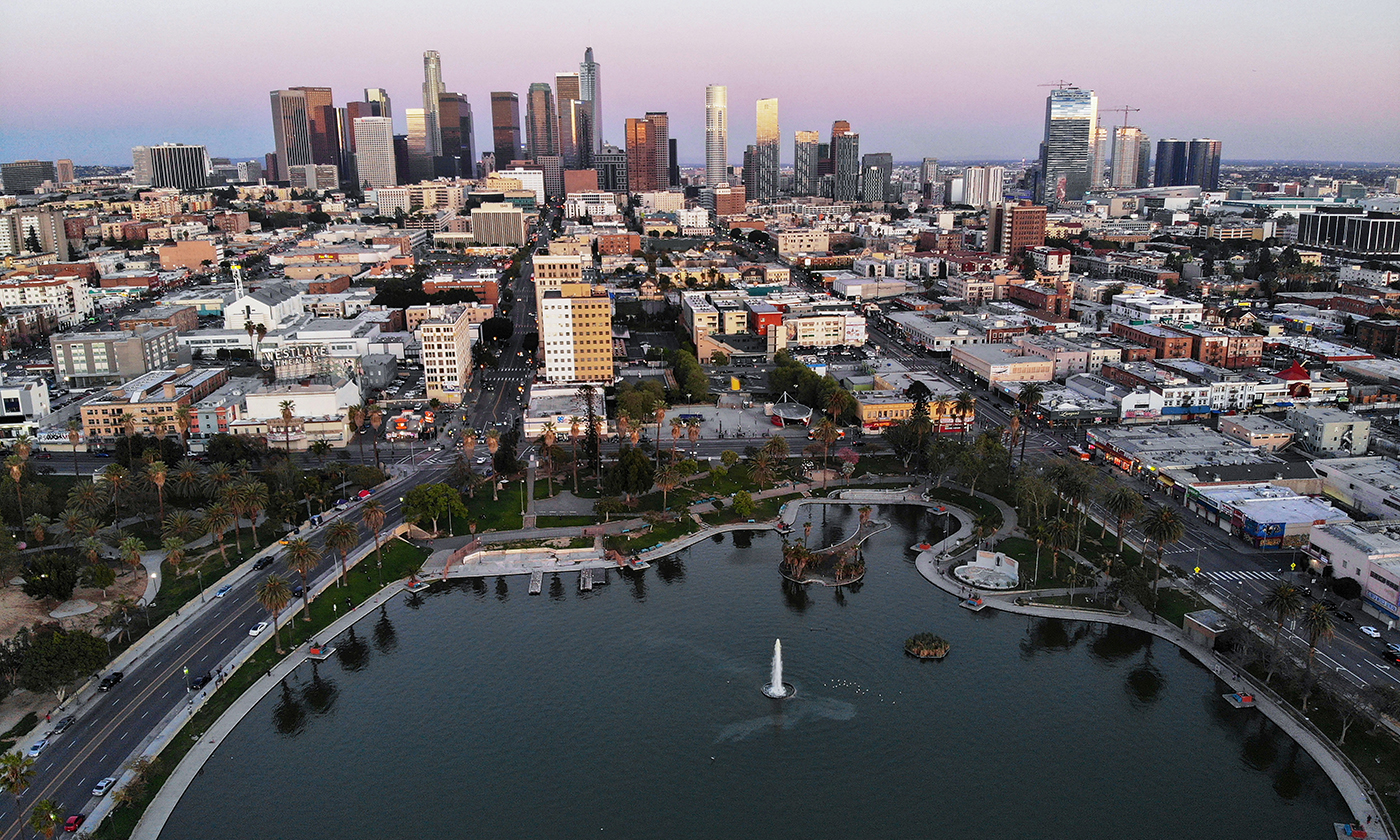
An aerial view shows MacArthur Park and downtown
 Los Angeles in the midst of the coronavirus pandemic
on April 15, 2020. Data from the Environmental Protection
 Agency (EPA) from March show that Los Angeles had
its longest stretch of air quality rated as "good" since 1995
as Safer-at-Home orders were issued in response to
the spread of COVID-19.
Simpler because our environmental troubles could be easily seen. The air above our cities was filthy, and the water in our lakes and streams was gross. There was nothing subtle about it. In New York City, the environmental lawyer Albert Butzel described a permanently yellow horizon: “I not only saw the pollution, I wiped it off my windowsills.” Or consider the testimony of a city medical examiner: “The person who spent his life in the Adirondacks has nice pink lungs. The city dweller’s are black as coal.” You’ve likely heard of Cleveland’s Cuyahoga River catching fire, but here’s how New York’s Gov. Nelson Rockefeller described the Hudson south of Albany: “one great septic tank that has been rendered nearly useless for water supply, for swimming, or to support the rich fish life that once abounded there.” Everything that people say about the air and water in China and India right now was said of America’s cities then.
No wonder people mobilized: 20 million Americans took to the streets for the first Earth Day in 1970—10 percent of America’s population at the time, perhaps the single greatest day of political protest in the country’s history. And it worked. Worked politically because Congress quickly passed the Clean Air Act and the Clean Water Act, and scientifically because those laws had the desired effect. In essence, they stuck enough filters on smokestacks, car exhausts, and factory effluent pipes that, before long, the air and water were unmistakably cleaner. The nascent Environmental Protection Agency commissioned a series of photos that showed just how filthy things were. Even for those of us who were alive then, it’s hard to imagine that we tolerated this.

09 February, 2020

14 cities around the world that are better for pedestrians than people with cars

Cities that depend on wherever and whenever possible on human-powered transport, that’s walking and cycling, are clearly among the best places to live.

No cars, happy people.
Travelling around the world to look at, and consider, cities that have created major sections free of motor  vehicles, Melbourne’s Bruce Echberg was able to report about these successes for the Urban Design Forum (UDF).

“Promoting motorless zones not only makes cities more friendly for those on foot or cycling. The change can also improve air quality and congestion as well as help preserve historic streets that might otherwise be damaged by constant use and overcrowding”, he wrote on the UDF’s website.


04 November, 2019

How we feel about our cars means the road to a driverless future may not be smooth

There is a reasonable expectation that autonomous vehicles will dominate the future of transport. Utopian visions suggest these driverless vehicles will lead to dramatic changes to our cities and their transportation. 
Autonomous vehicles operating on a network would allow traffic to move safely and seamlessly through cities. They would use less space per vehicle. Traffic flow would be unhindered by traffic lights or other traditional driver signals. 
Image result for How we feel about our cars means the road to a driverless future may not be smooth
Car owners’ attachment to driving and the willingness
of others to switch from public transport could confound
 rosy predictions for autonomous vehicles.
More efficient transportation would use less fuel. Urban spaces could be repurposed as parking needs virtually disappear.
But this utopian vision depends on a range of factors. In particular, these predictions largely rely on how current car drivers respond to the advent of autonomous vehicles. 
Our research suggests people’s attitudes to driving and their cars could limit the predicted benefits to traffic flow and city efficiency, at least during the initial transition to driverless vehicles. 

Read the story from The Conversation by a Senior Lecturer from the University of Adelaide, Raul A. Barreto -  “How we feel about our cars means the road to a driverless future may not be smooth.”

08 September, 2019

Should we call climate change an emergency?

The term Climate Emergency has appeared in public discourse with remarkable speed and is now increasingly the language of not just the climate movement, but also a growing number of cities, states, parliaments and Universities. Yet it is not without its critics who argue the language of emergency may have unintended consequences by providing license for potentially dangerous interventions in the climate system, such as solar geoengineering. This article briefly reviews where the term came from, its current influence, risks and prospects.
Climate change is increasing the frequency and
severity of forest fires,  which seems frighteningly
 relevant in view of the considering the many bushfires
troubling parts of northern New South Wales and
south-eastern Queensland.
None of what follows reduces the urgency and seriousness of the climate crisis. In 2018 the Intergovernmental Panel on Climate Change (IPCC) released their most blunt report to date, stating that to stay under 1.5ºC requires the world economies to reach net zero emissions by 2050. Some researchers have since argued that climate change is happening faster than the IPCC has anticipated, potentially breaching the 1.5ºC temperature threshold by 2030. With still rising emissions, and bereft of a politically viable plan to date, current projections point to a 3ºC plus world before the end of this century, with the high risk of crossing climate thresholds from which we may not be able to escape. This is the risk, but not yet the unavoidable future; the world still has capacity to ensure a less dangerous future climate.
There are at least two distinctive views on the language of emergency, one rooted in concerns that incremental change is too slow and therefore the language around climate change had to change. The second is the assessment by some scholars that dangerous geoengineering technologies may be implemented to reduce global warming in the event emergency action is deemed necessary.

Read the Medium story by Simon Kerr - “Should we call climate change an emergency?”

11 May, 2019

Long term planning required in the face of climate change.

The profession has been bombarded with various solutions to combat climate change and global warming. The design response from landscape architects and architects alike has been impressive. 
Oasia Hotel.
While so-called “green architecture” principles can sometimes risk being cliché marketing stunts and ring hollow in terms of solving tangible climate challenges, if done properly these solutions can have a positive net effect to clean and cool the air in cities.

Green buildings trends will continue to impact our cities’ residential buildings. As cities, governments and developers see the economic and climate benefits of these solutions, we will see more green roofs and green facades such as Bosco Verticale/Vertical Forest by Stefano Boeri in Milan or Oasia Hotel in Singapore by WOHA/ STX Landscape Architects. 


Read the WLA story by Martin Barry - “Long term planning required in the face of climate change." 

31 March, 2019

Earth Hour: landmarks go dark to highlight plight of planet

Cities around the world were marking Earth Hour on Saturday by turning off lights at 8:30pm local time in a call for global action on climate change.
 The Houses of Parliament mark WWF’s Earth Hour, in London.
The Earth Hour gesture calls for greater awareness and more sparing use of resources, especially fossil fuels that produce carbon gases and lead to global warming.

Beginning in Sydney in 2007, Earth Hour has spread to more than 180 countries, with tens of millions of people joining in.

In Hong Kong, major buildings along Victoria Harbour turned off their non-essential lights and the city’s popular tourist attraction known as the Symphony of Lights was cancelled.

More than 3,000 corporations in Hong Kong signed up for Earth Hour 2019, according to the WWF Hong Kong website. Skyscrapers including the Bank of China Tower and the HSBC Building in Central, the city’s major business district, switched off their lights in response to the global movement.


Read the story from The Guardian - “Earth Hour: landmarks go dark to highlight plight of planet.”

19 January, 2019

More trees are the answer to cool down our cities

Urban life can be an insulated existence, consisting of circling between one temperature-controlled space after another. But cities are not invulnerable to climatic changes. Indeed, when it comes to heat, they can fare worse. They are also far from homogenous. Counter to the images of “domed cities” that Buckminster Fuller proposed for Manhattan in the 1960s and that Dubai is touted to be pursuing, cities do not have equally distributed temperatures. Even if they do, the risk those temperatures represent are far from equally perceived or experienced.
 ‘At present, development for new housing tends to
occur on greenfield sites where one of the first steps
is to remove existing trees to enable the movement
 of building equipment and later cars’ 
Australians typically pride themselves on being pretty sanguine about the nation’s extreme weather, at least when it comes to spectacular events like Dorothea Mackellar-esque “flooding rains” or disasters playing out elsewhere on our vast continent. But this week even our assumed role as the world’s most variable climate took a turn for the worse, as Australia hosted the planet’s 15 hottest sites. Many of these extreme temperatures were recorded inland in small settlements. Port Augusta, for example, with 15,000 residents, was number two on the list at 49C. Nonetheless, the heat wave rolled across the continent affecting major urban settlements such as Canberra and Western Sydney.


Read the story from The Guardian by Marco Amati and Lauren Rickards -  “More trees are the answer to cool down our cities.”

19 December, 2018

‘Future-proofing’ is how you say climate change in Texas

There’s a new term for all the work needed to prepare coasts and cities for the consequences of climate change, and it’s blissfully free of the words “climate change.” Introducing “future-proofing.” As in, it’s time to “future-proof” Texas to brace for future disasters like Hurricane Harvey, according to a new comprehensive report.
"Future proofing" is how you say climate change in Texas.
Prepared by Republican Governor Greg Abbott’s reconstruction commission, the report recommends myriad ways for the state to “future-proof”: elevate homes, construct storm-surge barriers, and offer buyouts for homes at high risk of flooding, to name a few.

What’s more interesting is what’s missing. Take the time to read the 168-page report, and you’ll find mention of rising sea levels and more intense storms. You might scratch your head upon finding phrases such as “changing human and environmental conditions” or “changing future weather patterns.” It would be hard to miss “future-proofing,” a phrase that’s employed 44 times. But you won’t find the exact words “climate change” anywhere except for the footnotes, as Dallas News reported on Thursday.


Read the story from Grist by Kate Yoder - “‘Future-proofing’ is how you say climate change in Texas.”

Sydney and Melbourne vow to ditch coal power

The cities of Sydney and Melbourne committed themselves to phasing out coal on Thursday, in a move at odds with Australia’s aggressively pro-coal national government.
Sydney has committed to 100% renewable electricity by 2035. 
The country’s two largest cities joined an international coalition of states, regions, cities and businesses who have committed to ending coal power generation.

Australia is the fourth largest coal producer in the world. Its federal government is known for its fierce support for the sector and signalled on Wednesday that it would use taxpayer money to underwrite new coal plants.

Neither city provided a specific end date for coal. Sydney has committed to a 100% renewable supply by 2035.


Read the Climate Home News story by Natalie Sauer - “Sydney and Melbourne vow to ditch coal power.”

14 September, 2018

The Global Climate Action Summit

The Global Climate Action Summit will bring leaders and people together from around the world to “Take Ambition to the Next Level.” It will be a moment to celebrate the extraordinary achievements of states, regions, cities, companies, investors and citizens with respect to climate action.

It will also be a launchpad for deeper worldwide commitments and accelerated action from countries—supported by all sectors of society—that can put the globe on track to prevent dangerous climate change and realize the historic Paris Agreement.

The decarbonization of the global economy is in sight. Transformational changes are happening across the world and across all sectors as a result of technological innovation, new and creative policies and political will at all levels.


States and regions, cities, businesses and investors are leading the charge on pushing down global emissions by 2020, setting the stage to reach net zero emissions by midcentury. 

30 August, 2018

Local climate efforts won't be enough to undo Trump's inaction, study says

Individual cities, regions and businesses across the globe are banding together determinedly to confront climate change - but their emissions reductions are relatively small and don’t fully compensate for a recalcitrant US under the Trump administration, a new study has found.
The emissions cuts promised by cities and businesses fall short
 of enabling countries to avoid breaching agreed thresholds for
dangerous warming.
A cavalcade of city mayors, regional government representatives and business executives from around the world will convene in San Francisco next month for a major summit touting the role of action beyond national governments to stave off the worst impacts of climate change.

But the greenhouse gas cuts offered up by these entities are relatively modest, according to new research, placing the onus on nations to raise their ambitions even as the US, the world’s second largest emitter, looks to exit the landmark Paris climate agreement.

An evaluation of climate change pledges by nearly 6,000 cities, states and regions, representing 7% of the global population, and more than 2,000 companies that have a combined revenue comparable to the size of the US economy, found a total projected reduction of between 1.5bn to 2.2bn tons of greenhouse gases by 2030.


Read the story from The Guardian by Oliver Milman - “Local climate efforts won't be enough to undo Trump's inaction, study says.”

12 April, 2018

The Science We Need for the Cities We Want.

The Science We need for the Cities We Want: Working together to implement the global research and action agenda on cities and climate change.

On March 7, 2018, On the last day the CitiesIPCC Cities and Climate Change Science Conference in Edmonton, 10 of the leading urban and scientific global organizations presented “The Science We Need for the Cities We Want: Working together to implement the global research and action agenda on cities and climate change” a joint statement describing how they will work together to support the implementation of the global research and action agenda on cities and climate change.

Relevant organizations interested in lending their support of this Joint Statement and the implementation of the global research and action agenda on cities and climate change are invited to contact us using the form below.  In your message,  please include a short statement on why your organization is interested in supporting the global research and action agenda on cities and climate change and ways you envision engaging in this initiative.


Read the full joint statement here - “The Science We Need for the Cities We Want.”

08 April, 2018

As e-biking grows, U.S. cities consider easing rules on where the machines may be used

A surge in the use of electric bicycles throughout the United States is prompting cities to revise regulations that restrict their use, including bans against riding them on sidewalks and trails.
JUMP, one of five dockless bike operators in the
District, brought its e-bikes to the city last fall,
and it has become one of the most popular
services, officials said.
The nation’s capital and other Washington-area jurisdictions are among those taking steps to modernize and streamline policies advocates say are outdated, set unrealistic restrictions and confuse riders of bikes that can be run on electric power as well as by pedalling.
“The number of bicyclists in the U.S. is growing, in part because of the rise of e-bikes, but it is difficult for people to know where they are allowed to ride them,” said Morgan Lommele, with the cycling advocacy group PeopleForBikes. “The laws are all over the place for electric bicycles.”


08 March, 2018

Off to Munich for the International Passivhaus Conference

We have to rebuild our cities to use less energy and house more people, and Passivhaus design is a useful tool for both problems.
The Passive House (Passivhaus) will be discussed
at an international conference in Munich.
Starting on Friday, the leaders of the Passive House movement around the world are meeting in Munich for the International Passive House conference. Passive House, or Passivhaus, is probably the toughest energy efficiency standard anywhere; houses that meet the standard have super insulation, minimal thermal bridging, high quality windows and controlled ventilation. They are comfortable to live in and cost almost nothing to heat and cool.

I am a huge fan of Passive House, and am attending the conference in Munich, but I am increasingly convinced that it simply isn't enough anymore. Because what is really driving our energy consumption these days is transportation, where we are going backwards. It's sprawl, and it's the form of our housing. It is how we get between our houses and where we work or shop. Passivhaus can be applied to any kind of building, but expensive single family designs out in the country are not going to move the needle on our problems.


Read the TreeHugger story by Lloyd Alter - “Off to Munich for the International Passivhaus Conference.”

04 March, 2018

More Than 100 Cities Worldwide Now Powered Primarily by Renewable Energy

As the price of renewable energy drops, more cities are cutting the cord with fossil fuel-based electricity.
Burlington, Vermont, gets 100 percent of its power
from renewable energy, including from solar farms
 like this one, built on locally made systems that
track the sun. 
A new report released Tuesday by the environmental group CDP finds that more than 100 cities worldwide now get the majority of their power—70 percent or more—from renewables. That's up from 42 in 2015, when countries pledged to cut greenhouse gas emissions in the Paris climate agreement.

CDP notes that more than 40 of those cities are now powered entirely by renewables, including Burlington, Vermont, which gets its electricity from a combination of wind, solar, hydro and biomass. Burlington will have more company within the next 20 years—58 U.S. cities, including Atlanta and San Diego, having announced plans to do the same.


Read the Inside Climate News story by Georgina Gustin - “More Than 100 Cities Worldwide Now Powered Primarily by Renewable Energy.”

21 February, 2018

Climate change 'will push European cities towards breaking point’

Major British towns and cities, including Glasgow, Wrexham, Aberdeen and Chester, could be much more severely affected by climate change than previously thought, according to new research.

 A rescue boat in a flooded street of Nemours,
 near Paris, France, after downpours in June 2016.
The study, by Newcastle University, analysed changes in flooding, droughts and heatwaves for every European city using all climate models.

Looking at the impact by the year 2050-2100, the team produced results for three possible outcomes – low, medium and high-impact scenarios.

But even the most optimistic case showed 85% of UK cities with a river, including London, would face increased flooding.

In the high-impact scenario, some cities and towns in the UK and Ireland could see the amount of water per flood as much as double. The worst affected is Cork, which could see 115% more water per flooding, while Wrexham, Carlisle, Glasgow, and Chester could all see increases of more than 75%.


Read Tom White’s story on The Guardian - “Climate change 'will push European cities towards breaking point’.”

16 November, 2016

How to Prep a City for Climate Change

Cities around the world already have begun responding to climate change, and a new report from the Earth Institute provides a deep analysis about the risks they face and a detailed look at what some cities are doing about it.

The 880-page report is the result of three years of work by 350 contributors and was produced by the Urban Climate Change Research Network, based at Columbia University’s Earth Institute. Network representatives last month presented the second UCCRN Assessment Report on Climate Change and Cities (ARC3.2) at the United Nations Conference on Housing and Sustainable Development (Habitat III) in Quito, Ecuador.

The work is part of a larger effort by the network to produce a resource for guiding cities in their response to climate change. The report, updated from the first version in 2011, provides expanded coverage of cutting-edge scientific research on climate change and cities. It presents climate projections and catalogues urban disasters and risks, along with the effects on Habitat III in cities.

It also gives concrete solutions for cities looking to reduce their impact on climate change and adapt to changes already underway; urban planning and design; equity and environmental justice; economics, finance and the private sector; critical urban and social sectors such as energy, water, transportation, housing and informal settlements, and solid waste management; and governing carbon and climate in

Read State of the Planet story - “How to Prep a City for Climate Change.”

08 April, 2015

Urban sprawl equally troubles regional towns and cities worsening emissions


U

rban sprawl troubles cities the world over and it is equally troubling for most of Australia’s regional town and cities.

Sometimes it feels like this even in
 relatively tiny Shepparton.
That same sprawl produces much of the carbon dioxide simply because those towns and cities are inefficient and force people into carbon-rich lifestyles.

Generally, the infrastructure is such that people have little option but to use their carbon dioxide producing cars for almost everything.

Subsequently, as Climate Central reports - “Urban Sprawl, Cars Hamper Cities’ Best Efforts on CO2”.

29 May, 2014

Former New York mayor reflects Gleeson's 2010 views


Brendan Gleeson's
 "Lifeboat Cities".
It was in 2010 that Brendan Gleeson published his book “Lifeboat Cities: Making a New World” and now the former New York City mayor is saying effectively same thing.

Michael Bloomberg said, in his new U.N. job, that cities hold the key to confronting climate change.

The three-term mayor and billionaire businessman, who was the keynote speaker at the opening of a three-day U.N. meeting on making urban areas – whee about 70 percent of the world’s population is expected to live by 2050 – more liveable, sustainable, economically successful and environmentally friendly.

The Huffington Post story headed: “Cities hold key in fight to slow climate change, Bloomberg says” explained that city mayors, at least in America, have executive powers to reduce city emissions.

05 December, 2013

Population and climate change threaten U.S. cities


The combination of population and climate change are stressing water supplies around the world.

The Huffington Post today considers 11 U.S. cities that are going to be seriously troubled maintaining water supplies in a warmer and dryer world.

It points out that for decades scientists have been warning that the country’s lakes, rivers and aquifers will be hard pressed to quench the thirst of people of a “growing population in a warming world”.

In a story headed: “These 11 cities may completely run out of water sooner than you think”, said a recent report from NOAA’s Cooperative Institute for Research in Environment Science did not alleviate those fears.